Sex Talk Sunday
March 16, 2018I sit in a class of virginal twenty-somethings,
rows of polka dot skirts, shiny shoes, sculpted hair,
waiting for a stern and nervous bishop
to deliver the semi-annual sex talk.



I sit in a class of virginal twenty-somethings,
rows of polka dot skirts, shiny shoes, sculpted hair,
waiting for a stern and nervous bishop
to deliver the semi-annual sex talk.
Before sleep I overhear them,
their scrabble of words
scattered to draw meaning
from a day with eight kids,
Now that you are named
and heretofore known
and promised missions and maidens
and temples and talents

(after the autopsy, after the funeral, after AIDS)
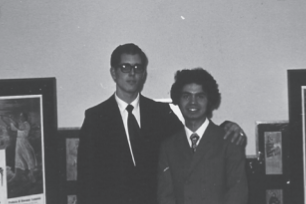
I’ve started to read John’s missionary letters from Italy. Nearly one a week for two years. From what Mom told me when I asked about them, I expected requests for money, reports of trouble, and depressed silences. John communicated all of that, of course; but his letters are profoundly uplifting as well (or is it fraternal nostalgia I’m feeling?).

Let me begin by stating that this is not an academic paper; there’s no bibliography. It is, rather, a personal reflection addressing the difficult questions of reconciling faith and the academy—many of which have already been raised today.
I hope that you are amused by the title of my talk. I hope that you are envisioning Jesus brunching by the Sea of Galilee, wearing bejeweled Armani sunglasses and a pashmina ascot, sipping mimosas and flamboyantly expounding the homosexual agenda with an Aramaic lisp. I also hope you are thoroughly baffled, maybe even a little offended—although this crowd seems shameless.
Jonathan Z. Smith famously remarked that “a comparison is a disciplined exaggeration in the service of knowledge.”One of the insights that has animated the study of comparative religion in the past several decades is that those doing the comparing must be aware of the kinds of knowledge they are serving. Said another way, scholars involved in the comparison of religions must confront questions such as: Why compare this one tradition with another? Does the comparison of two entire traditions, as opposed to comparing two persons, give the scholar too much leeway in constructing his or her own narrative? Does the comparison of two traditions or individuals lead to false dichotomies that serve an unspoken agenda? In short, what is the purpose of comparison?
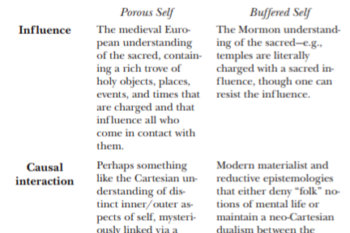
I’m going to try and convey aspects of Charles Taylor’s work that I find tremendously helpful in working through the challenges that all of us confront and that give rise to conferences like this one. Let me begin, however, with a personal note about Taylor. He is perhaps the most successful contemporary philosopher bridging the analytic continental divide and is best known for his contributions to political philosophy, moral philosophy, philosophy of social science, and the history of philosophy.
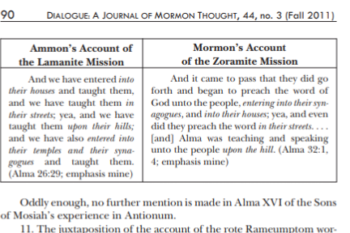
The thesis of this paper is a modest one, namely, that reading the Book of Mormon with an eye to its literary context significantly enhances the reading experience regardless of whether one’s objective is instruction, insight, aesthetics, or merely the pleasure of discovering coherence in its various details.A necessary corollary is that the Book of Mormon, as a text, is sufficiently crafted to warrant such attentive effort. There is nothing remarkable about the suggestion that internal context matters—that even a minimal level of understanding of any scriptural passage requires consideration not only of who is speaking, why, and to whom, but also of how a particular verse fits into a larger argument or interacts with nearby passages, or of how a discourse re lates to either its immediate or extended corresponding narrative. But this is not the manner in which Latter-day Saints typically read the Book of Mormon, either individually or as a community; even as we make our way sequentially through the book, we are much more likely to reflect upon isolated doctrinal proof texts or paraphrased narrative episodes.
With the Babylonian destruction of the First Temple in 587 BCE, it became necessary for the Jewish Fathers to create, as it were, a “synagogue in exile,” in which the emphasis shifted from the temple to the Torah as the locus of worship. With the destruction of the Second Temple in 70 C.E., the Jewish rabbis once again emphasized the Torah as their temple. During these periods and after, the text of God’s revelation became the focus, not only of the Jewish heart and mind but also of its imagination. These sages considered every jot and tittle, every caesura and metaphor, as God’s design and, further, that God intended, even commanded, the rabbis to search out not only all possible interpretations of the text and everything that lay hidden in the text, but more than this—to create all possible inventions and imaginative explorations that lay embedded in or suggested by the text.

Among Latter-day Saint academics, few have achieved the professional stature or exerted the intellectual influence of Richard Lyman Bushman. Gordon Wood, a member of the blue-ribbon panel featured here and a scholar with few peers in the historical discipline, calls Bushman “one of our most distinguished American historians.” Generous and dignified as well, Richard Bushman is the proverbial “gentleman and a scholar.” His words and deeds have touched many lives across the span of his more than fifty-year academic career. To commemorate that career on the eve of his eightieth birthday, it seemed fitting to honor him among his professional colleagues and friends at the January 2011 annual meeting of the American Historical Association (AHA).