Artists

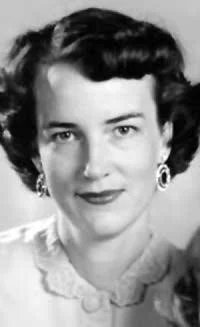
Roma Poole Allen

ROMA POOLE ALLEN was born in .Whitney, Idaho, in 1923 and lives now in Logan, Utah, where she received both a B.S. and an M.F.A. from Utah State University. She has taught throughout Utah, has won numerous awards, and has exhibited at many local galleries and museums.

Learn more

Louise Garff Hubbard

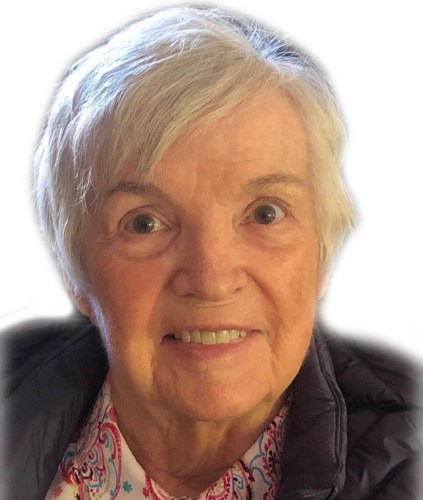
LOUISE GARFF HUBBARD lives in Logan, Utah, where she earned both a B.S. and an M.F.A. from Utah State University. She has taught art classses at Utah State University and for the Utah Arts Council. Her work has been included in numerous state and regional art exhibits.

Learn more

Barbara Madsen

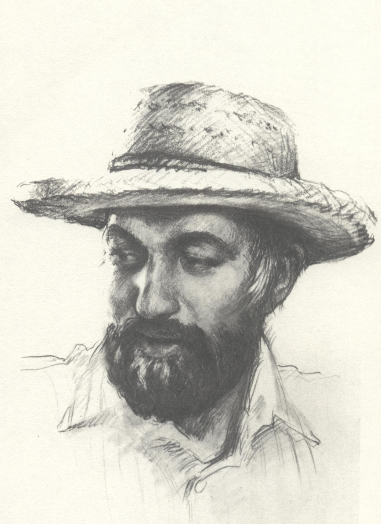
Barbara Madsen recently taught as a visiting instructor of print￾making at Brigham Young University and in 1989 at Southern Utah State College. She is currently working on her art and doing collabo￾rative printing. She received a bachelor of fine arts from Brigham Young University and a master of fine arts from Drake University in Des Moines, Iowa. Her work has been exhibited throughout the nation in competitive exhibitions including College of Notre Dame of Mary￾land, New Jersey Center for the Visual Arts, North Dakota Print and Drawing Annual, and in Kanagawa, Japan, at the fifteenth Interna￾tional Exhibition of Prints. Numerous awards include several juror’s purchase awards from the Utah Arts Council, Exhibition 48 purchase award from Southern Utah State College, and from Art Link, Fort Wayne, Indiana. Madsen’s work reflects a profound need to find peace and truth among the stark and often grim circumstances of life. She says, “We live in a world of opposites. We stare at brutality, blindness, turmoil, and sirens; yet we seek a world of resolution, wholeness, and peace. We are confronted with shadow, deceit, screaming, and loneliness; yet we hope for light, tranquility, honesty, and clarity. There is a division of reality in our minds; beyond desolation, conflict, and greed, there exists a verdant world of hope, of passageways, and luminous truth.”

Learn more

Cuna Quilters

The San Bias Islands on the north (Atlantic) coast of Panama are the homeland of the Cuna Indians, creators of the molas featured in this issue. While many of the Cuna groups inhabiting about forty of the several hundred islands in the chain have been very reclusive*, the San Bias groups have interacted with the outside world at least since the time of Balboa. Their relationship with outsiders, however, has been cordial but somewhat distant. Until very recent times, interracial marriages or births were generally grounds for banishment or death, so the Cuna are virtually pure Indian, one of the purest in the western hemisphere. Their cultural values of cooperation, honesty, chastity, and benevolence and some of their oral history and written stories bear striking parallels to the Church and its teachings. In the last forty years, the Church has attracted many members on the islands. Mola , a native art form, literally means “clothing”; but the word has come to mean a multilayered rectangle worked in applique and reverse applique. A good mola has many cutout areas; tiny, almost invisible stitches; and few, if any, large areas without stitching. Even a skilled mola maker may need several weeks to complete a project. Traditionally, molas have been used as the front or back of women’s blouses. The techniques of applique and reverse applique used to make mola blouses have developed and flowered over the last 150 years. Earliest known molas were adaptations of traditional face and body painting. Some of these early designs are still popular today. More common, however, are pic￾torial molas, taken from nature, everyday activities, books, posters, newspapers, or in our case, Church periodicals and missionary lesson kits.

Learn more

Edward J. Fraughton

How I came to be artist is still a bit of a mystery. Park City, the colorful Utah community where 1 was born and grew up, was quietly fading into oblivion, not so much because the rich silver ore had spent itself but because times were simply different. Although our family never owned a car or enjoyed the luxury of hot run￾ning water, I was blessed to have an inspired mother, a devoted step-father, wonderful friends and teachers who deeply believed in me. My university years were bittersweet – sweet because I discovered my potential – bitter because my choices at the time were considered and judged “politically incorrect.” Refusing to bow to several of my professors’ emphasis on style over substance, I was punished by being denied the right to complete the final quarter toward my master’s degree. This had been an important goal for which I had worked a night shift at a steel mill for over five years. Recognition from my peers at the National Sculpture Society, National Academy of Design, and National Academy of Western Art soon redeemed me from my stubborn resolve to add something of my own to six thousand years of traditional sculpture. This summer’s retrospective exhibition of my work at the Gilcrease Museum in Tulsa confirmed that my youthful dreams could be fulfilled.

Learn more

Elfie Huntington

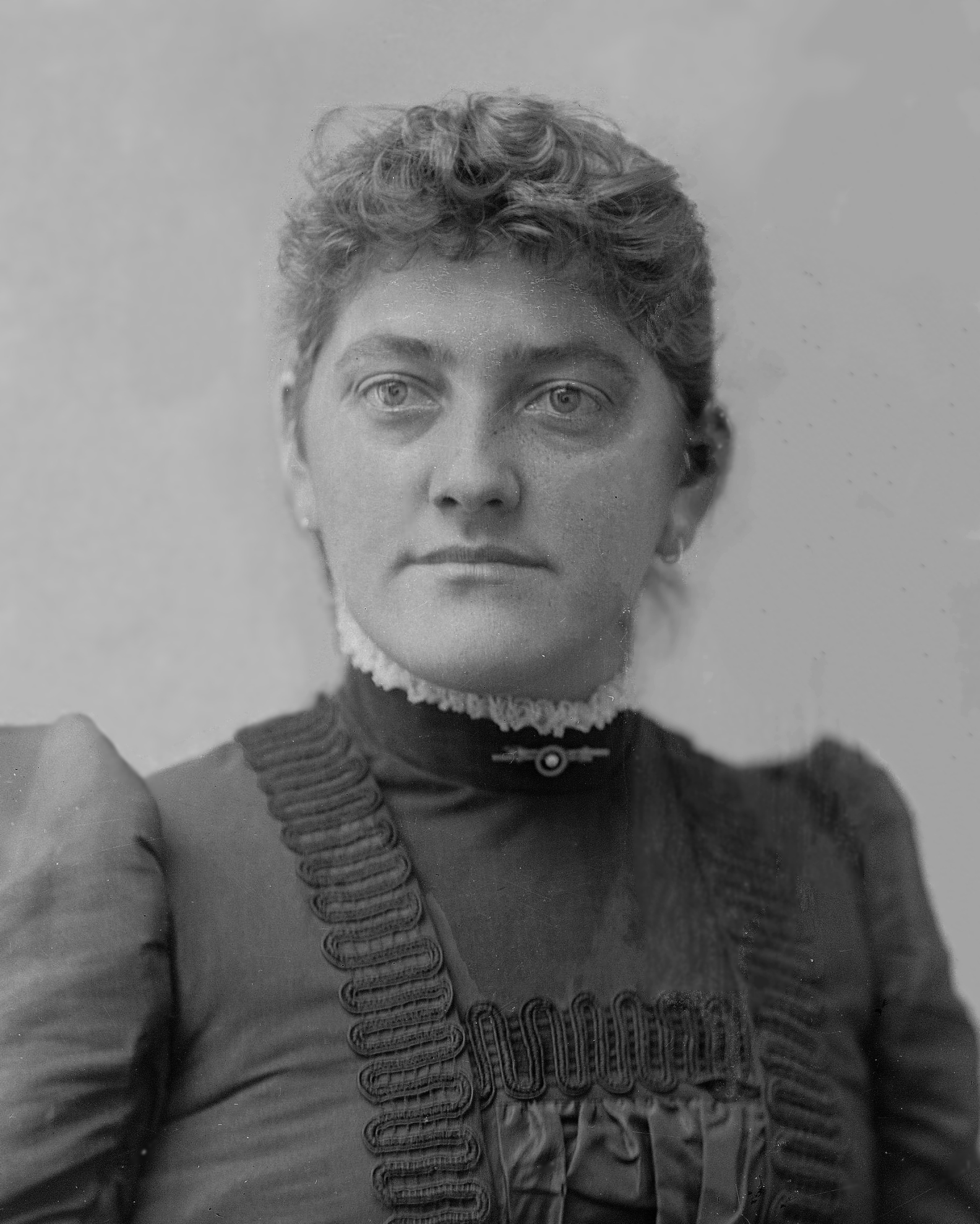
The photography of Elfie Huntington typically “focuses on people in real￾life situations,” says curator Cary Stevens Jones in her exhibit catalog, A Woman’s View: The Photography of Elfie Huntington (1868′ 1949), sponsored by the Utah Women’s History Association and toured by the Utah Arts Council from 1988-93. Three important elements, “geography or sense of place, autobiography, and metaphor,” converge in Huntington’s work “to form a powerful, personal vision,” says Jones. Huntington “photographed community rituals, picnics, parades, men going to war, July Fourth celebra￾tions, sleigh riding, and harvesting. She also portrayed [Springville, Utah’s] darker side-drunks collapsed in the streets, fights breaking out, and preach￾ers rolling into town in boxcars to warn sinners of impending doom.” Although she was deaf because of meningitis, Huntington refused to be con￾sidered handicapped. “She was a complex woman with the capability and courage to confront defects in society and in herself… who in her intensity to describe the fringe of society gave us many unsettling visual experiences. She intended to go beyond surface appearances, to expose the illusions of youth, of harmony, of well-being, of innocence by looking straight ahead with the camera.” Jones says Huntington’s work is separated from “the pure￾ly historical or geographical photographs that dominate nineteenth-century photography” because of its deliberate use of metaphor. “She saw Springville as a stage,” says Jones, “from which to make larger comments about life.. .In her driving quest to evoke, suggest, and communicate com￾plex thoughts and feelings, she established herself as one of the most cre￾ative and innovative photographers of her time.” Dialogue is pleased to present the work of Elfie Huntington in this issue and expresses gratitude to Cary Stevens Jones, Director of Hippodrome Galleries at FHP Healthcare in Salt Lake City, Utah, for her efforts in pre￾serving and promoting the work of this exceptional artist and for giving Dialogue permission to reproduce these images and statements from her cata￾log. (See original work in Huntington- Bagley Collection, Harold B. Lee Library, Brigham Young University.)

Learn more

Brad Aldridge

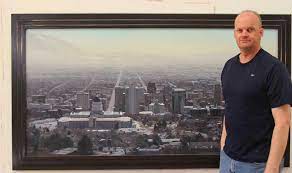
Brad Aldridge describes his work as iconographic landscape. “For me, aspects of the landscape often take on a personal spiritual symbolism. For example, clouds or the moon in my paintings often alludes to the metaphys￾ical aspect of life, whereas trees may refer to the more tangible or physical. My art is often about a dialogue between the two. Occasionally, I use figures to further emphasize the spiritual narrative. Triptych, arch, and tabernacle altarpiece formats give the viewer visual clues to the underlying spiritual content of my work. Large gold frames also contribute to the iconographic feel of my art. “My paintings are, for the most part, oil on masonite. The surfaces are usually quite textured. These textures are caused by sanding, scraping, and scratching the gesso. My plein-air landscape paintings are occasionally done on canvas which seems to accept the paint more readily as I paint quickly to capture a specific scene at a particular time of day. “My work often deals with opposites such as light and darkness, day and night, life and death, water or gardens in the desert, to name a few. On a for￾mal level, my work contains areas of sharp contrast, further pursuing the theme of opposites. This is evident in the lights and darks of the paintings as well as the gold frames which often have dark areas as a contrasting element. “My ultimate goal in art is to create objects of beauty which nourish the viewer on a spiritual level.”

Learn more

William Henry Bartlett

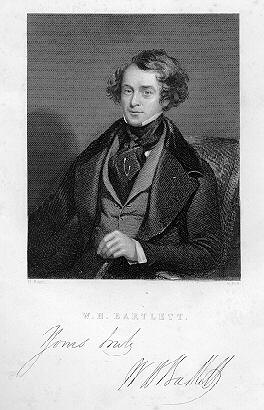
The illustration on the front and back covers is from a steel engrav￾ing made from a drawing by William Henry Bartlett (1809-54). The engraving first appeared in William Beattie’s The Waldenses, or Protestant Valleys of Piedmont, Dauphiny, and the Ban de la Roche (London: G. Virtue, 1838), and in subsequent translations published in French (1838) and German (1840). Bartlett was a prominent nineteenth-century artist who collaborated with Beattie (1793-1875) on other projects including: Switzerland (1834); Scotland (1838); Caledonia (1838); The Castles and Abbeys of England (1842); The Ports, Harbours, Watering-Places, and Coast Scenery of Great Britain (1842); and The Danube (1844). Bartlett was also the author of books which contained his drawings including: Niagara Falls (1837-38); Engravings (1839); Walks around the City and Environs of Jerusalem (1844); Forty Days in the Desert (1848); Nile Boat (1849); Scripture Sites and Scenes (1850); A Pilgrimage through the Holy Land (1851); Footsteps of Lord and His Apostles (1852); The Pilgrim Fathers (1853); The History of the United States of America (1853); and Pictures from Sicily (1853). Following Bartlett’s death Beattie published his Brief Memoir of the late William Henry Bartlett (London: M.S. Rickerby, 1855). The town pictured in Bartlett’s drawing is Torre Pellice or La Tour in French – the language preferred by its inhabitants.Torre Pellice was the headquarters of the Waldensian church and the location in Piedmont which Lorenzo Snow selected in 1850 as the starting point for his Italian mission. The drawing includes the river Angrogna where initial Mormon converts were baptized in 1851. It also shows two mountains (Casteluzzo and Vandalino) which Snow climbed and renamed “The Rock of Prophecy” and “Mount Brigham” when he organized the Italian Mission. Franklin D. Richards also ascended “The Rock of Prophecy” when he vis￾ited Torre Pellice in 1855, and Ezra Taft Benson rededicated the Italian Mission in 1966 from this same location.

Learn more

Allen Dale Roberts

Born in 1947, Allen Dale Roberts was raised in Milwaukee and the San Francisco Bay area before settling permanently in Utah where he received a B.A. in Art & Design with an architectural major from Brigham Young University in 1973, and later pursued advanced studies in architecture, history, and philosophy at the University of Utah. He has loved art since he was a young child and at age twelve received a scholar￾ship to the Milwaukee Art Institute where he did his first oil painting. An architect and historic preservationist by profession and writer by avocation, Roberts revived his long-dormant interest in fine art and began painting in 1991 after a nearly twenty year hiatus from artistic activity. A believer in “plein aire” painting, he pursued his interest in the Utah land￾scape and historic built environment. Inspired by outdoor painting experi￾ences with Randall Lake, Earl Jones, and Ken Baxter, Roberts is also fond of the turn-of-the-century realist works of John Singer Sargeant and Utah’s master tonalist, LeConte Stewart. Currently co-editor of Dialogue: A Journal of Mormon Thought and co￾author of Pulitzer Prize-nominee, Salamander: The Story of the Mormon Forgery Murders, Roberts plans to focus increasingly on representational and symbolic painting as a means of self-expression. His paintings have been exhibited in galleries throughout Utah, where he also has exhibited his paintings, drawings, and photographs in a one-man show.

Learn more

David Linn

David Linn was born in Palo Alto, California, and grew up in the hills of the South Bay peninsula. He began painting shortly after birth and has only occasionally paused to pursue other interests such as music composition, mountain climbing, writing poetry, and designing objects that fly (sometimes). He recently received an MFA in painting from Brigham Young University, and currently resides at the foot of a mountain in Elk Ridge, Utah. He cites influences as divergent as Baroque masters and American Luminists to contemporary Conceptual Site and Earthwork artists. David’s work has been exhibited widely and may be found in various museum, corporate, and private collections throughout the country. “My work is born out of a need to articulate for myself alternate worlds and states of being – a spiritual existence forming deep currents that flow beneath the observable world. These created internal worlds seem at times more real than my physical environment because they are evidence to me of what is felt more acutely. My work has evolved into a meditation on themes of searching, passage, and purification through these internal wilderness places – a landscape where events and objects take on a multi-layered symbolism and actions become ceremonial in nature.”

Learn more