

 Back to full Issue

Articles/Essays – Volume 59, No. 1
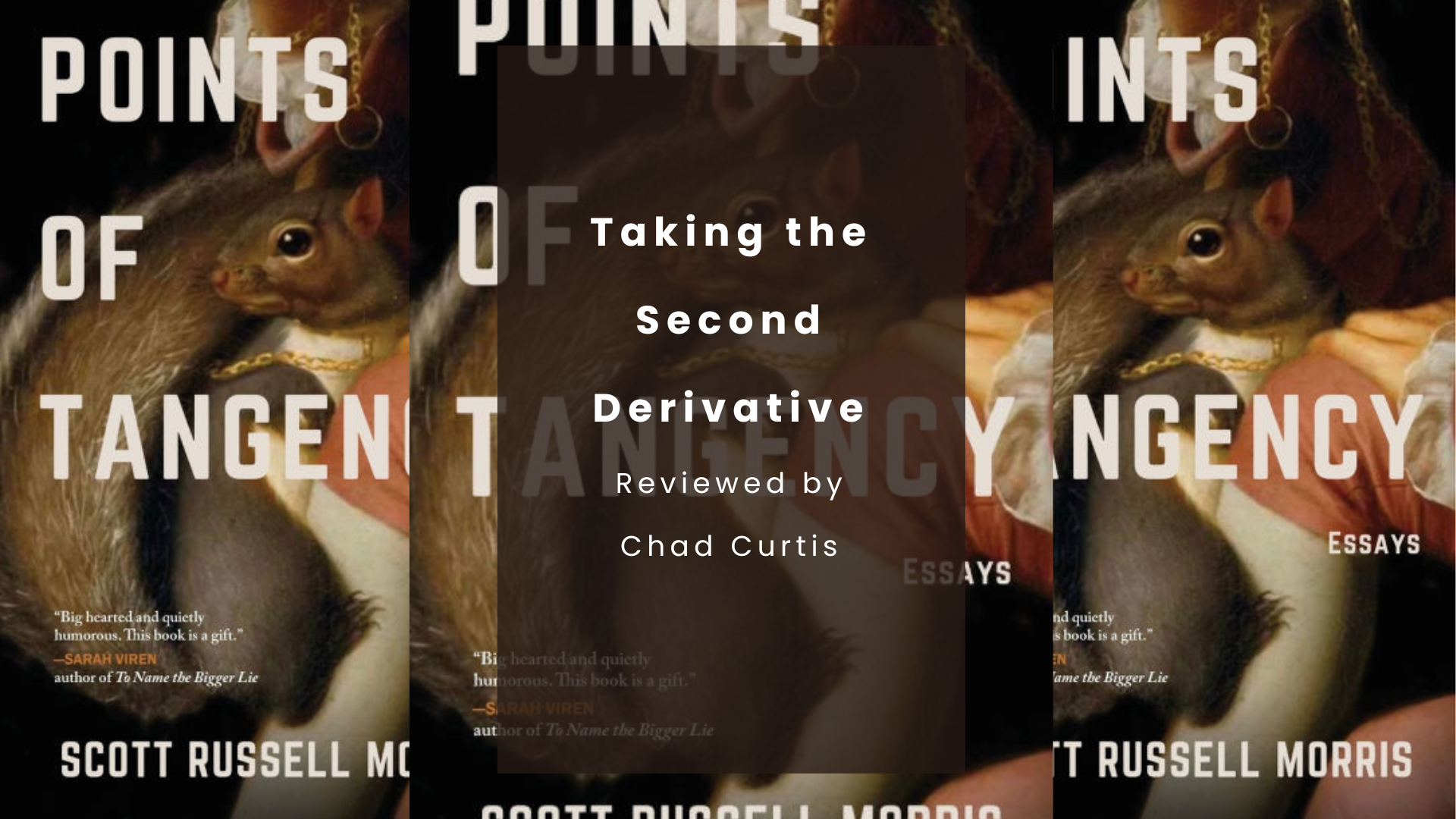
Taking the Second Derivative | Scott Russell Morris, Points of Tangency
When I was invited to review Points of Tangency, I had a moment of anxiety. The blurb hit a little too close to home: “Scott Russell Morris, a closeted queer Mormon, tells the story of meeting and then marrying his now wife.” Me, a gay Mormon in a mixed-orientation marriage, reviewing a collection of personal essays by another queer Mormon in a mixed-orientation marriage. I am always glad to find a fellow traveler—we have to stick together after all—but by writing a book or keeping a blog about being gay and Mormon, you are inevitably going to be held up as some sort of exemplar for others. I have already read plenty of books in this genre, and I didn’t want to read another book that felt like a manual for being gay and Mormon.
But this book isn’t that. Points of Tangency is not a manual or even a memoir, starting with “where I was born, and what my lousy childhood was like, and all that David Copperfield kind of crap.”[1] Take, for example, the first essay in the book, “Nothing in Particular.” The essay is composed of a series of vignettes of varying lengths on the topic of nothing. Some announce they are about nothing, say a reflection on Genesis 1:1’s “In the beginning there was the void.” Others, such as a story about getting caught in a blizzard in eastern Idaho, leave you waiting to find out how the topic has to do with nothing. Moving from one section to another requires the reader to reorient themselves, but that is the genius of the form. What gives the essay its depth isn’t necessarily what is explicitly stated; it’s the juxtaposition of these disparate elements. The insights come from the reader drawing connections between these pieces—what lies between the words is in some ways what is more important than the words themselves. There is an art in selecting these pieces, but by their nature, the essays also require a lot from the reader to imbue them with meaning. The form of the book is perfect for embracing uncertainty, nuance, ambiguity, and room for growth.
While the blurb of the book says it tells the story of Morris meeting his wife, “story” is meant in a loose term. The essays are vaguely chronological, but they aren’t woven together into a linear narrative. We get scenes of their relationship developing interwoven with reflections on squirrels and chats with strangers at an Amsterdam hostel. The closest thing to a theme throughout these scenes is a tension or difference in expectations within their marriage. This line really resonated with me: “I had to give up the safety I felt in my placid life, where I was comfortable and certain, where I had time to observe and reflect. . . . I still miss that individuality sometimes. But once you’ve attached yourself to someone, once you’ve opened up, let the fires of forgiveness gut you, there will be pieces missing and there will be new, flame-forged, smoldering bits you hadn’t known about before” (86). The book doesn’t paint a picture of an unhappy marriage, but it does have the vulnerability to explore the growing pains that are inherent in two “becoming one flesh.” Morris’s reflections and illustrations of small moments in his courtship and early marriage brought me to reflect on my own. Writing about these intimate moments requires a difficult balance between being honest about internal struggles and the perspectives of others. Morris directly acknowledges how difficult this balance can be: “As I write this, Kirsten worries that this essay makes her appear unsupportive, the kill-joy to my boundless enthusiasm” (170). When my grandmother wrote her memoirs, I wanted to write a review to illustrate how impactful it was for me to learn about her heritage and childhood. But when I published it on my blog, I got immediate backlash from my extended family for publicly shaming her and I took it down. Writing about others close to you in an honest and vulnerable way for a wider audience is perhaps impossible—it seems like airing your dirty laundry—but I admire those who try because it shows how we are all human.
Throughout the book, I paused to admire the beautiful prose. I was reading the essays in the evenings while I watched my kids play in the park. You couldn’t immediately jump from one essay to the other, because you need time to think about what each one means. I’m jealous of people who can write like Morris. I am an engineer by training, and a major reason I went into STEM at all was because I wasn’t confident in my writing skills, despite loving poetry and novels in high school. The form I am most familiar with is the scientific article that follows the same predictable format: introduction, methods, results, discussion, conclusion. When I do write for myself, it is straight and to the point. From what I gathered from Morris’s recollections, the writing style isn’t necessarily all planned from the get-go: “New to the form, I didn’t know how to end the essay, so I made a decision that went against my obsessive, do-gooder, straight-A sensibilities: I simply stopped typing and submitted the essay unfinished. My professor told me he loved the ending and I knew I had found a calling” (16). Each essay does very little telling; you, the reader, determine the significance of the various pieces, much like a visitor to an art museum ponders the message of a portrait.
In retrospect, any anxiety I had about reading Morris’s essays was unwarranted. While I was sitting in the park after finishing the book, pondering how each essay fit together, I read the author’s note, which gave more context on Morris’s writing of the book:
While writing and editing the first drafts of this collection, I presented the front of a devout straight man. . . . [But now] I wanted this book to reflect who I really was, but starting over would have meant writing a book entirely different than the one this was trying to be. Instead, where appropriate, I’ve edited the essays to mention my sexuality. I suspect some readers might notice the discussions of my sexuality and my desires are stained by a religious anxiousness born from teachings that my thoughts were unholy and damnable. I no longer believe that I need to repent for being attracted to men, but for a long time I did and these essays reflect that worry. Perhaps some readers will take this anxiousness to be an anti-queer stance or even just less than enthusiastically proud. I hope they will see instead that these essays are trying, at last, to be honest. (203–205)
Points of Tangency beautifully captures the unique experience of a queer Mormon. It isn’t meant to be normative. When I have tried to write about my own experience as a gay Mormon in the past, I made the mistake of leaving every other aspect of my life out. Certainly, that anxiety is a part of the experience, but Morris’s enthusiasm for squirrels, writing postcards, and teaching abroad all are just as much a part of his queerness too. In a way, this book to me embodies queer joy. It demonstrates that one’s experiences in the closet are beautiful too in spite of this religious anxiety.
Scott Russell Morris. Points of Tangency. Stevens Point, WI: Cornerstone Press, 2024. 230 pp. Paperback: $24.95 ISBN: 978-1-960329-50-9.
[1] J. D. Salinger, Catcher in the Rye (Back Bay Books, 1951), 1.