By the Mouth of Two or Three
March 13, 2018If the world were truly and wholly sullen,
the starlings would never sing—never.
They would see only blood in the clouds
of sunrise and sunset and hold their peace



If the world were truly and wholly sullen,
the starlings would never sing—never.
They would see only blood in the clouds
of sunrise and sunset and hold their peace
God once asked a murderer about the location of his victim. The murderer evaded the question by posing another: “Am I my brother’s keeper?”

In his book The Omnivore’s Dilemma: A Natural History of Four Meals, Michael Pollan identifies major problems caused by the recently emergent food industry and the negative effects they have on the health and wellbeing of individuals, communities, and the environments. Pollan’s observations mirror those of American poet-prophet Wendell Berry. Both highlight losses associated with the demise of independent, small-farm agricultures. Here, I suggest that the Mormon ethic of food in its ideal (if not lived) form beautifully, simply, and powerfully restores what is lost.
In 1842, Joseph Smith wrote a letter to John Wentworth, editor of the Chicago Democrat, outlining “the rise, progress, persecution, and faith of the Latter-day Saints.”That letter concluded with thirteen “Articles of Faith” that were later published in the Nauvoo Times and Seasons. In a general conference of the Church in Salt Lake City in 1880, these articles of faith were canonized as scripture for members of the Church of Jesus Christ of Latter-day Saints.
Nearly thirty-five years ago, Merrill Bradshaw wrote: “It seems almost unbelievable that after all these years of the development of Mormon thought we still have no genuine Mormon aesthetic theory.”Such a statement might initially strike the reader as a bit out of date considering the abundance of writing on Mormon aesthetics since Bradshaw penned those words.However, that very abundance illustrates the existence of an ongoing conversation about Mormon aesthetics that reflects the difficulty Bradshaw mentions.
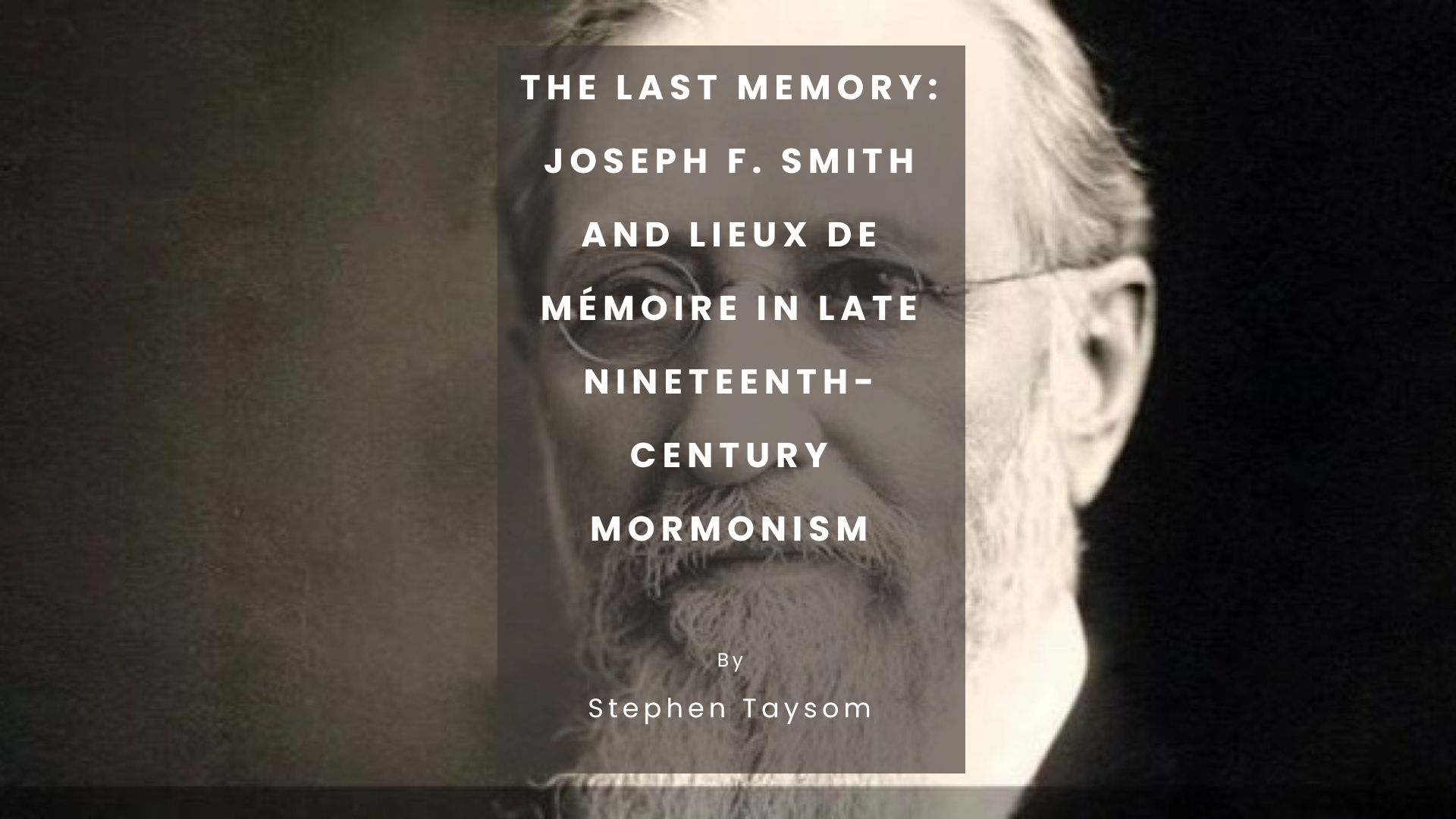
On the day after Christmas in 1915, Joseph F. Smith (JFS), then president of the LDS Church and less than three years away from his own death, spoke to a group of people in the Eleventh Ward meetinghouse in Salt Lake City. The past was always important to JFS and as he got older he found himself, usually at the behest of other Latter-day Saints, giving voice to his memories with increasing frequency. JFS accepted the invitation to speak on this day because “[s]ome of the good folks present are anxious to hear something about my early experiences.”Although few things are more common than an old man telling stories about his youth, this event, and the dozens like it that JFS participated in during the last years of his life, was about far more than personal memory.
In 1988 I completed my bachelor’s degree in music composition at BYU and moved to New York where I began a graduate program in ethnomusicology. I became disillusioned with the state of classical composition as I knew it at the time and felt that, although I wanted to continue to pursue my lifelong dream of being a composer, I would realize that dream more fully by enriching my musical study with music I had not yet encountered from other cultures. New York had the advantage of an underground jazz scene about which I knew as much as one could learn in those days from hanging out in the imports sections of record stores and reading esoteric music ’zines.
I should keep a journal. If I did I could look up what year this happened. Or exactly why I drove to Ed’s house and knocked on his door. Or what time it was when…
I asked five diverse scholars to answer the question: What would you change in Mormon musical practice? Here are their replies. —Editor

Do not think of your suffering.
Release it
through your breath
into the flute.