DiaBLOGue

Abundant Events or Narrative Abundance: Robert Orsi and the Academic Study of Mormonism

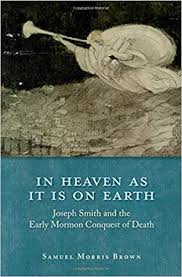
This essay is an experiment of sorts. For some time, Mormon Studies has attempted to move beyond the narrow confines of its past, with its focus on institutional histories and biographies of important people (mostly white men), toward a more methodologically nuanced and interpretive multi-disciplinary approach. Part of that growth requires that the data of Mormon Studies be scrutinized through the theoretical approaches coming out of disciplines such as religious studies. This essay does two things. First, it describes Orsi’s method and situates it within the context of religious studies methodology. Second, it scrutinizes the historical narratives associated with Joseph Smith’s “golden plates” through the lenses provided by Robert Orsi’s theory of “abundant events” in order to test the suitability of Orsi’s method to the data of Mormon Studies.

Featured Artist

Babble
Discus
Double Split
Dozer
Filter
Fruit of Memory
Honey Blue
Pink
Recompose
Monument to the Western Landscape
Skull Valley

Letters to the Editor

Mark Thomas, A Postapocalyptic Perspective?
Jacob Bender, Jacob Bender Responds
Michelle Inouye, Brother, Can You Spare a Book?

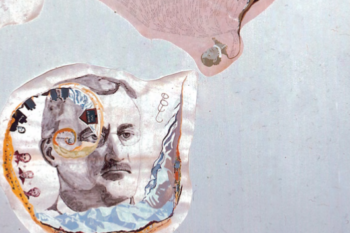
About the Art: Valerie Atkisson

“Tanner Spiral” is an exploration of my great-grandfather’s (Henry S. Tanner) family. He decided to take his first polygamous wife ten years after the first Manifesto. He had already been the mission president of the…

An Imperfect Brightness of Hope

After admonishing his people to follow Christ and be baptized, Nephi said, “Wherefore, ye must press forward with a steadfastness in Christ, having a perfect brightness of hope, and a love of God and of all men. Wherefore, if ye shall press forward, feasting upon the word of Christ, and endure to the end, behold, thus saith the Father: Ye shall have eternal life” (2 Ne. 31:20). I see a paradoxical tension between the concepts of “enduring” and “having a perfect brightness of hope.” The word “endure” connotes little in the way of pleasure; its etymological root is “hard.” In French the word dure, which comes from the same Latin root, means “difficult,” “harsh,” “severe,” or “stern.” On the other hand, the words “perfect brightness of hope” connote light and optimism, warmth and peace. The two concepts don’t seem to go together. 

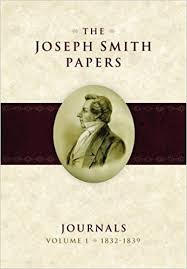
Worth the Wait | Dean C. Jessee, Mark Ashurst-McGee, and Richard L. Jensen, eds., Journals, Volume 1: 1832–1839; Journals, Volume 2: December 1841–April 1843

I am a relative newcomer to the academic side of Mormon history. I never traded photocopies of photocopies of historical documents. I only know of the most scandalous shenanigans in the field through my reading of secondary treatments such as Turley’s Victims and my own limited sleuthing of such primary sources as issues of the Seventh East Press and federal court records. I did start researching in the old LDS Church Archives on the first floor of the Church Office Building in 2006 and I have sometimes been denied access to materials requested, but I personally only know a field of increasing access, openness, and—as evidenced by the Joseph Smith Papers Project—institutional support.

The Revelations & Opinions of the Rev. Clive Japhta, D.D.

as extracted from a series of emails James Goldberg discovered in his junk folder  I am—without question—an American. If I’ve ever doubted that, it was clear the moment I walked into the humidity and human…

“An Exquisite and Profound Love”: An Interview with Andrew Solomon

Andrew Solomon has written about mental health, politics, and culture for the New York Times and the New Yorker and is the author of four books. The Noonday Demon: An Atlas of Depression won the 2001 National Book Award for Nonfiction and was a finalist for the 2002 Pulitzer Prize. In his most recent book, Far from the Tree: Parents, Children, and the Search for Identity, Solomon explores what it means to be a parent in the context of adversity. Dialogue board member Gregory A. Prince interviewed Solomon on March 28, 2011, in New York City.