DiaBLOGue

Unity and the King James Bible

The Authorized (King James) Version of the Bible (KJV)has been the de facto English LDS Bible since the very beginning of the Restoration. The initial reason for this is simple: The KJV was the Bible of American Protestantism in the nineteenth century and was therefore Joseph Smith’s Bible. For example, Joseph Smith and Oliver Cowdery used an 1828 KJV to begin work on the Inspired Version of the Bible, known by Mormons as the “Joseph Smith Translation” (JST).

The King James Bible and the Future of Missionary Work

Not long ago I went out with the full-time elders and we taught a young mother who was quite interested in our message. In fact, she had been meeting with the missionaries for several weeks. When they referred to a biblical scripture and invited her to read along, she did so and then responded, “That’s not what it says in my Bible.” Even though she was a conservative Christian, from a Pentecostal background, she was using the New International Version (NIV). And it is not just that the words were different—most Christians are familiar with multiple versions of the Bi ble these days. The meanings did not match up. The elders were flustered, having no idea how to handle the situation, and they tried to move on to the next point as quickly as possible. 

The Feeling of Knowing | Tyler Chadwick, ed., Fire in the Pasture: Twenty-first Century Mormon Poets

For me, poetry’s unique power is to hold in immediate suspension what we know and how we know it. Poets surpass philosophers in representing a harmonious tension of ontology and epistemology. We renew through the condensation of poetic language the feeling of knowing most authentically. The poems in Fire in the Pasture are not wanting. As a group of poems, Fire succeeds admirably in renewing our feelings of knowing. 

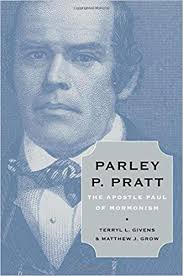
Loyal Follower, Bold Preacher | Terryl L. Givens and Matthew J. Grow, Parley P. Pratt: The Apostle Paul of Mormonism

In May 1857, a jilted husband finally found the man who had taken his wife. After tracking him to western Arkansas, he organized a posse to cut off his escape, followed him into a thicket of trees, pulled him from his horse, and stabbed him repeatedly near his heart. Hector McLean left to fetch a gun, returned, and fatally shot Mormon apostle Parley P. Pratt in the neck. 

Mormon Scholars in the Humanities Conference | Savior, silver, psalms, and sighs, and flash-burn offerings

Help thou mine unbelief  and I 
Will give away my sins or keep them close to know you;   
Will seek you in the best  and brokenest of books; 
Will cling hard, let loose, bring forth flesh and fruit,  if this will please;
Will more-than-tithe my time and talent, open windows;   
Make room for oil and balsam, if you’ll pour;   
Will labor, useless, to admit,  but leave a spare under the mat,
Create diversions, throw down ropes; 
Will pray and fast and follow and hope; 

Mormon Scholars in the Humanities Conference | Mormons, Films, Scriptures

I asserted without argument a few years ago at the annual meeting of the Association of Mormon Scholars in the Humanities that the Mormon film movement of 2000–2005 witnessed the production of only one truly Mormon film, namely, Napoleon Dynamite (2004).The claim for which I did provide an argument was that the bulk of the movement launched by Richard Dutcher’s God’s Army (2000) and brought to its culmination with Dutcher’s (thank fully-later-re-titled) God’s Army 2 (2005) was principally a study in the possibility of introducing into Mormonism, for ostensibly pas toral reasons but with theologically fraught consequences, an arguably non-Mormon sense of religious transcendence. What I did not note then, but would like to reflect on now, is the curious role scripture played—and did not play—in this short-lived movement. 

Mormon Scholars in the Humanities Conference | Overcoming Technology: The Grace of Stuff

We tend to think of technology as a way of producing this or that. Simple technologies produce obvious results: a match produces fire. More complicated technologies, such as computers, also produce things, though sometimes it is less obvious what they produce. Our messages may get lost in the ether, but that metaphor recognizes that I produced something using my computer, whatever it was that got lost. There are good reasons to understand technology in terms of production. 

Association of Mormon Letters Conference | Beyond Missionary Stories: Voicing the Transnational Mormon Experience

In The American Religion, critic Harold Bloom begins his analysis of Mormonism with this well-known prophesy about the future of Mormon literature: 

A major American poet, perhaps one called a Gentile by the Latter-day Saints, sometime in the future will write their early story as the epic it was. Nothing else in all of American history strikes me as materia poetica equal to the early Mormons. . . .