Speculations: Wine/Oil
March 16, 2018Christ was perfect. Christ turned water to wine at the wedding at Cana. Did Christ create the perfect wine?
Christ was perfect. Christ turned water to wine at the wedding at Cana. Did Christ create the perfect wine?
To be good
in Lorenzetti’s view
is to build a piazza
more enticing
Love is the great
unspoken thing:
the horse and his oats
The man he will become
floats above her head
A look springs up:
words falling from his skirt
I am a lover of legends, a spinner of tales. Pepper your preaching with anecdotes if you want my attention. Punctuate your sermons with parables, your homilies with flesh and blood, your lessons with people who breathe. Do this for veracity’s sake, for as Neal Chandler once so astutely reminded us in Dialogue, “Story truths are mostly truer than the truths of exhortation.”But great stories are also subjective, ambiguous, multi-faceted, and complex, not conducive to ten-minute talks or Gospel Essentials lessons, and they seem to be fading in importance, even as the need for thoughtful faith increases in this complicated world.
During the cold war years after World War II, Mormons, including some Church leaders, increasingly infused national concerns about Communism with strong moral and religious overtones. J. Reuben Clark Jr.(1871–1961), first counselor in the First Presidency, asserted in 1949: “Our real enemies are communism and its running mate, socialism.”Almost four years later, Church President David O. McKay (1873–1970) urged: “Every child in America [should be] taught the superiority of our way of life, of our Constitution and the sacredness of the freedom of the individual.”Communism, he stressed, “has as its ultimate achievement and victory the destruction of capitalism” and the “undermin[ing] of the Restored Gospel.” “It is as much a part of the religion of American Latter-day Saints,” the LDS Church News asserted, “to accept the Constitution of the United States, and defend it, as it is to believe in baptism or the resurrection.”
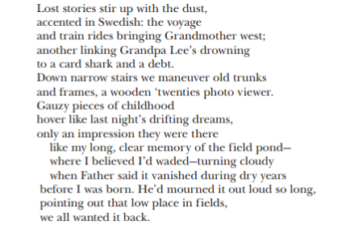
I don’t remember ever seeing my grandfather and grandmother together. I seem to remember a picture, him standing a foot taller than her, his face weathered. She wears her wide-brimmed gardening hat. But if it exists, I can’t find that picture. During my memory they lived apart. When I was very young she lived in her white, wood-framed house at Greenjacket, near Vernon, Utah, and he lived in his small box of a cabin at Riverbed, fifty miles westward in the desert. Was it her asthma that kept them separate or her desire to support the family with money she earned from selling her paintings? When asked, older relatives mention both reasons, but neither seems sufficient.
Recent years have seen renewed scholarly interest in the tradition of the virtues and vices.This tradition has roots in both Judeo-Christian and Greco-Roman ethics, and reached the height of its Western cultural importance during the medieval period. Since that time, many artists and thinkers have continued and further developed the virtues and vices tradition. Edmund Spenser‘s The Faerie Queene (1590-96) and Benjamin Franklin‘s Autobiography (1791) both expand this tradition, with Spenser’s lively stories about the power of virtue and the danger of vice and with Franklin’s description of his aborted attempt at a handbook on “The Art of Virtue.” In addition, Oscar Rejlander’s landmark photograph Two Ways of Life (1857) is an allegory of the contrasting paths of virtue and vice. Other artists have focused particularly on the seven deadly sins, notably Kurt Weill and Bertolt Brecht in their The Seven Deadly Sins (1933) and the series by American artist Paul Cadmus titled The Seven Deadly Sins (1945–49).
Two things have been on my mind recently. They have provoked a lot of thought and research. Over the past months, I have spent hours on the internet perusing medical studies, Church websites, and countless blogs, looking for answers. At first glance, the two seem to be entirely unrelated topics, but as they’ve occupied so much of my thoughts, I’ve come to notice some similarities.
“Have you ever acted as though you had a testimony of something you were still unsure of at church? Maybe you found yourself hoping that if you played the role, it would eventually feel real? Or have you ever said you believed something that you didn’t have a testimony of because you knew it was expected of you, and you were surrounded by people that wouldn’t hesitate to confirm their own witness of the same subject? Is this being dishonest?”