DiaBLOGue

Home and Adventure: An LDS Contribution to the Virtues and Vices Tradition

Recent years have seen renewed scholarly interest in the tradition of the virtues and vices.This tradition has roots in both Judeo-Christian and Greco-Roman ethics, and reached the height of its Western cultural importance during the medieval period. Since that time, many artists and thinkers have continued and further developed the virtues and vices tradition. Edmund Spenser‘s The Faerie Queene (1590-96) and Benjamin Franklin‘s Autobiography (1791) both expand this tradition, with Spenser’s lively stories about the power of virtue and the danger of vice and with Franklin’s description of his aborted attempt at a handbook on “The Art of Virtue.” In addition, Oscar Rejlander’s landmark photograph Two Ways of Life (1857) is an allegory of the contrasting paths of virtue and vice. Other artists have focused particularly on the seven deadly sins, notably Kurt Weill and Bertolt Brecht in their The Seven Deadly Sins (1933) and the series by American artist Paul Cadmus titled The Seven Deadly Sins (1945–49). 

Uncertainty and Healing

Two things have been on my mind recently. They have provoked a lot of thought and research. Over the past months, I have spent hours on the internet perusing medical studies, Church websites, and countless blogs, looking for answers. At first glance, the two seem to be entirely unrelated topics, but as they’ve occupied so much of my thoughts, I’ve come to notice some similarities. 

To the 78 Percent

“Have you ever acted as though you had a testimony of something you were still unsure of at church? Maybe you found yourself hoping that if you played the role, it would eventually feel real? Or have you ever said you believed something that you didn’t have a testimony of because you knew it was expected of you, and you were surrounded by people that wouldn’t hesitate to confirm their own witness of the same subject? Is this being dishonest?” 

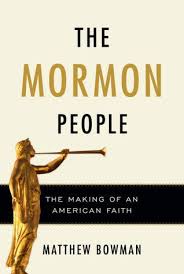
Errand Out of the Wilderness | Matthew Bowman, The Mormon People: The Making of an American Faith

In Perry Miller’s famous essay on the Puritans, he described how John Winthrop and his fellow dissenters left England in the hopes of establishing on the other side of the Atlantic a godly society that could serve as a model for the reformation of the mother country and its church. In the wake of the English Civil War and as the end of the seventeenth century neared, their descendants were plagued by the sense that the mission of their fathers had foundered. “Having failed to rivet the eyes of the world upon their city on the hill,” wrote Miller, “they were left alone with America.” 

Making Visible the Hand of Ritual | Devery S. Anderson and Gary James Bergera, eds., Joseph Smith’s Quorum of the Anointed, 1842–1845: A Documentary History; Devery S. Anderson and Gary James Bergera, eds., The Nauvoo Endowment Companies, 1845–1846: A Documentary History; and Devery S. Anderson, ed., The Development of LDS Temple Worship, 1846-2000: A Documentary History

Although we may not know it, we live our lives immersed in ritual. Many of our daily exchanges with other human beings are ritualized. We often categorize and compare religions by referencing how highly structured, or not, their liturgical worlds are. I grew up being told that Mormons avoided ritual because it connoted empty practice and vulgar symbolism. The truth is, however, that Mormon temple worship is among the richest symbolic systems of worship in Christianity. 

Mormon Authoritarianism and American Pluralism

Russell: I wanted to start off this conversation by asking David about the subtitle of his book, “How Religion Unites and Divides Us.” That concern over unity and division has been a serious one for the Mitt Romney campaign. He’s made efforts to bridge divides in order to make his candidacy appealing to a particular segment of conservative Republican primary voters who, generally speaking, have not looked well upon Mormons.

Field Walking

Jennifer is a mother of three—Sadie in high school, Carson in middle school, Jordan in elementary—which means weekdays start at 6:00 A.M. and quickly unspool, devolving into a mad scramble of showers and hair dryers…

The Afternoon Hour

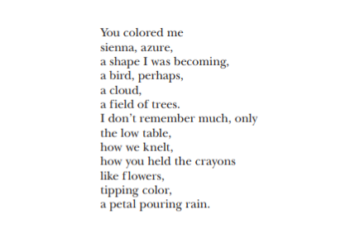
You colored me 
sienna, azure, 
a shape I was becoming, 
a bird, perhaps, 

Atlanta to Salt Lake

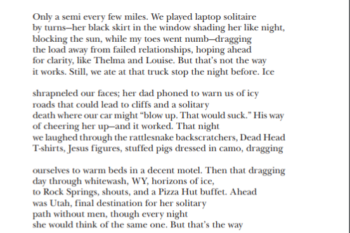
Prose will not capture some people, the way 
they drift. You can only see them dragging 
their furniture through Wyoming night, 
down a dark throat of road, the ice