DiaBLOGue

The Truth Will Set You Free | Errol Morris, Tabloid

Tabloids, it seems, make good headlines. When Errol Morris’s new film Tabloid began its limited release on July 15, 2011, British papers were themselves dominating the news, with the News of the World closing its doors on July 10 and Rupert Murdoch appearing before Parliament less than two weeks later. The timing was weirdly appropriate: Morris’s film examines an episode from 1977 when the British papers were awash with the story of Joyce McKinney, an American girl alleged to have abducted a Mormon missionary and briefly made him her sex slave. In looking at the tactics of tabloid reporters in 1977, it seems that not much has changed. Surely the reporters then would have hacked McKinney’s mobile phone had they been able. 
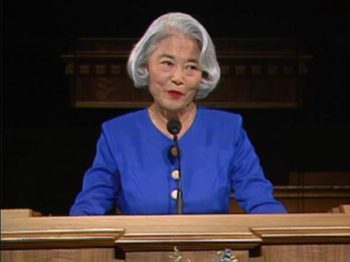
“There Is Always a Struggle”: An Interview with Chieko N. Okazaki

Chieko Okazaki: In my meetings with the young women or with the Relief Society women, I’m often really surprised that they do not feel that they can function as women in the Church—not all of them, of course, but many of those who come to me and talk to me. I just keep wondering, “How did they get to that point of feeling like they were not worth anything in the Church?” 

Greg Prince: Did you feel that way when you were younger?

Requiem in L Minor

Today the L’s. In the old address book, the L pages are impossible—phone numbers lined out, zip codes scratched in, whole entries x’d or margined with a question mark. Even the H’s are more decipherable.…

Speculations: Wine/Oil

Christ was perfect. Christ turned water to wine at the wedding at Cana. Did Christ create the perfect wine? 

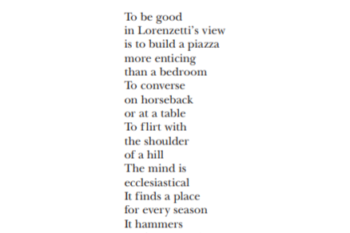
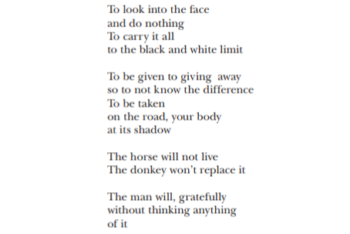
Nazarín

Love is the great 
unspoken thing: 
the horse and his oats 

Give Me My Myths

I am a lover of legends, a spinner of tales. Pepper your preaching with anecdotes if you want my attention. Punctuate your sermons with parables, your homilies with flesh and blood, your lessons with people who breathe. Do this for veracity’s sake, for as Neal Chandler once so astutely reminded us in Dialogue, “Story truths are mostly truer than the truths of exhortation.”But great stories are also subjective, ambiguous, multi-faceted, and complex, not conducive to ten-minute talks or Gospel Essentials lessons, and they seem to be fading in importance, even as the need for thoughtful faith increases in this complicated world.

The Richard D. Poll and J. Kenneth Davies Cases: Politics and Religion at BYU during the Wilkinson Years

During the cold war years after World War II, Mormons, including some Church leaders, increasingly infused national concerns about Communism with strong moral and religious overtones. J. Reuben Clark Jr.(1871–1961), first counselor in the First Presidency, asserted in 1949: “Our real enemies are communism and its running mate, socialism.”Almost four years later, Church President David O. McKay (1873–1970) urged: “Every child in America [should be] taught the superiority of our way of life, of our Constitution and the sacredness of the freedom of the individual.”Communism, he stressed, “has as its ultimate achievement and victory the destruction of capitalism” and the “undermin[ing] of the Restored Gospel.” “It is as much a part of the religion of American Latter-day Saints,” the LDS Church News asserted, “to accept the Constitution of the United States, and defend it, as it is to believe in baptism or the resurrection.” 

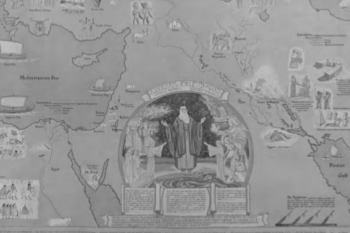
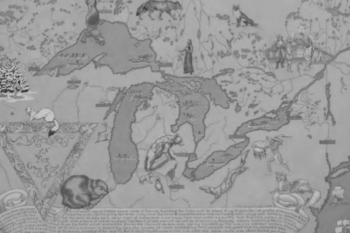
Mapping Manifest Destiny: Lucile Cannon Bennion (1891–1966)

I don’t remember ever seeing my grandfather and grandmother together. I seem to remember a picture, him standing a foot taller than her, his face weathered. She wears her wide-brimmed gardening hat. But if it exists, I can’t find that picture. During my memory they lived apart. When I was very young she lived in her white, wood-framed house at Greenjacket, near Vernon, Utah, and he lived in his small box of a cabin at Riverbed, fifty miles westward in the desert. Was it her asthma that kept them separate or her desire to support the family with money she earned from selling her paintings? When asked, older relatives mention both reasons, but neither seems sufficient.