DiaBLOGue

In Lieu of History: Mormon Monuments and the Shaping of Memory

As a missionary in France and Belgium, I frequently encountered devout Catholics who would describe their journeys to Lourdes or Fatima. “Ah, oui! J’ai vu la grotte, la grotte où la Vierge s’est apparue à Bernadette! J’étais lá!” While these humble women, dressed in robin-egg-blue housecoats, could not bring home a piece of the cross, they could show me their holy water, rosary beads, or skinned knees, emblems of their devotion and commitment. Their pilgrimage was no trite tourist trip. They didn’t watch the spectacle with ironic detachment, rolling their eyes at the commodification of sacred space. Non! They walked on holy ground. I nodded and smiled. But I confess that the stories amused me. Holy water indeed. 
Wives and Other Women: Love, Sex, and Marriage in the Lives of John Q. Cannon, Frank J. Cannon, and Abraham H. Cannon

John Q. Cannon, Frank J. Cannon, and Abraham H. Cannon were the three eldest sons of George Q. Cannon, the man viewed by historians as second only to Brigham Young in prominence in late nineteenth-century Mormon Utah. George Q. Cannon was a man of unusual talents and skills, whose far-flung influence extended to ecclesiastical, political, literary, journalistic, and business matters in Utah and the West, and each of the three sons inherited much of their father’s brilliance, culture, and charisma.

Joseph Smith’s Letter from Liberty Jail as an Epistolary Rhetoric

Joseph Smith may not have ever spoken the word “rhetoric,” but his participation in juvenile debating societies probably brought him some contact with rhetoric’s long tradition.Regardless of his knowledge of this tradition, it is obvious that Smith knew how to persuade people through speech and writing. In addition, his writings instruct readers about how to persuade in a manner consistent with the restored gospel of Mormonism.

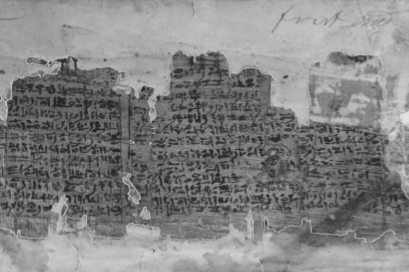
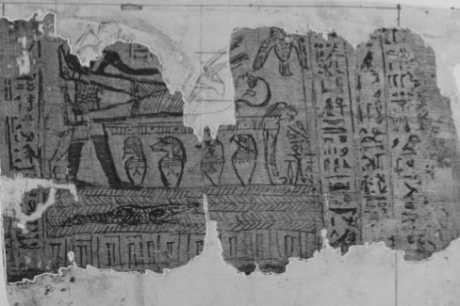
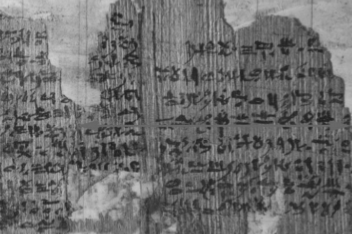
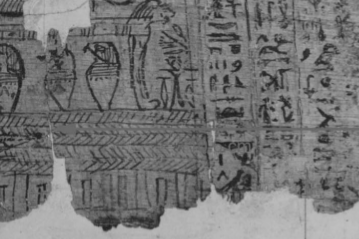
The Original Length of the Scroll of Hôr

Dialogue 43.4 (Winter 2010): 1–42
The purpose of this paper is to introduce a robust methodology that eliminates the guesswork in determining winding locations by visual inspection of crease marks or lacunae features, and to determine whether the missing interior section of the Hôr scroll could have been long enough to accommodate the Book of Abraham. Fortunately, this is a question that can be definitively answered by examining the physical characteristics of the extant portions of the scroll. The haste and greed of Michael Chandler provide the key to unlocking this mystery.

A Sacrament of Stewardship

Carrol and Edwin Firmage contributed papers to the fall issue that review Mormon history during the nineteenth century and early twentieth centuries and scriptural precedent, in an attempt to motivate a Mormon audience toward improved ecological fidelity: Edwin Firmage Jr., “Light in Darkness: Embracing the Opportunity of Climate Change” and Carrol Firmage, “Preserves” (43, no. 3 [Fall 2010]: 100–127 and 128–65). 

That the Glory of God Might Be Manifest

Roene Reeve was born December 21, 1946, in Hurricane, Utah, to Ora and Leo Reeve. She was welcomed into the family by her two older brothers, Stephen and David. Unknown to the doctor who delivered her, Roene was born with Rh disease. A postnatal blood transfusion prevents the disease from having negative consequences, but the doctor in Roene’s case was unaware of these procedures, and she went undiagnosed. By the time Ora and Leo took her to a specialist in Salt Lake City, it was too late. She was severely handicapped, both mentally and physically. When Roene was older, doctors recommended that she be institutionalized at the Utah State Hospital in American Fork. After only one month, Ora could not stand to be away from Roene and brought her home. 

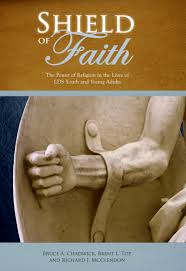
LDS Youth in an Age of Transition | Bruce A. Chadwick, Brent L. Top, and Richard J. McClendon, Shield of Faith: The Power of Religion in the Lives of LDS Youth and Young Adults, and Christian Smith with Patricia Snell, Souls in Transition: The Religious and Spiritual Lives of Emerging Adults

One of the most difficult and perilous times in a life is the transition from childhood to adulthood. Moving into the freedoms of adult life while still relying on parents to pay the bills creates tensions within the adolescent even as it brings frustrations for the parents. How does one make the leap from dependent to depend able, from reactionary to responsible? And will religious faith survive, go stagnant, or flourish through these changing roles and identities?