From Outside the Settlement
March 16, 2018It’s hard to balance
the pads of your feet on a railing.
He hadn’t thought of that
until just now,
with the sound of water
skirting below him.



It’s hard to balance
the pads of your feet on a railing.
He hadn’t thought of that
until just now,
with the sound of water
skirting below him.

My next poem
will have gunfire
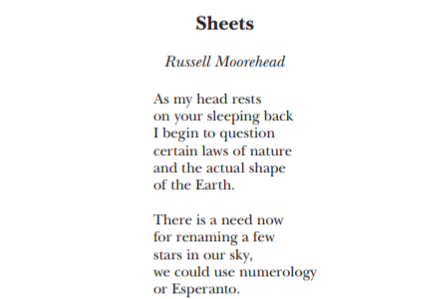
As my head rests
on your sleeping back
I begin to question
certain laws of nature
and the actual shape
of the Earth.

He is, perhaps, the same god as the God of Big Things,
but not meant to be worshipped or to run your life,
only to annoy you or not annoy you,
whichever the script calls for.

Even when we are asleep, our minds are active. Scientists surmise that our brains process and sort the events of the day at this time. Spiritual people believe God sometimes uses these moments to communicate…

When philosopher Alastair MacIntyre came striding into my Vanderbilt University office brandishing the New York Times in October of 1985, I knew something was up. “Congratulations,” he said, “your church has just entered its Renaissance period.” I was used to seeing him walk into Furman Hall on Ash Wednesdays with a gray streak on his forehead, and we had talked about Mormonism, but I had no clue what he was talking about. He showed me the front page of the paper. It was the Mark Hofmann bombings—murders to cover up Hofmann’s forgeries. “It only took you 150 years,” Alastair noted. “It took us a millennium and a half.”

Cranney: Richard mentions in Philosophy and Social Hope the dangers of fundamentalist religions and the extent of their political influence. Where did Mormonism fit on the fundamentalist continuum?
Mary Rorty: That’s a very interesting question because that’s something that has changed a great deal in my lifetime. The thought that Mormonism now considers itself in part an ally of the Evangelical Protestant movement is a surprise to many people, and that’s certainly not the side of Mormonism to which Richard had been exposed.
Cranney: Were there any specific instances . . . Of course, he died before Proposition 8 in California.

Marvin Hill argued in 1989 that the fundamental problem early Mormonism was designed to address was the problem of pluralism. Pluralism, according to Hill, caused a situation of social disintegration and insecurity to which Mormons hoped to bring stability and uniformity.Hill’s analysis is insightful in its attention to the institutional and political issues but does not fully engage the religious dimensions of the problem
My involvement in biblical studies has also awakened in me an interest in other holy books. In the 1970s, I had the opportunity to do some work on the Qur’an, a fascinating combination of things familiar and unfamiliar for a biblical scholar. I had a vague hunch that, in a somewhat similar way, the Book of Mormon might make exciting reading, but a contact with that book and its study came about quite accidentally.
Dialogue 43.2 (Fall 2010): 45–63
Mormon women weren’t passive recipients of the new feminism. We helped to create it.