Spiritualizing the Organic
March 28, 2018The garden heaves with what does not belong—
plastics, agent orange, rubber cement, land mines
that won’t biodegrade, disintegrating corpse
bones, sanded into earth by worms


The garden heaves with what does not belong—
plastics, agent orange, rubber cement, land mines
that won’t biodegrade, disintegrating corpse
bones, sanded into earth by worms
“If there was every a person, in terms of social justice in our society, for fairness, it would have been David O. McKay. Had it been up to him, alone, he would have given the Black the priesthood that quick!” So spoke one general authority recently, who was called to his position by President McKay and who discussed with him the issue of ordination of Blacks.
Three men
in a circumference of scant sentences,
slow dull sounds
trade expertise,
A few years ago while visiting a used bookstore in the Old City (Gamla Stan) section of Stockholm, I asked the proprietor whether he had any materials about Mormons. He brought out a small and likely unique (3 1/2″ x 5 1/2″) 39-page pamphlet titled, “Om Mormonerne” (About the Mormons), by S. B. Hersleb Walnum, a “Prison Priest,” published in Bergen, Norway, in 1852.
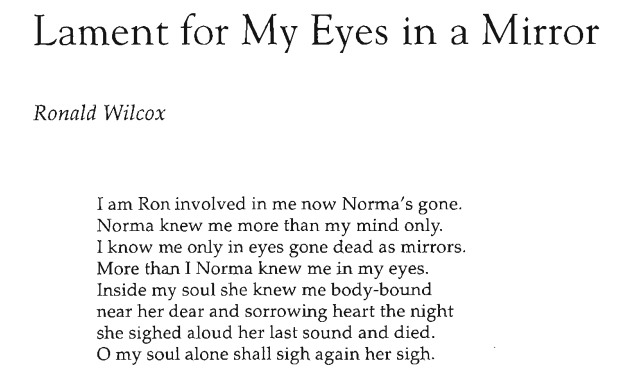
I am Ron involved in me now Norma’s gone.
Norma knew me more than my mind only.
I know me only in eyes gone dead as mirrors.
More than I Norma knew me in my eyes.

[1]Describing her research for The Proper Gods, a novel about the Yaqui Indians and their culture, Virginia Sorensen said her work had been “an excursion into cultural anthropology” that she thought would continue the rest…
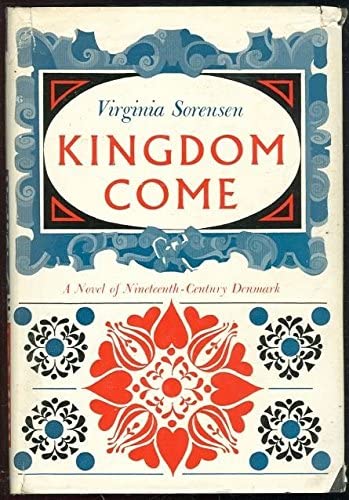
Much has been written about the heroines in Virginia Sorensen’s adult fiction, their real-life counterparts, and inspirations. By contrast, relatively little attention has been given to her male characters and the family figures on whom many were based. As a self-proclaimed family chronicler, Sorensen found in her male forbears, indeed all members of the Eggertsen family, a significant source of information and ideas for her fiction.
Many years ago Virginia Sorensen wrote me a prophetic letter. She had just read my article, “Through Immigrant Eyes: Utah History at the Grass Roots.” She sounded breathless: “For years and years/’ she wrote, “I have believed—for what reason, I wonder, since I never really lived in the houses where the true tradition was but could only visit a while, and listen, and pause always by the gate where I could hear and see it?—that I was the one to tell this story you speak of. Almost I have heard The Call!”
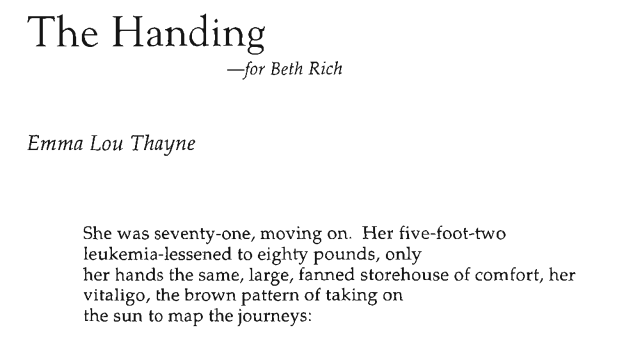
—for Beth Rich
She was seventy-one, moving on. Her five-foot-two
leukemia-lessened to eighty pounds, only
her hands the same, large, fanned storehouse of comfort, her
vitaligo, the brown pattern of taking on
the sun to map the journeys:
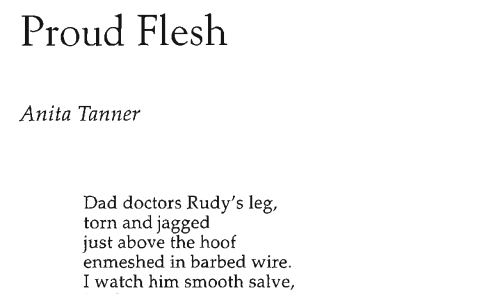
Dad doctors Rudy’s leg,
torn and jagged
just above the hoof
enmeshed in barbed wire.