

 Back to full Issue

Articles/Essays – Volume 59, No. 1
Heavenly Bodies: Mormon Male Homoerotics in the Sacred Art of Arnold Friberg
A tan, bare-chested man stands in the foreground to the right, half turned away from the viewer. His right foot is perched on a rock, causing his studded leather kilt to hike up, exposing a hairless and muscular thigh. His vascular arms and neck are taut, and in one leather-cuffed hand he holds a sword. He turns to look at an oncoming enemy. His sword creates a visual barrier to the flock he protects, and his light skin acts as a visual metaphor of righteousness in stark contrast to the darker skin and hairy body of his foe. This man is the embodiment of male virility and physical prowess, the protector of a nation in peril.
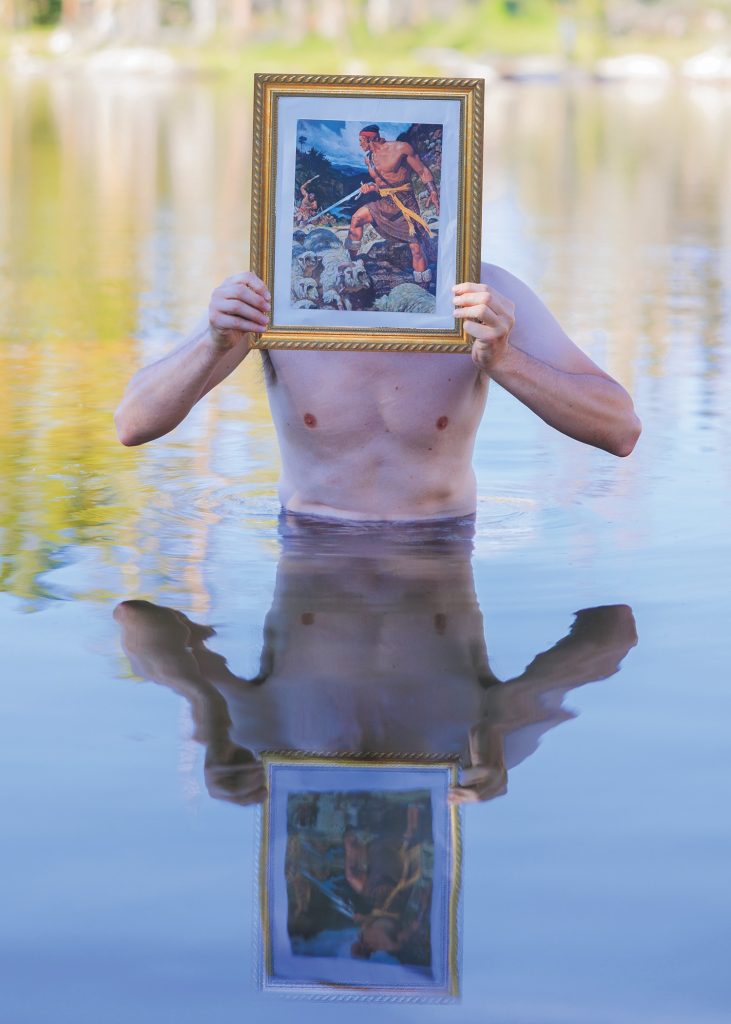
Figure 1. Beatta M Tuominen, The Reflection of a Man, 2025, photograph.
This striking tableau is one of many painted by Arnold Friberg depicting a scene from the Book of Mormon. Titled Ammon Defends the Flocks of King Lamoni (fig. 1), this 1952–1955 painting references a story about the hero Ammon from Alma 17. Friberg’s art has been widely utilized by the Church of Jesus Christ of Latter-day Saints for much of the twentieth and twenty-first centuries in devotional materials, official publications, and decorations for the walls of church buildings. His most frequent subjects are men in action; his religious paintings depict heroes from scripture while his patriotic paintings showcase Canadian Mounted Police and the Founding Fathers of America. But a Friberg man is always identifiable by his square jaw and broad shoulders atop slim hips. And despite the ancient Israelite origins of the characters in his Book of Mormon paintings, Friberg consistently whitewashes his subjects, depicting men who would be more at home in Venice Beach than Zarahemla.[1]
Friberg’s work gained prominence in the early to mid-twentieth century, during a transitional period in American culture, and the carved physiques of Friberg’s subjects highlight a fascination with the male form, celebrating hypermasculinity by exaggerating sexual difference: hard versus soft, active versus passive, and male versus female. Friberg created male figures who not only adhered to but superseded Western standards of male beauty and virility.[2] In her foundational work Epistemology of the Closet, Eve Kofsky Sedgwick deconstructs the strict binary of hetero and homo with regard to sex, gender, and sexuality. Not only, she asserts, are these categories shifting and unstable, but they exclude or marginalize the multitude of other ways in which homo- and hetero-eroticism and desire exist in the human experience. While homoeroticism can include sexual acts, it is reductive to think of it only in relation to sexual activity. Sedgwick argues: “It is a rather amazing fact that, of the very many dimensions along which the genital activity of one person can be differentiated from that of another (dimensions that include preference for certain acts, certain zones or sensations, certain physical types, a certain frequency, certain symbolic investments, certain relations of age or power, a certain species, a certain number of participants, etc. etc. etc.) precisely one, the gender of object choice, emerged from the turn of the [twentieth] century, and has remained, as the dimension denoted by the now-ubiquitous category of ‘sexual orientation.’”[3] It is not my intent to argue that the gender of object choice, as Sedgwick puts it, is unimportant, but rather to agree with Sedgwick that undue emphasis on creating homo and hetero binaries erases the multitudes of other categories of desire and erotic potential. While Friberg’s art is not explicitly sexual, it conveys explicit eroticism. Friberg’s paintings idealize the brawny male body, thereby evoking the fantasy and desire within an imagined male viewer that he too might achieve such masculine mightiness. This is a desire of sexual mirroring, a desire to be like rather than to have or possess. This form of homodesire is not based on a desire to have sex with the object of admiration necessarily; rather, it is a combination of admiration and attraction for an aspirational and idealized representation of masculinity. However, this does not make it less sexual, as the desire is intimately tied into a sexed and gendered male body. Friberg’s depictions of men are specifically homoerotic in their careful and loving detailing of the male body within that context. They are erotic in that they explicitly convey sex and desire, and in that they elicit desire in the viewer.
Making Muscular Men in America
Historians of Mormonism have often identified the period directly after then-prophet Wilford Woodruff declared an end to the practice of earthly plural marriage as an important era of transition.[4] This period of approximately thirty years, from 1890 to 1920, is a period of confusion and realignment wherein members of the Church of Jesus Christ of Latter-day Saints had to find new balances between mainstream acceptance and religious peculiarity. This era of transition, which sociologist Armand Mauss identifies as a period of (sometimes uneasy) assimilation, includes Utah Territory joining the Union in 1896 and broader Mormon participation in national politics. Mauss notes that while religious movements must occasionally shift course as a means of survival, this does not necessitate full assimilation to the dominant culture.[5] Instead, for cognitive consistency, believers will bring their ideals and values into line with their adjusted religious beliefs, finding ways to incorporate these adjustments through communal identity and history.
Religious studies scholars Amy Holt and Sara Patterson suggest that a key challenge for Church members in this era of transition was shifting understandings of marriage, family, and sexuality. How could one maintain gender peculiarity and difference outside of the practice of plural marriage? According to Hoyt and Patterson, other “peculiar” doctrines such as the dietary law known as the Word of Wisdom substituted for plural marriage, aligning Mormon masculinity with other perceived American ideals. “The new Mormon male,” they argue, “was fit, spiritually and physically, and ready to engage both the religious and secular worlds. His body represented the new Mormon image of an ideal American citizen—a prosperous economic being, a physically able and monogamous man, and a worthy member of the church.”[6] The “peculiar” sexuality of Mormon men in the late nineteenth century as it relates to plural marriage was, according to Hoyt and Patterson, a key factor for defining masculinity and gender for Mormon men. That demonstration of sexuality was integral to their self-understanding of their gender and how they presented as masculine to the world. Removing that practice then caused a reevaluation of gender and what it meant to be male and Mormon when one had to be monogamous.
In many ways the Mormon struggle with gendered identity mirrored broader American trends of the time. In the late nineteenth and early twentieth centuries, American society underwent rapid changes due in part to shifts associated with industrialization and westward expansion and imperialism. These seismic societal changes created aftershocks that were felt throughout American culture, and they forced a reexamination of seemingly inherent traits and values. Protestant Christian religious leaders in America implemented efforts to shore up religious and cultural identities against these shifting norms, particularly with regard to gender. Rapid industrialization caused large-scale migration to cities, changing the structure of both work and family life. The mythic figures of the American pioneer and cowboy, representing a more rugged, masculine ideal, seemed in danger of going extinct. The muscular Christianity movement emerged, according to Hoyt and Patterson, as “an antidote to the perceived sissification of America’s men.”[7]
One must question how a trait such as gender, which is perceived by these groups to be natural and innate, can simultaneously come under such an existential threat. The answer to this question is debatable. On the one hand, muscular Christianity emerged as a movement that sought to bring men back to church (at a time when male attendance at Protestant Christian services was on the decline) while also reasserting so-called masculine ideals such as strength and athleticism, political involvement, logical thinking, and economic success.[8] As historian Richard Kimball explains in his work on sports history and muscular Mormonism, “Historians debate whether an actual ‘masculinity crisis’ existed, but there is evidence that many Americans perceived a problem and responded by creating a masculinization programme that would reinstate manliness in an effort to maintain traditional male superiority.”[9] The muscular Mormon movement, as a cousin to muscular Christianity, reacts to the public ridicule of Mormon men immediately before and after the 1890 manifesto ending the practice of plural marriage by pivoting from peculiarity to all-American brawn.
This perceived crisis in masculinity and the Mormon era of transition also aligned with the emergence and availability of new media such as comic books and film, which offered new models of masculinity for public consumption. The introduction in the 1920s and 1930s of (sometimes literally) larger-than-life comic strip heroes such Buck Rogers, Flash Gordon, and Superman began a new visual shorthand for constructing American masculinity. Historian of popular culture Jeffrey Brown explains: “Classical comic book depictions of masculinity are perhaps the quintessential expression of our cultural beliefs about what it means to be a man. . . . One of the most obvious and central focal points for characterizing masculinity has been the male body. As an external signifier of masculinity, the body has come to represent all the conventions traditionally linked to assumptions of male superiority.”[10] The body provides the inscribable surface onto which society can write gendered norms, and these new action heroes provided a template for such cultural inscriptions of masculinity.
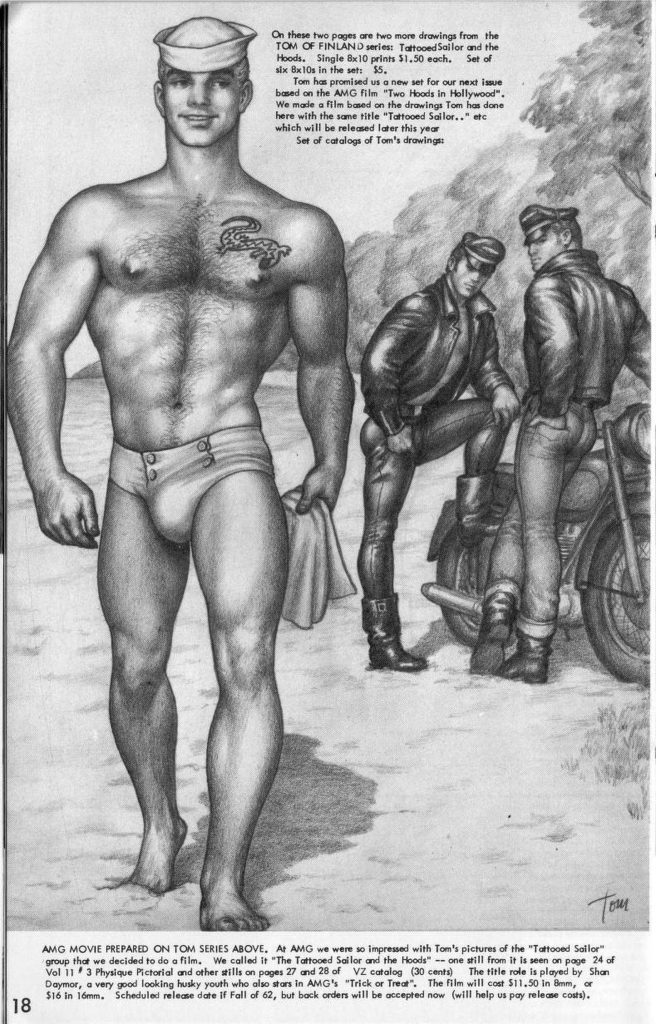
Figure 2. Tom of Finland, drawing from his Tattooed Sailor and the Hoods series. This image first appeared in the men’s magazine Physique Pictorial 12, No. 1 (July 1962).
In short, Friberg was not alone in his ideological construction of masculinity. Friberg’s contemporary, Finnish artist Touko Valio Laaksonen, who published his work under the pseudonym Tom of Finland, created art featuring similarly outsized hypermasculine subjects. Unlike Friberg, Tom of Finland’s art was explicitly sexual, depicting men with exaggerated bulges and outsized muscles (see fig. 2). However, his work shares many ideological points with Friberg’s. Both Friberg and Tom of Finland are engaged in acts of ideological gender construction that seem, at first glance, to be rebelling against normative or mainstream culture from the position of an outsider (Friberg as a Mormon and Tom of Finland as a gay man). But under closer examination one can see in both of their work a devotion to upholding hegemonic cultural ideals of masculinity. Hunter Scott presents an intriguing critique—not of Tom of Finland’s work, necessarily, but rather how it is culturally situated and understood within homonormative dialogue.[11] Scott explains: “Although it is true that Tom’s ‘dirty drawings’ may invoke subversive meanings, their subversions do not prevent the same images from recycling oppressive discourses. . . . Undoubtedly, Tom queered masculinity. He forged a new aspirational identity and a set of visual codes for gay men that challenged conventional understandings of homosexuality as effeminate by embracing hypermasculinity while simultaneously denying masculinity’s full hegemonic implications. In doing so, however, Tom continued a fascist legacy of idealizing a masculinity understood to be white.”[12] Like Friberg, Tom of Finland used art to construct desirable and idealized men who, in their abundance of brawn and secondary sexual characteristics, upheld hegemonic standards of beauty and health.
Norman Rockwell’s illustrations for magazines like the Saturday Evening Post throughout the early and mid-twentieth century have become iconic idealized representations of American culture and society. Unlike Friberg’s, Rockwell’s commercial work has maintained its mainstream popularity, although it is no less ideologically driven. His work from the 1910s through the 1950s depicts an America that is almost exclusively white and middle-class.[13] Rockwell is similarly concerned with sissification. A recurring theme in his work is the “fop” or “sissy” contrasted with the “real boy.” Eric J. Segal, in his analysis of Norman Rockwell and masculinity, explains that “the sissy, then, can be understood as a stigmatizing term, explicitly coercing conformity to normative masculine identities in terms of nationhood, middle-class unity, and gender. . . . The sissy is a denigrated figure repeatedly deployed to differentiate the proper and acceptable from the degenerate and repulsive.”[14] Rockwell’s first Saturday Evening Post cover, Boy With Carriage from 1916 (fig. 3), highlights this dichotomy, contrasting a well-dressed young man in a suit (complete with a bowler hat, gloves, and a baby bottle in his front breast pocket) pushing a baby carriage as he is mocked by two rougher boys wearing baseball uniforms. It is a study in contrasts: The two baseball players are funny, lively, and arranged in comradeship together against the “sissy,” who is sour-faced and burdened with childcare, a distinctly less masculine-coded activity than baseball.[15] Rockwell’s work throughout this period, particularly his illustrations for the Boy Scouts of America, illuminate the same concerns that animate the muscular Christian and Mormon movements.
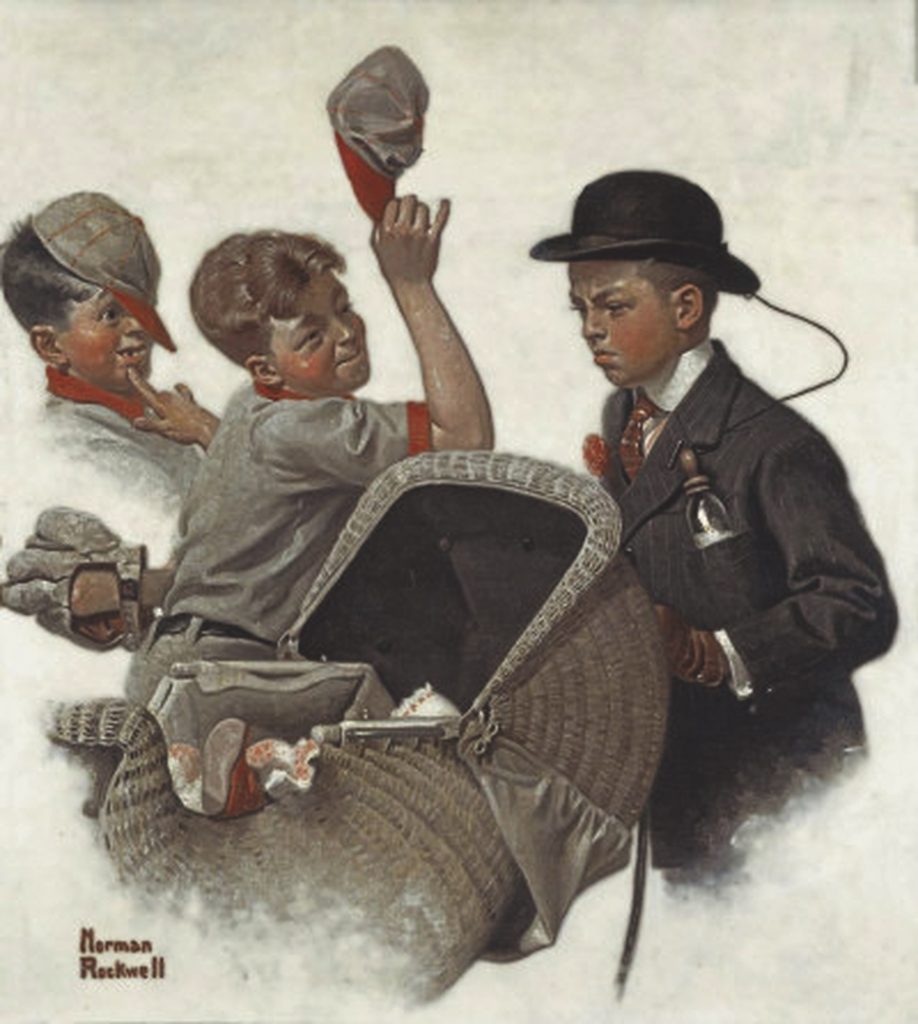
Figure 3. Norman Rockwell, Boy with Baby Carriage, 1916, oil on canvas.
During this mid-century period of fascination with the masculine form, the Church of Jesus Christ of Latter-day Saints was in the midst of its decades-long quest to assimilate into mainstream American culture, and Arnold Friberg’s men resemble the heartthrobs of mid-century Hollywood. Rock Hudson would not be out of place in Friberg’s studio. Taylor Petrey, utilizing the tools of queer theory to analyze sexuality and gender in modern Mormonism, makes the case that “in modern Mormonism, gender is a fluid concept that must be secured and produced with strong ecclesiastical, legal, and cultural norms. In Mormon evaluation, gender is perpetually liminal, never being finally accomplished.”[16] Despite Church claims to the contrary, he argues that gender is not now, and has throughout church history never been, a stable locus of identity. Rather, it has always been understood as constructed or at the very least constructable. With this understanding of Mormonism and gender, one can interpret Friberg’s art, particularly that commissioned by the Church for official use, as taking part in that construction.
Theorizing the Buff Body
The art of Arnold Friberg has been used by the Church of Jesus Christ of Latter-day Saints to craft an idealized muscular Mormon man that draws on the discourse surrounding muscular Christianity. Friberg’s men are painted from a male gaze, reflecting the artist’s understanding of male power as he writes it upon the bodies of his figures. As Noel Carmack notes in his study of twentieth-century Latter-day Saint depictions of Jesus Christ, “Religious images serve as a tangible manifestation and affirmation of doctrine.”[17] Sacred and devotional art turn the invisible of religious devotion and doctrine into material reality, reflecting both the theological and cultural ideals of a religious community.
Building on this concept and the foundational work of Judith Butler, philosopher and feminist theorist Elizabeth Grosz argues that there is no “real” or authentic body that exists outside of cultural inscriptions, that there is no interiority or exteriority but rather a Möbius strip of inscribable surface, constantly orienting to new inputs.[18] If, as Grosz asserts, it is only through experiencing what the other is experiencing that we begin to develop a sense of self and that there is no body or self that exists outside of cultural (and, for those who are members of a religious community, doctrinal) inscription, then sacred or devotional art not only reflects the mores of a religious community but also acts as a chisel through which norms and ideals are inscribed upon the individual.[19] However, if the self is not chambered, is not separable into material and immaterial but is instead a cohesive whole, a constantly reorienting inscribable surface, then Friberg’s mythmaking does not reflect a truth about the Mormon self but instead creates a new orientation for the individual and collective self of twentieth-century Mormonism. Our bodies are constantly moving and reorienting, and “a single movement reorients the whole of the body” creating posturing and bodily style.[20] Since the body is almost always in constant motion, receiving and processing cultural inscriptions (such as those modeled by Friberg’s art) illuminate the processes by which we understand our selves: outside to inside, incorporating kinetic, postural, tactile, and visual sensations. These understandings of the self, and the nonstatic orientation of the self, provide a blow to the accepted narrative of distinct spheres and mind-body duality tacitly endorsed by Friberg.
In speaking about his own work, Arnold Friberg acknowledged the generative nature of art, that it was intended to do something for and to the viewer, that “his large muscular characters are intended to physically portray the inward greatness of the men he depicts.”[21] Friberg asserts that he was reading his subjects from the inside out, materializing spiritual greatness onto magnificent bodies. “When I paint Nephi [one of the major heroic figures in the Book of Mormon],” he said, “I’m painting the interior, the greatness, the largeness of spirit. Who knows what he looked like? I’m painting a man who looks like he could actually do what Nephi did.”[22] In this way, Friberg is ostensibly invested in a doctrine of mind-body dualism in which the self is separable into chambers or elements, the spirit (or mind) and body occupying the same space but not fully married. As such he imagined that he was depicting greatness of spirit manifested through an idealized physical form.
Friberg cannot imagine a spiritually heroic figure that is not a virile, muscular man. As Julie Allen points out, even when Friberg’s paintings include female figures, “these women are visually as blandly nondescript as their textual equivalents. It is the men, large of stature and taut with righteous purpose, who dominate both Friberg’s canvases and the scriptural stories they bring to life.”[23] If, as Friberg asserted above, his depictions of men were meant to portray their greatness and power of spirit, what can we then interpret about his disinterest in similar depictions of women? Friberg’s choice here must be deliberate, as it is reflected across his sacred and secular art.
We can place Friberg in a long line of religious illustrators and historical revisionists who color backward, papering over the historical record and bypassing veracity in favor of potent cultural signifiers.[24] His work is constructive, creating titanic simulacra that can bear the weight of reading gendered norms backward into sacred narratives. Biologist and feminist theorist Anne Fausto-Sterling argues that scientific fields that consider themselves to be objective and without cultural bias have used their status as legitimate sources of knowledge to naturalize binary sex and gender, thus making this theory unimpeachable and firmly shutting out any alternatives. In this way, they are engaged in acts of constitution and creation, constructing bodies to fit the social definitions of sex and gender. Fausto-Sterling rejects the false dichotomy that sex and nature are “real” and gender and culture are “constructed,” instead arguing that all cultural knowledges are masquerading as prediscursive and natural, ignoring the fact that gendering and labeling the body is always a social decision.[25] There is not, and cannot be, a-cultural knowledge of the body. In fact, scientific investigation must involve knowledge construction, and all knowledge construction happens within a particular cultural context. Friberg models this process of performing the cultural on the body, looking in and on the body to find gender and where it comes from. When he first began painting for the LDS Church, he envisioned doing a series on Joseph Smith, saying, “How I could bring that guy to life! Through strong pictures, I could build Joseph into an American hero.”[26] While this series did not materialize, he brought that same constructive vision to his other work.
Friberg’s Westernized interpretation of virtuous masculinity is apparent in moving Mormon men from abject other to normative ideal. Elizabeth Ruchti argued that the persistence of anti-Mormon sentiment throughout the nineteenth and twentieth centuries prompted Church members to become “obsessed with their image, wanting desperately to avoid accusations that they are merely a ‘cult’ and not a ‘real religion.’”[27] This image consciousness helps to create what I have elsewhere called the cellophane identity of Mormons in America: visible to the world but still separate and impermeable, sealed away, in but not of.[28] This insight into Mormon public identity helps us to understand why Friberg’s art gained such popularity. Not only do faithful Mormon men have divine authority through the restored priesthood, but the theologically constructed Mormon body is also perfectible, capable of ascension and exaltation within the plan of salvation. Mary Campbell explains, “Friberg’s work channels the potent amalgam of male spirituality and (hetero)sexuality that necessarily runs through a religion that promises an eternity of polygynous godhood to men who live by its standards in the here and now.”[29] The promise of eternal virility is written on the skin of Friberg’s heroes, so much so that he was hired by Cecil B. DeMille to design costumes for The Ten Commandments.[30] As Campell notes, masculinity (and femininity) are, within Latter-day Saint theology, eternal and immutable characteristics. An endowed member of the church will continue in a gendered and sexed body, which raises the stakes for creating a proper or correct (by the standards of the church) body.
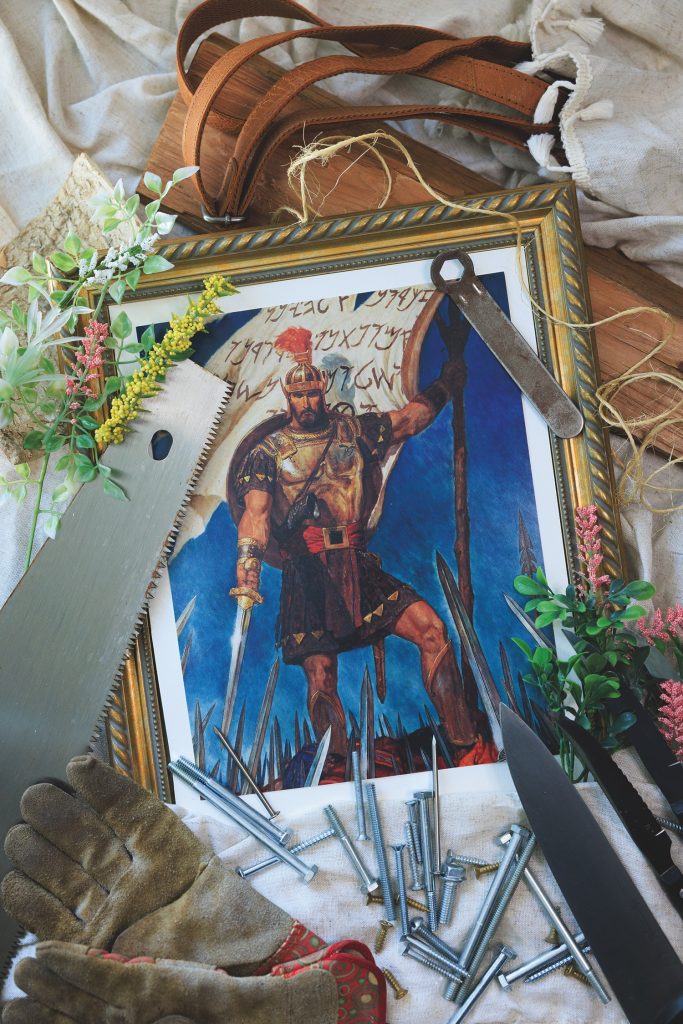
Figure 4. Beatta M Tuominen, The Suggestion of a Man, 2025, photograph.
One of Friberg’s best-known works is Captain Moroni Raises the Title of Liberty, sometimes called Captain Moroni and the Title of Liberty, painted between 1952 and 1955 (fig. 4). It depicts a scene from the book of Alma, a key figure in the Book of Mormon. As described in Alma 46:12, “And it came to pass that he rent his coat; and he took a piece thereof, and wrote upon it—In memory of our God, our religion, and freedom, and our peace, our wives, and our children—and he fastened it upon the end of a pole.” Moroni in Friberg’s painting holds the staff of the banner in one hand; in his other hand is a sword, pointing away and down toward disembodied soldiers, depicted only by their weapons. Moroni’s stance is in many ways a mirror to Ammon’s, one leg cocked and resting on what is, presumably, though it is not clear in the image, a pile of the rent clothing of his followers, as described in Alma 46.[31] Like Ammon, his body glistens, tanned, muscular, and hairless thighs displayed by his open stance. What is, presumably, the sheath for his naked sword dangles suggestively between his legs, in shadow behind his costume. In this painting we can see the reflection of Friberg’s work with DeMille in Moroni’s Romanesque armor and tunic. If we were to interpret Friberg’s work through a Foucauldian lens of social construction, we might say that history, and artists, produce bodies and then tell us how to interpret them. Or, as Grosz puts it, “Bodies are fictionalized, that is, positioned by various cultural narratives and discourses, which are themselves embodiments of culturally established canons, norms, and representative forms, so that they can be seen as living narratives, narratives not always or even usually transparent to themselves.”[32]
Friberg’s vision of glistening masculinity marked a departure from cultural depictions of Mormon men in the nineteenth century by embracing, at least implicitly, the ideals of the muscular Christianity movement. One must at this point raise a question: If, as the 1995 “The Family: A Proclamation to the World” asserts, “gender is an essential characteristic of individual premortal, mortal, and eternal identity and purpose,” how can an essential characteristic, intrinsic in not just this life but the ones before and after, come under such threat? If gender, and masculinity in particular, is in fact divinely instituted, natural, and essential, how can it be so easily lost? Once again, we should look to Grosz to understand this unique form of queered panic. As she explains it, sexed bodies become the deployment of sexuality, the object of knowledges and normalizations.[33] Cultural inscriptions (makeup, hairstyle, dieting, bodybuilding, etc.) mark the body as amenable to whatever the prevailing exigency of power is. They make the body into particular established types: primitive, capitalist, American, goth, preppy, and so forth. And this is not simply a matter of bodily adornment. Even naked bodies are marked by these cultural signifiers/inscriptions. Whether it is weight, scars, disciplinary history, posture, tan, all mark the body as malleable and inscribable. There is no “natural body.” Many of these inscriptions are voluntary; they are what Foucault calls “techniques of self-production.”[34] For Mormon men looking to reestablish a masculine identity into the twentieth century, these techniques of self-production—which were influenced by muscular Christianity and popular media—were as a result both homophilic, demonstrating a marked preference for the same gender and same gender depictions, but also homoerotic, creating and imbuing admiration and desire (cultural and social desire, if not necessarily sexual desire).
But, Jesus is a MAN
A similar cultural rebranding was underway for another iconic man: Jesus Christ. Within muscular discourse, popular depictions of Jesus caused significant consternation. As Richard Kimball so succinctly put it, “Jesus maintained his humility and piety, but he also worked out.”[35] Within muscular Christianity and muscular Mormonism, men are both victims under threat of extinction and also dashing religious heroes. Women are alternatively too powerful (and thus unwomanly) or misguided and confused, in need of correction and redirection. The art produced in this era likewise reflects these anxieties and ideals. It is instructive, meant as example and aspiration for the male viewer. In a 1904 article for the LDS youth magazine Juvenile Instructor, George Reynolds, more famous for his eponymous Supreme Court case, decried the way that most artists depicted Jesus as a “somewhat effeminate and sentimental young man with long flowing locks, a weakling in body and with few traces on his face of the strength of character within. All this is wrong, Christ was not red-haired, nor effeminate, neither was he a dyspeptic, nor a dreamy sentimentalist; the Being who drove the money changers out of the Temple was no weakling. He would be a vigorous, deep chested, broad shouldered man, with well-cut features and above the medium height, with his bodily energies developed through a life of youthful labor in Joseph’s carpenter shop at Nazareth.”[36] Once again, we note the lingering descriptions of manhood. The emphasis on strength and size. A truly virtuous man, be he prophet or savior, must be virile. Reynold’s desire for a depiction of Jesus as brawny and masculine is not meant to appeal to the female gaze, but is instead written aspirationally for men, providing both role model and homophilic/erotic ideal.
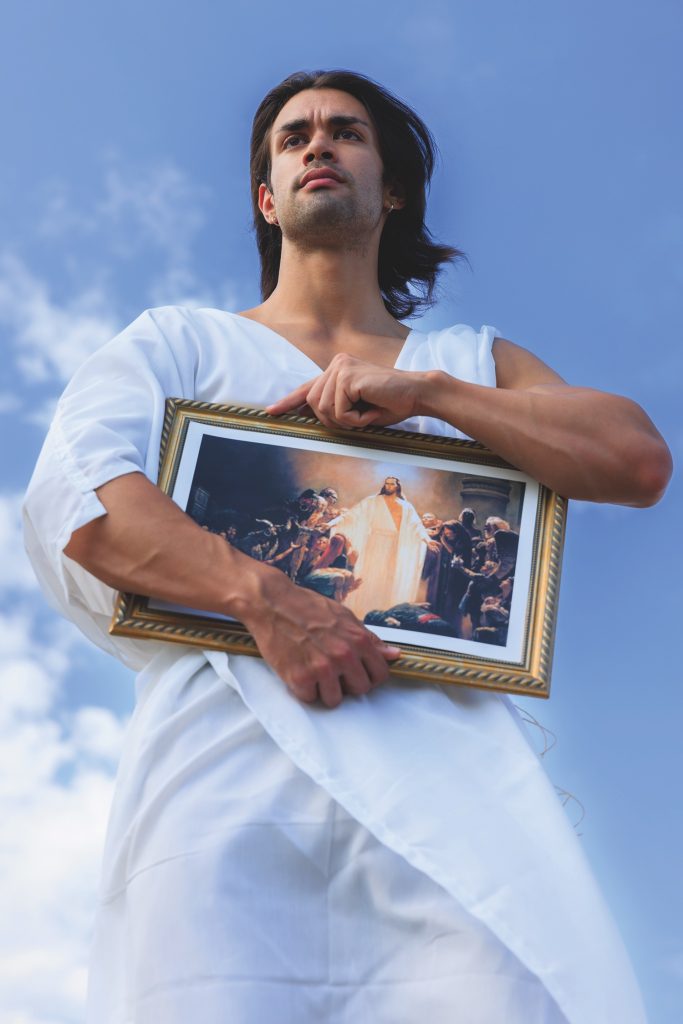
Figure 5: Beatta M Tuominen, The Idealization of a Man, 2025, photograph.
Between 1952 and 1955, Friberg completed a Book of Mormon painting that presented his interpretation of a resurrected Jesus appearing to the Nephites. He initially called the piece Christ Appearing to the Nephites, but later he retitled it The Risen Lord (fig. 5). Speaking of the painting, Friberg said, “Jesus is neither a weakling nor a victim, but a commanding presence; one look at His eyes and men sacrificed everything to follow Him.”[37] Once again we see the emphasis on male appeal and companionship, as well as on the male gaze. Friberg is painting to make manifest the virtuous ideal, which he can only imagine through larger-than-life muscularity. In Volatile Bodies, Grosz questions traditional understandings of corporeality, materiality, and sexuality. To do so she must address, and deconstruct, the work of psychoanalytic theorists like Jacques Lacan and Sigmund Freud, who have shaped Western understandings of the body. Her analysis of those two men is particularly helpful for understanding how the homophilic and homoerotic ideal of masculinity gains such prominence. Both psychoanalysts articulate a theory of identity formation that necessitates an other, particularly a female other (because the key subject is most commonly assumed and understood to be male). Femininity is defined by its lack, whether of the phallus or some other intrinsic quality, and can only serve as a distorted mirror through which the male subject can learn, identify, and create their body.[38]
With this understanding, it becomes much easier to understand why these male homophilic and homoerotic representations gain such prominence. If nobility, leadership, and spiritual greatness is being manifested outward on the body, and women are, in this worldview, lacking in necessities, the male form must gain ascendancy in an idealized form. In interpreting Friberg’s work and the place of prominence that it has held in Church publications, can we ignore its overt homosocial, homophilic, and homoerotic implications? What does it mean for a family-oriented church to center this unwittingly subversive form of homo-masculinity? Friberg’s men are larger than life, larger than what is realistic or possible for the vast majority of men. They are bulging with possibility, bursting with potential energy. The male-centered focus of muscular Mormonism excises femininity, paying only the briefest attention to women’s presence, instead centering a male gaze that lingers on bronze, sculpted thighs and steely eyes. In creating these titans, men who would not be out of place in Men’s Health magazine, does Friberg unwittingly open up room for queering the Mormon male experience? Perhaps the outsider experience of Mormon men in the era of transition, characterized by fears of emasculation or unmanliness, overcorrects away from one form of perceived sexual deviance (polygamy) and in overcorrecting, creates queered space for homoerotic and homophilic imagining.
[1] In this instance, “whitewash” is being used both in its traditional colloquial meaning—to cover over any real or perceived imperfections—but also to point out that Friberg often depicts his protagonists as fairer skinned or white-coded.
[2] See Edisol Dotson, Behold the Man: The Hype and Selling of Male Beauty in Media and Culture (Routledge, 2021) for a more in-depth analysis of the development of male beauty standards in Western art and culture.
[3] Eve Kosofsky Sedgwick, Epistemology of the Closet (University of California Press, 1990), 8.
[4] Amy Hoyt and Sara Patterson, “Mormon Masculinity: Changing Gender Expectations in the Era of Transition from Polygamy to Monogamy, 1890–1920,” Gender & History 23, no.1 (2011): 72.
[5] Armand L. Mauss, The Angel and the Beehive: The Mormon Struggle with Assimilation (University of Illinois Press, 1994), 8.
[6] Hoyt and Patterson, “Mormon Masculinity,” 73.
[7] Hoyt and Patterson, “Mormon Masculinity,” 77. Hoyt and Patterson use the term “sissification” here to describe the fears of many Protestant Christian leaders of the time that the Christian denominations generally, and men particularly, had become overly feminized. See the section below on Norman Rockwell for a further discussion of the trope of the sissy.
[8] Hoyt and Patterson, “Mormon Masculinity,” 77.
[9] Richard Kimball, “Muscular Mormonism,” International Journal of the History of Sport 25, no. 5 (2008): 551.
[10] Jeffrey A. Brown, “Comic Book Masculinity and the New Black Superhero,” African American Review 33, no. 1 (1999): 26.
[11] “Homonormative” is a term popularized by Lisa Duggan in the early twenty-first century. It refers to the phenomenon of heteronormative ideals being adopted or grafted onto queer culture and identity, often as it gains cultural visibility. See Lisa Duggan, “The New Homonormativity: The Sexual Politics of Neoliberalism” in Materializing Democracy: Toward a Revitalized Cultural Politics, ed. Russ Castronovo and Dana Nelson (Duke University Press, 2002), 175–94
[12] Hunter Scott, “Facing Sameness: Reconsidering the Radicality of Tom of Finland,” InVisible Culture, no. 36 (2024): 1–20.
[13] Eric J. Segal, “Norman Rockwell and the Fashioning of American Masculinity,” The Art Bulletin 78, no. 4 (1996): 635.
[14] Segal, “Norman Rockwell,” 640.\
[15] Segal, “Norman Rockwell,” 634.
[16] Taylor G. Petrey, Tabernacles of Clay: Sexuality and Gender in Modern Mormonism (University of North Carolina Press, 2020), 15.
[17] Noel A. Carmack, “Images of Christ in Latter-day Saint Visual Culture, 1900–1999,” BYU Studies Quarterly 39, no. 3 (2000): 19.
[18] Elizabeth Grosz, Volatile Bodies: Toward a Corporeal Feminism (Indiana University Press, 1994), 116.
[19] Grosz, Volatile Bodies, 74.
[20] Grosz, Volatile Bodies, 84.
[21] Carmack,” Images of Christ,” 40.
[22] Steve Osborn, “A Master’s Touch,” This People 5 (1984): 51.
[23] Julie K. Allen, “Mormonism, Gender, and Art in Nineteenth-Century Scandinavia,” in The Routledge Handbook of Mormonism and Gender, ed. Taylor Petrey and Amy Hoyt (Routledge, 2020), 115.
[24] One can look at a painting such as Jacques-Louis David’s Napoleon Crossing the Alps (1805) to see an historical example of this type of masculine mythmaking.
[25] Anne Fausto-Sterling, Sexing the Body: Gender Politics and the Construction of Sexuality (Basic Books, 2000) 3.
[26] Robert T. Barrett and Susan Easton Black, “Setting a Standard in LDS Art: Four Illustrators of the Mid-Twentieth Century,” BYU Studies Quarterly 44, no. 2 (2005): 9.
[27] Elizabeth Ruchti, “The Performance of Normativity: Mormons and the Construction of an American Masculinity,” Journal of Men, Masculinities and Spirituality 1, no. 2 (2007): 138.
[28] See Kate Davis, “Technologies of the Selfie: Mormon Influencers and the Performance of Gender Online,” Mormon Studies Review 12 (2025): 35–45.
[29] Mary Campbell, “Mormonism, Gender, and Art,” in Petrey and Hoyt, Routledge Handbook of Mormonism and Gender, 251.
[30] Campbell, “Mormonism, Gender, and Art,” 251.
[31] Alma 46:22. “Now this was the covenant which they made, and they cast their garments at the feet of Moroni, saying: We covenant with our God, that we shall be destroyed, even as our brethren in the land northward, if we shall fall into transgression; yea, he may cast us at the feet of our enemies, even as we have cast our garments at thy feet to be trodden under foot, if we shall fall into transgression.”
[32] Grosz, Volatile Bodies, 118.
[33] Grosz, Volatile Bodies, 154.
[34] Grosz, Volatile Bodies, 143.
[35] Kimball, “Muscular Mormonism,” 555.
[36] George Reynolds, “The Personal Appearance of the Savior,” Juvenile Instructor, August 15, 1904, 498–99. George Reynolds was the defendant in a pivotal US Supreme Court case, Reynolds v. United States, challenging anti-polygamy and anti-bigamy laws on the basis of a First Amendment right to freely practice one’s religion. The 1878 case, which was decided against Reynolds, has had a lasting impact on legal protections (or curtailment) for religious freedom in the United States. For more information, see James L. Clayton, “The Supreme Court, Polygamy, and the Enforcement of Morals in Nineteenth Century America: An Analysis of Reynolds v. United States,” Dialogue: A Journal of Mormon Thought 12, no. 4 (1979): 46–61.
[37] Ted Schwarz, Arnold Friberg: The Passion of a Modern Master (Northland, 1985), 142. This painting and quote are discussed in Carmack, “Images of Christ,” 41.
[38] Grosz elaborates on these points of similarity and departure from Lacan and Freud in “Body Images: Neurophysiology and Corporeal Mappings,” chapter 3 of Volatile Bodies.