

 Back to full Issue

Articles/Essays – Volume 59, No. 1
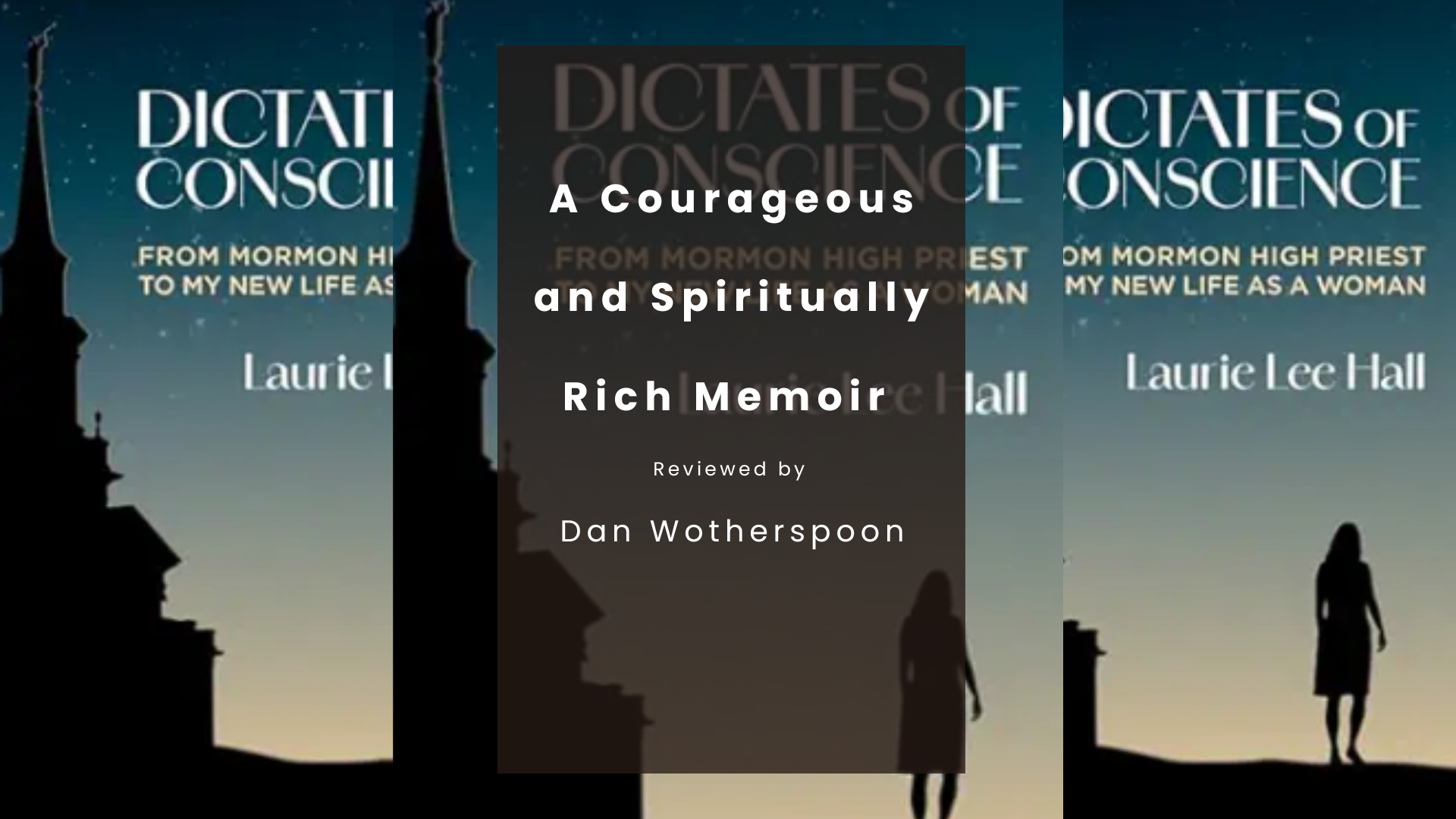
A Courageous and Spiritually Rich Memoir | Laurie Lee Hall, Dictates of Conscience: From Mormon High Priest to My New Life as a Woman
In Dictates of Conscience, Laurie Lee Hall offers us a searingly honest, spiritually rich, and beautifully written memoir. She allows us deep access to her head, heart, emotions, as well as her testimony of Jesus Christ and the Restoration. I know that anyone who reads it will come away with not only a much better understanding of what it means to be transgender but also increased compassion for those who experience gender dysphoria. I know I was profoundly moved by her journey from a high-ranking and quite visible LDS Church employee and leader to her ultimate acceptance of herself as transgender.
Hall’s transformation—spiritual, social, emotional, and physical—is clearly the through line of the memoir, but her narrative is much more than that. It’s also a chronicle of grace, personal revelation, confusion, and great accomplishment.
The book begins with Hall’s early life—her birth with hypospadias, a difference in sexual development (DSD), and her early sense that she was different, even though she lacked the language to describe it. These opening chapters help us understand the deep-rootedness of her identity. She shares poignant memories, such as being taught to pee while standing and feeling instinctively that something was wrong. One tender moment stands out: when, as a child insisting to her mother that she was really a girl, her mother replied that if she had been born a girl, they were planning to name her Laurie Lee. This name stayed with her for the rest of her life, as she felt inside that she was indeed Laurie Lee.
Still, this book is not a childhood memoir. It quickly moves into more public, adult phases of her life: her training to be an architect, her conversion to the Church after receiving a Book of Mormon from a fellow student, her mission to Buenos Aires, and eventually her marriage to Marleen and the start of their family. Through it all, she was continuing to refine three remarkable gifts that had manifested quite early in her life—artistic, mathematical, and leadership.
Moving forward in her narrative, she writes what I consider to be one of the most important lines in the book. After having been befriended by LDS men who modeled what it meant to be a “father, servant, and leader,” she reflected: “Because of the church, I no longer had to worry about how to find my place in a man’s world” (82). Mormonism had given her a clear script for how to walk through life as a male.
Hall writes movingly of moments when her female identity surfaced powerfully, particularly in the context of parenting. Upon the birth of one of their daughters, Liz, she recalls: “Holding her and cuddling was fulfilling. I imagined being able to breastfeed and bond with her as her mother did. . . . For the first time, my female self felt deeply maternal, and I wanted to express that part of my identity” (101). These are among the memoir’s most emotionally powerful passages, where gender identity and spiritual yearning intertwine.
As family, professional, and church pressures mounted, she began secretly to dress in her wife’s clothes as a stress release. Eventually, the tension between her public persona and her internal truth became unbearable. In 1996—already a high priest group leader and a successful young architect—she became overwhelmed by the conflicts between her external and internal life. She broke down, crying out, “I cannot do male anymore!” In her distress, she briefly considered ending her own life (107). The cost of performance at that moment had become too much.
After practicing architecture for ten years in New York, the Hall family moved to Utah. Hall began working for the Church, first in the welfare department, then the meetinghouse facilities division, and finally the temples division, where she had always secretly hoped to serve.
Meanwhile, she served as bishop and then stake president. While she served as stake president, the Church began to pressure members and leaders to give money in support of Proposition 8, California’s 2008 attempt to define marriage as unions between one man and one woman. She had to sit through many meetings in which she and other church leaders were instructed to challenge those within their stewardship to support the proposition. Hall then and there determined, “I will never utter one word about Prop 8 to anyone in my stake, to my counselors, or even to my wife. I would not stain our stake’s pulpit with this venom. And I never did” (146). That moral clarity—and her refusal to allow Church politics to poison the ward communities under her stewardship—deeply impressed me.
The story of Hall’s coming out as transgender to family, friends, and others, along with her departure from Church employment, take more than seventy pages to tell. These chapters are illuminating and at times excruciating. She speaks of the attitudes of various general authority leaders she interacted with during this time, coming to know both support from and consternation by them. After deciding that she needed to live full-time as a woman, she was excommunicated from the Church by a stake president she had recommended for the position, as well as by many she had called and set apart for their high council callings. One result of this decision was to effectively end her Church career as she needed to have a current temple recommend to remain employed. I can’t do justice to the complicated story of her employment after she let people know she was transitioning to living full time as a woman. I’m quite angry about much of it.
Still, Hall’s tone throughout remains gracious and generous. She writes kindly of her ex-wife who supported her throughout her coming out processes but who eventually chose to end their marriage, and she joyfully shares the story of meeting and falling in love with her new partner, Nancy Beaman. It’s a beautiful story of connection, support, and well-deserved happiness. I love that she has found that.
Dictates of Conscience is a beautifully designed book, printed on high-quality paper and has a wonderful dust jacket. It also contains a fair number of photos from Hall’s life. I was a bit disappointed by some of the early photos presented. The ones in the book certainly reveal their age, but I would have appreciated an attempt, at least, to use today’s tools for enhancing images.
Hall’s voice in this book matches the woman I have come to know and love. We have shared loving and good conversations, several of which are recorded as podcast episodes from my time hosting Mormon Matters and now Latter-day Faith. The woman in these pages is the same one I’ve spoken with: beautiful, kind, gracious, compassionate, and very spiritual.
For those who navigate complex relationships between personal revelation and institutional loyalty, this memoir offers a powerful witness. Hall’s journey is not one of rebellion, but of determination to follow the Spirit and the dictates of her conscience. Her story has moved and uplifted me. I cannot recommend this book highly enough.
Laurie Lee Hall. Dictates of Conscience: From Mormon High Priest to My New Life as a Woman. Salt Lake City: Signature Books, 2024. 350 pp. Hardcover: $34.95. ISBN: 978-1-56085-479-1.