

 Back to full Issue

Articles/Essays – Volume 59, No. 02
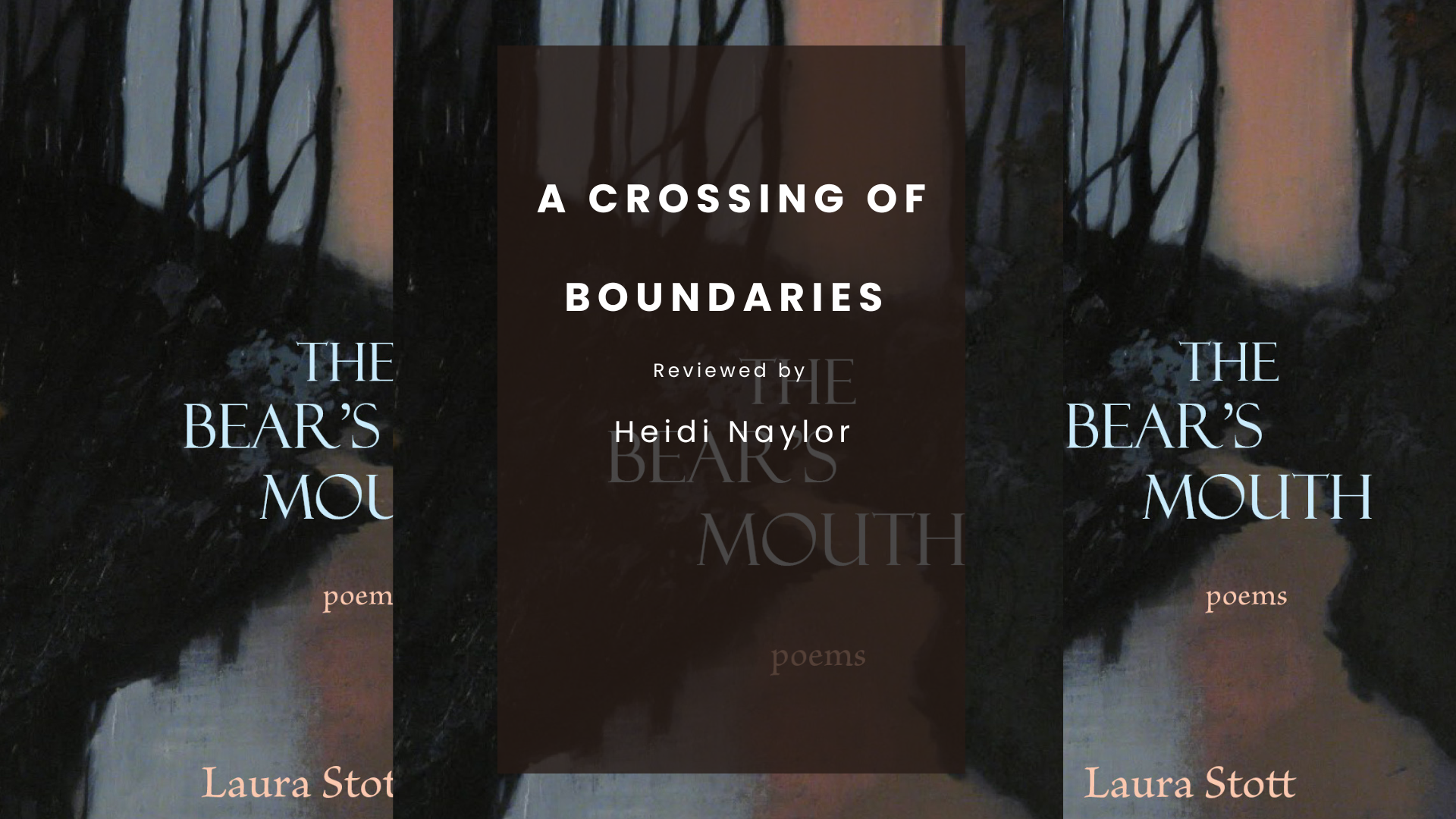
A Crossing of Boundaries | Laura Stott, The Bear’s Mouth
The first poem will break your heart. It’s the shakedown start of a pilgrimage into loss and beauty that speaks in tough, physical language of the collecting—the “plucking”—of “an abandoned nest / from a red dogwood’s spindly arms” during a mother and child hike through a “slim canyon.” The family has recently lost a daughter and sister. Here, the poem sets up the narrative of The Bear’s Mouth: how to inhabit a world that is immediate in brutality and tenacious in wonder. The trick, it seems, is to find a “guide [that] shows us how to do it” (11).
Laura Stott is that tender, insistent escort.
A myth about a little girl leaving her parents and her two sisters to cross a meadow becomes a metaphor of longing for this sweet baby daughter. She falls inside a glacier . . . she runs through woods into a wild meadow . . . she crawls inside the feral bear that guards the underworld. The mother climbs in too, “past [her] own monster” (15). We as readers are left breathless.
The collection is structured in three sections—trimesters come to mind, resurrection springs to heart—each filled with sorrow for the lost little girl, but also with the dance of life that insists on moving forward, in going on. United States poet laureate Ada Limón says that “poetry is a place where both grief and grace can live,” and it feels like she is speaking about Stott’s own poetic voice.[1] In “Dance,” the state health department can’t find a record of the speaker’s stillborn baby. “8 thousand dollars say I spent 22 hours in Labor and Delivery,” this voice notes. In the next line, “bees are drinking juice from the concord grapes . . . each [grape] looks like a planet” (22). The speaker’s younger little girl is stuffing September strawberries into her mouth, “her hand flat and like a star over her lips.” Whales, deer, owls, fish . . . even “Monster”-y spiders get a nod of note and recognition of the “earth [they] are waiting to be born into—dream of the wings you’ll eat, and kingdoms between roses” (24).
The second section belongs to the lost little girl, and the anguish at her passing is linked with other sorrows, such as those of “children taken at the border,” for what was the baby’s loss but a crossing of boundaries gone terribly wrong? (49). “Soon the entire world will fit inside the brown bear’s mouth,” laments the speaker (51). She wants “more faith in the wind to send [prayers] to God” and more hope for the little “bird [their daughter is named for] . . . that dives and dives and dives” (47).
The third section’s poems about Alaska, about family life, are joyful: an outing with friends to watch the Perseid meteor shower. A little girl’s lost pink pony—“Where’s Heart? Where’s Heart?”—which turns out to be clutched “tight in her small hand.” A mama deer appears, with her “two speckled fawns . . . what luck we get to see them. What life we have to live here” (68). A birthday party features “a mandolin, a violin, a bass, a banjo, a guitar . . . [yet] from all the strings, the saddest song rises like happiness in all of us” (69). A “restless baby [is] only calmed by cold air” (81). Pay attention, our speaker reminds us, never discount the most ordinary of gifted moments: “There goes my first born, gliding past me at the pool with her dad in a man-made river, smiling and carrying the sun like she was born to do,” while—also—“beneath all . . . Sharks dance in the light, then disappear. There, a flash of iridescence. A fish. A silver school of them a mile long. A song yawns out of the deep” (72).
“O slobber of child kisses on a window . . . O afternoon sunlight . . . O wild and precious life” (83), our speaker sings. Bereft, yet not broken, she “will always try to crawl back in[to the bear]” (85). But she “can’t fit into . . . that shadow place . . . Not yet” (85). The “other sister is with us” still and somehow (75). And before their reunion, there is almost too much of a fierce, yet ordinary, beauty to endure.
Laura Stott. The Bear’s Mouth. Spokane, WA: Lynx House Press, 2024. 85 pp. Paperback: $18.95. ISBN: 978-0899241999.
[1] Ada Limòn, “A Poet’s Take on Looking to Language for Radical Hope,” interview by Judy Woodruff, PBS News Hour, Dec. 18, 2018, https://www.pbs.org/newshour/show/a-poets-take-on-looking-to-language-for-radical-hope.