

 Back to full Issue

Articles/Essays – Volume 59, No. 1
Before Thou Camest Forth: Belonging, Desire, and the Exclusion Policies
Murky Memories
I don’t know where I was or what I was doing when news spread about what has become known as the November 2015 exclusion policy.[1] I might not have known about it at all. At the time, I was a high school senior, a member of the debate team, an active Latter-day Saint, a Boy Scout, a priest. Devout, in a way that doesn’t ask too many questions.[2]
When President Russell M. Nelson delivered the BYU devotional “The Love and Laws of God” in 2019, I watched from Arizona on the television. I don’t quite remember why. It might have been inadvertent, catching the broadcast while exploring channels. (Cable was very new to our family.) In this devotional, he brought up the 2015 exclusion policy—and while I am no longer sure, it is entirely possible that this would have been the first time I even knew about it—and he explained its rationale: “We did not want to put young children in the position of having to choose between beliefs and behavior they learned at home and what they were taught at church.”[3] This seemed to me to make sense. Asking a child to covenant to follow the commandments of God and therefore consider their own parents sinners seemed pretty awful to me. That the baptismal covenant, at least as outlined in the Book of Mormon, doesn’t really mention anything about same-sex intimacy, did not, evidently, cross my mind.[4] Nor did, more broadly, the idea that someone could accept baptism but reject the Church’s queerphobic policies.
All this is to say that the November exclusion policy may well have slipped past me. There was, I suppose, no one to tell me about it, or at least no one who knew I would’ve wanted to know—and I had no conscious reason to want to know. Despite having a nonbinary friend, I hardly understood the LGBTQ experience. Even as I became politically progressive through speech and debate—even as I embraced anti-racism and feminism—I didn’t feel curious about queerness. It still felt like something that happened to other people. I faked my way through a practice debate on trans medical autonomy and made a coach very proud—but that was the extent of my comprehension. Which is to say: incomprehension. I was sufficiently affirming that my nonbinary friend didn’t spurn me, but I don’t think I ever actively considered myself an ally. If someone in the ward had themselves been an ally, they probably would have seen me—all buttoned up in a suit and tie, passing the sacrament each week in a short haircut, a perfect Peter Priesthood—as hardly someone interested in understanding queer Latter-day Saints.
Well. I say all that. But I did often wear a rainbow necktie.
It had a shimmery look and a fine silken texture. I seemed to remember it coming from a department store in Japan, a gift from my mother while we traveled there to visit her friends and our family. As strange as it might be to believe, in wearing it, I never thought of myself as communicating anything about the queer community or how I felt about them. I just thought it looked nice.
Reading into this is tempting. Maybe I should. Maybe I shouldn’t. It is hard for the hen to remember ever being an egg.
Let’s start differently.
Something Like Revelation
I don’t know where I was or what I was doing when news spread about what has become known as the November exclusion policy. I don’t know when I heard about it.
I do remember the Face2Face devotional held for the launch of Saints: The Standard of Truth, the Church’s new book about its early history.[5]
On September 9, 2018, I was at my parents’ home in Arizona. I had, by this time, gone through the Missionary Training Center (MTC); come home early from the Japan Kōbe Mission because of health issues; been set apart as a service missionary; volunteered at local charities and as a Gilbert Temple ordinance worker. Before the MTC, I had been outwardly dutiful but inwardly blasé, hardly devout. After, I was, to put it plainly and devotionally, converted. I’d had a mighty change of heart. I was also, I personally regret to say on account of my present politics, a little more politically conservative than I’d been as a high schooler. Not a reactionary, I think—I thought nothing good could come out of legislative proscriptions about sexuality, and I wanted the civil rights movement to be the real history of the United States—but I believed in moral suasion, and I prayed for God to create some way for my queer friends to become cisgender and straight without it being awful and painful for them.
All that to say that I had become the sort of twenty-so-year-old who cared a lot about what was said in a Face2Face devotional about a new Church history book.
Whether I watched on the television or a computer screen, I don’t remember.
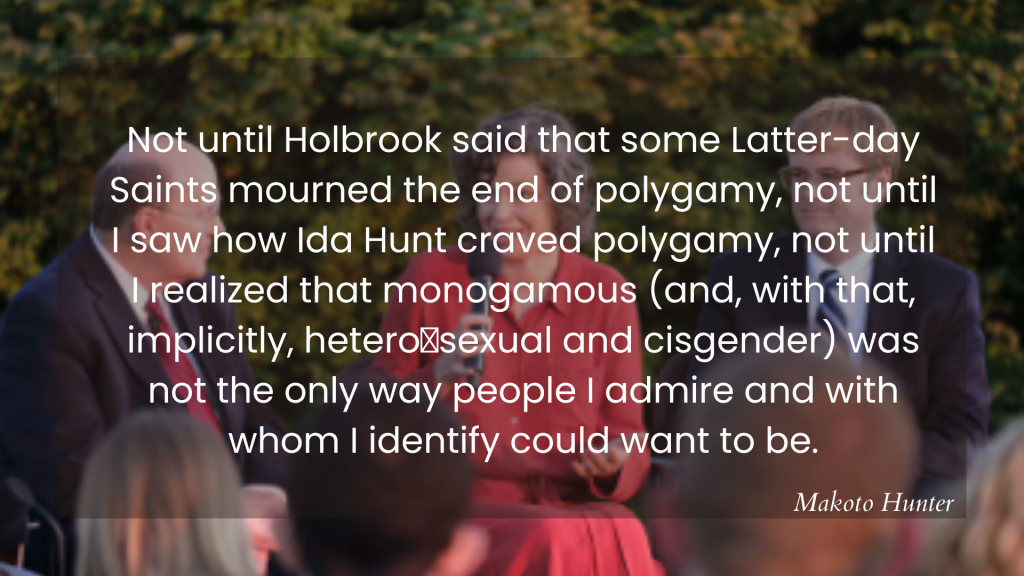
I do remember how I felt when Kate Holbrook answered a question about plural marriage.[6]
The hosts read a question shared by a viewer: “I’ve struggled for years to come to peace about polygamy in the early Church. Why was it necessary for Joseph Smith and many other leaders to practice it?” This was, more or less, how I felt too. Plural marriage had always been something breathlessly rushed through during a lesson about the Doctrine and Covenants, something awkwardly laughed about because it was too strange, too weird. I clung to anecdotes about Brigham Young wishing he could die rather than marry polygamously because it just seemed so obviously wrong.[7] This was not a feminist antipathy born during my high school speech and debate days. This aversion had preceded those and had persisted through the mild conservatism of my early adulthood.
I was, in other words, as far as I have been able to tell, a relatively typical Latter-day Saint of my generation, as far as the question of polygamy went. Faithfulness and a mighty change of heart did not make it stop seeming gross. I paid close attention to the screen, and when Elder Quentin L. Cook asked Kate Holbrook to answer, I paid close attention to her.
Holbrook initially emphasized how plural wife ancestors of hers set a moving example of faith, and how plural marriage was a rare exception while monogamy was the Lord’s rule. This was, in some sense, comforting.
But then Kate Holbrook pushed back a little on the question’s assumptions—gently, so gently. But push she did.
“When some people heard [the 1890 manifesto announcing an end to plural marriage], they were relieved,” she said. “Plural marriage had been hard for them, and they rejoiced.” This was as I had figured.
“And when some people heard this manifesto,” she continued, “they were devastated, and they cried. They had sacrificed so much, and they had testimonies of this principle.”[8]
I was surprised—confused, even. Devastated? Cried? About the end of polygamy? This seemed to have the story backward. Wasn’t the agony supposed to come with its adoption, not its conclusion?
For all that I knew people who were LGBTQ in one way or another, it hadn’t really sunk in that someone could want to be something other than “normal.” Something other than, in this case, monogamous.
Looking back, I suppose it was a typically imperious attitude for a Latter-day Saint. It hadn’t sunk in that someone righteous could want to be some way other than normal. The memory is old enough that I don’t flinch at it. But I blame myself for it a little. Sure, the Church had shaped me. But if young Latter-day Saints I meet these days are any indication, self-righteousness isn’t inevitable.
In any case, the strangeness stuck with me. It stayed with me all the way until the second volume of Saints released in 2020. This volume gave much of the stage to the story of Ida Hunt Udall, who was so avidly for plural marriage that she turned down a proposal from a monogamous suitor.[9] This, too—the thought that there were women who wanted plural marriage so much that they wanted it more than monogamy—left me thunderstruck. Monogamy (implicitly heterosexual) had seemed so obvious, so automatic, so inevitable. Variation therefrom was the realm of nonmembers or inactive members. But here was Ida, on display in a Church publication as practically a protagonist—as someone worthy of sympathy and respect, even emulation.
Between Holbrook’s injunction and Udall’s life was something that felt like a revelation, albeit not then in so many words. It was a discovery at least. Until then, I hadn’t imagined that “righteous” people could genuinely want to do things I had been taught to consider wrong. I’d never thought that someone might want to marry polygamously. I’d never considered that someone might want to be queer.
I’d never imagined that someone might want to be me.
Not until Holbrook said that some Latter-day Saints mourned the end of polygamy, not until I saw how Ida Hunt craved polygamy, not until I realized that monogamous (and, with that, implicitly, heterosexual and cisgender) was not the only way people I admire and with whom I identify could want to be.
I can’t be completely sure I wouldn’t have started to question my gender without these experiences. But I have usually thought it no coincidence that it was later that year, in 2020, that I began to try in earnest to understand what being trans meant and felt like. At first, I thought I was trying to understand a character I wanted to write. Then, I thought I was trying to understand my nonbinary friend.
Pretty soon, I was trying to understand myself.
In the parlance of the trans community, my egg cracked.[10]
And I wondered if Ida had felt the same thing, so many years before.
Let’s start differently.
Deceiving Our Own Selves
The exclusion policy and the way I’d learned to think about desire and gender did not emerge ex nihilo in the twenty-first century.[11] Both had roots in a much larger, older story about empires, nations, and race. Historically speaking, heterosexual monogamy has long been a marker for white supremacist, Christocentric, heteronormative imperialism. Or, to put it in less abstruse terms, during the age of overt military imperialism, especially the eighteenth, nineteenth, and twentieth centuries, white people have tended to be Christian people and because of that have tended to be monogamous people and because of that have tended to assume that monogamy was a sign of “Christian civilization” and that nonmonogamy—that polygamy—was equivalent with “heathenness,” with “savagery,” with “backwardness,” with deserving to be colonized. In history, these boundaries have usually been more porous than given credit for—there have been more white polygamists and Brown monogamists than imperialists found convenient to recognize—but the imagined lines still carried (and carry) enormous power and meaning.[12]
Latter-day Saints instituted plural marriage in this context and became that context’s victims, accused of being “uncivilized,” of being less-than-white, less-than-American, unfit to govern themselves—of deserving to be colonized.[13] Church leaders, whether strategically or desperately or cynically, tried to “compensate” for the “stain” of polygamy by overperforming whiteness and patriarchy—assuring the United States that polygamists though they were, they were racist polygamists, sexist polygamists, colonialist polygamists, polygamists who belonged in a racist, sexist, colonialist America—to no avail. No disidentification was pointed enough to satisfy the empire of liberty,[14] and the Church became, in Wilford Woodruff’s words, “politically speaking, a dependent or ward of the United States,” at risk of losing sovereignty over themselves like the trajectory of American Indians all around them, like the very Utes and Shoshone and Paiutes and Goshutes and Diné they had helped the United States displace and dispossess. Trying to avoid this fate brought about the 1890 manifesto and, with it, eventually, the end of plural marriage in mortality as a practice of the Church.[15] Indeed, if anything, the Church became avidly monogamist and staunchly antipolygamist, even collaborating with law enforcement to prosecute and eliminate polygamy on earth.[16] To this end, during the twentieth century, the Church instituted a policy prohibiting the baptism of children of polygamists.[17]
Oh.
When the Church instituted the 2015 policy excluding from baptism children living with parents in a same-sex relationship, apostle D. Todd Christofferson cited the extant policy against baptizing the children of polygamists as a precedent. “For generations, we’ve had these same kinds of policies that relate to children in polygamist families,” he said, and the children of same-sex couples are in “the same sort of situation.”[18] Some Latter-day Saints, understandably, tried to contest this analogy, arguing that polygamy could be taught while same-sex attraction could not be.[19] That may be so. But I think Elder Christofferson’s sense of analogy is more on point than some realize. Attraction cannot be taught, but acceptance can be. Acceptance of polygamy as a reasonable, potentially loving, non-sinful practice between consenting humans is precisely as teachable as acceptance of same-sex romance as a reasonable, potentially loving, non-sinful practice between consenting humans.[20] Church leadership evidently believed that both could undermine their authority to clarify what they consider God’s will for how humans should arrange themselves intimately.
In 2019, the same year that the Church rescinded the 2015 exclusion policy for children of parents in a same-sex relationship, the Church also ended the exclusion policy for children of polygamists.[21] Instituted for the same reasons; terminated for the same reasons. The rise and fall of the 2015 exclusion policy clarifies that Latter-day Saint leaders’ fears of polygamy and queerness are ultimately one and the same. The nineteenth-century Church tried, desperately, to reassure the United States that even though they were polygamists, they were as racist and misogynist and colonialist as the rest of the nation and deserved citizenship rights in a racist, misogynist, colonialist America. Likewise, the twenty-first-century Church tries, desperately, to reassure the world that even though they are Mormons, they’re as sexually and socially normative as the rest of the cisgender, heterosexual mainstream and deserve a seat at the same tables, a share of the same power. The Church’s gerontocratic leaders do not project muscular machismo. Their albeit-male ecclesiastical hierarchy are prone to weeping at the pulpit, their insistence on marital chastity eschews the misogynistic sexual double standard (at least formally), and the long-standing discouragement of facial hair—once upon a time perhaps meant to distance the Saints from polygamists and hippies—now is reason to think of Mormons as permanently baby-faced. To say it more blithely, Mormons are not particularly manly—not, at least, in the superficial ways that have so much political currency with contemporary authoritarians.[22] In a young century filled with noise from “manosphere” influencers and trans-exclusive, quasi-feminist talking points, I am not surprised that the Church’s leaders are all too eager, whether consciously or not, to make another pointed disidentification—all too willing to assure the world that for all their weirdness, all their unmanliness, all their closets full of polygamous skeletons, they are as cis and as straight as any colonizer.
Conversion and Transition
In this essay, I’ve used the term “queerness” somewhat broadly, including under its umbrella the same-sex marriages targeted by the 2015 exclusion policy, the genderqueerness involved in my own transition, and the plural marriages to which I’ve compared both. Being gay and being trans are not the same, but they still occupy the same boat, at least because cis-heteronormatives perceive both as similarly threatening. If homology is in the eye of the beholder, Mormonism is right there in the boat too, even as it dresses itself in the shirts and ties of a normalcy so exaggerated it becomes excessive, even as it insists on its ordinariness so extremely that it’s practically camp.[23]
But I would rather not end on the terms of Christian colonialism. There are yet other boats we can share.
When I first wondered if the way I feel trans is anything like the way Ida Hunt felt polygamous, I was not considering our mutual oppression at the hands of a cis-heteromonogamous America. I was not dwelling on our shared exclusion from the mainstream of the Church we had been raised to love. I was not thinking about the Christian conservatives who lump gay marriage and plural marriage together in the same slippery slope to civilizational decline.[24]
Well. I did end up thinking about all of these.
But I wasn’t thinking about any of that first.
First—first—first, I thought about how we both desired despite ourselves and despite our families. Ida Hunt was raised by monogamous parents, and I was raised by cisgender parents.[25] Ida Hunt was already in a monogamous relationship, and I was already inhabiting a cis male identity. Ida Hunt had control over her life, and I had control over mine. Ida Hunt already had every reason to be happy, and I already had every reason to be happy. And, in a sense, we felt happy.
And yet—and yet—and yet—we weren’t. Not wholly. Not fully.
The trans theorist Andrea Long Chu writes in her book Females that “too often, feminists” (and, one might add, many people in general) “have imagined powerlessness as the suppression of desire by an external force, and they’ve forgotten that more often than not, desire is this external force. Most desire is nonconsensual; most desires aren’t desired.” This, she argues, undergirds the experience of being trans—at least how she experiences it, and how I do too. “Wanting to be a woman,” she writes, “was something that descended upon me, like a tongue of fire.”[26] The religious connotation is palpable, and she reinforces it in the second edition: “To become the subject of anything—desire, judgment, identity, rights, power—is very often a tortuous passage into a fragile, temporary, sometimes unbearable state. One finds examples of this everywhere. The subject of faith is plagued by fear and trembling”—in much the same way that the subject of transition is.[27] Wanting to be a woman—to be trans—to transition—fell upon me like a revelation—like a conversion—like a burning in the bosom, like a still small voice around me, like something I had always known and only not seen.
When someone joins the Church, one could say they convert to the restored gospel, or to Mormonism.
One could also say they transition: from non-Mormon to Mormon.
From cis-Protestant to trans-Saint.[28]
This, then, is the boat we could share: In a world that worships sovereignty,[29] the Saints and the queer instead are subject. Yielding to the still small voice of the spirit or to the feeling that your gender is different than your sex assigned at birth both require a great deal of meekness, of letting go of your understanding in order to learn something once thought impossible. Earlier, I mentioned that in twenty-first-century trans parlance, realizing that you’re trans is known as cracking your egg. In one sense, this expresses the way in which the true self emerges from a stifling shell. But in another sense, this expresses the way in which self itself crumbles, breaks, falls apart. Many transgender people shed the “dead names” of their pre-transition identities, and baptism by immersion performs the death and burial of old, sinful selves.[30] Transition and conversion are acts of both self-discovery and self-destruction. Or rather, not acts at all: surrenders, rather. Surrenders to—what? The whims of gender? The will of Heavenly Parents? The yoke of Christ? Any and all of the above, perhaps. In a world that seeks for power, we can instead seek to pull it down, to overturn both Protestant supremacy and cis-heteronormativity.[31]
Well. That is the boat we could share. Perhaps we share it even now.
Perhaps someday, Latter-day Saints will stop trying to sink the ship while they’re still aboard, will stop trying to pin themselves to a cis-heteronormativity that still hates them.
But as a trans woman, I understand it. I understand how easy it is to hate things about yourself that you don’t yet understand.
Conclusion
The 2015 exclusion policy ended in May 2019.[32] Ever since, the children of parents in a same-sex relationship have been able to receive baptism if their parents give permission.
In August 2024, the Church issued a supplement to the General Handbook that broadened restrictions on how transgender individuals can participate in the Church. The supplement prohibits transgender individuals from callings involving children and youth, limits their participation in overnight activities to only the daytime portions, and restricts their use of meetinghouse restrooms that conform to their gender,[33] playing on transphobic stereotypes about the supposed danger transness poses to minors (themselves reminiscent of antipolygamy stereotypes about the supposed harm of plural motherhood on children).[34]
This supplemental policy remains in place.
One door opened.
Another door closed.
It is hard to let your egg crack. It is hard to stop feeling sovereign. Being trans, I know that all too well—remember all too well the dizzying confusion of facing yourself, seeing yourself, knowing yourself and how wide the gap is between who you want to be and who you seem to be.
Hard enough as one trans girl to let go of the boy I seemed to be. Maybe that’s why it doesn’t surprise me that for the Church, it’s hard too.
[1] ”Before thou camest forth” is a partial quotation from Jeremiah 1:5 (KJV).
[2] Perhaps this was a quirk of my ward or my city or my peers, but even then, I and the other Latter-day Saint teenagers I knew did not usually call it “Mormonism” or ourselves “Mormons.” “Mormon” sounded too much like an epithet—too much like something cruelly said by an anti-Mormon. We usually spoke of ourselves as the unfortunately cliquey-sounding “members.” Then-Church president Russell M. Nelson’s direction to think of ourselves as Latter-day Saints and of the Church as the Church of Jesus Christ of Latter-day Saints felt, to me, like a relief.
[3] Russell M. Nelson, “The Love and Laws of God,” speech at Brigham Young University, Sept. 17, 2019, BYU Speeches, https://speeches.byu.edu/talks/russell-m-nelson/love-laws-god/.
[4] Mosiah 18:8–10 (Book of Mormon).
[5] The Church of Jesus Christ of Latter-day Saints, Saints: The Story of the Church of Jesus Christ in the Latter Days, vol. 1, The Standard of Truth (The Church of Jesus Christ of Latter-day Saints, 2018).
[6] The hosts read the following questions shared by viewers: “I’ve struggled for years to come to peace about polygamy in the early Church. Why was it necessary for Joseph Smith and many other leaders to practice it?” and “What do I tell my family when they ask about polygamy in the early days of the Church? They aren’t generally satisfied with the ‘well, we don’t practice it anymore’ answer.” See “Worldwide Devotional for Young Adults: A Face to Face Event with Elder Cook,” Sept. 9, 2018, Church Media Library, at 30 min., 30 sec., https://www.churchofjesuschrist.org/media/video/2018-09-1000-worldwide-devotional-for-young-adults-a-face-to-face-event-with-elder-cook?lang=eng.
[7] Brigham Young said that on first learning about polygamy, “It was the first time in my life that I had desired the grave.” See Leonard J. Arrington, Brigham Young: American Moses (Alfred A. Knopf, 1985), 100.
[8] “Worldwide Devotional for Young Adults,” at 34 min.
[9] The Church of Jesus Christ of Latter-day Saints. Saints: The Story of the Church of Jesus Christ in the Latter Days, vol. 2, No Unhallowed Hand (The Church of Jesus Christ of Latter-day Saints, 2020), chap. 32. Much of No Unhallowed Hand’s depiction of Udall cites the published version of her diary: Mormon Odyssey: The Story of Ida Hunt Udall, Plural Wife, ed. Maria S. Ellsworth (University of Illinois Press, 1992).
[10] Evelyn Bauer, “Cracking the History of the Trans ‘Egg,’” Them, Dec. 5, 2024, https://www.them.us/story/cracking-the-history-of-the-trans-egg. See also Grace Lavery, “Egg Theory’s Early Style,” TSQ: Transgender Studies Quarterly 7, no. 3 (2020): 383–98, https://doi.org/10.1215/23289252-8553034.
[11] “Deceiving our own selves” is a partial quotation from James 1:22 (KJV)
[12] Sarah Carter, The Importance of Being Monogamous: Marriage and Nation Building in Western Canada to 1915, The West Unbound: Social and Cultural Studies (University of Alberta Press and Athabasca University Press, 2008); Elisa Camiscoli, Reproducing the French Race: Immigration, Intimacy, and Embodiment in the Early Twentieth Century (Duke University Press, 2009); Mark Rifkin, When Did Indians Become Straight? Kinship, the History of Sexuality, and Native Sovereignty (Oxford University Press, 2010); Ann McGrath, Illicit Love: Interracial Sex and Marriage in the United States and Australia, Borderlands and Transcultural Studies (University of Nebraska Press, 2015); Sarah M. S. Pearsall, Polygamy: An Early American History (Yale University Press, 2019); Amanda Hendrix-Komoto, Imperial Zions: Religion, Race, and Family in the American West and the Pacific, Studies in Pacific Worlds (University of Nebraska Press, 2022); Zainab Batui Nagvi, Polygamy, Policy and Postcolonialism in English Marriage Law: A Critical Feminist Analysis, Law, Society, Policy (Bristol University Press, 2023); Nathan B. Oman, “Natural Law and the Rhetoric of Empire: Reynolds v. United States, Polygamy, and Imperialism,” in Law and the Restoration: Law and Latter-day Saint History (Greg Kofford Books, 2024), 165–210, repr. from Washington University Law Review 88, no. 3 (2011): 661–706. For more on the idea of Christian civilization (though not polygamy), see Matthew Bowman, Christian: The Politics of a Word in America (Harvard University Press, 2018).
[13] Oman, “Natural Law and the Rhetoric of Empire.” See also J. Spencer Fluhman, “A Peculiar People”: Anti-Mormonism and the Making of Religion in Nineteenth-century America (University of North Carolina Press, 2012), 110–13; Sarah Barringer Gordon, The Mormon Question: Polygamy and Constitutional Conflict in Nineteenth-century America, Studies in Legal History (University of North Carolina Press, 2002); Christine Talbot, A Foreign Kingdom: Mormons and Polygamy in American Political Culture, 1852–1890 (University of Illinois Press, 2013); W. Paul Reeve, Religion of a Different Color: Race and the Mormon Struggle for Whiteness (Oxford University Press, 2015); Brent M. Rogers, Unpopular Sovereignty: Mormons and the Federal Management of Early Utah Territory (University of Nebraska Press, 2017).
[14] Eva Payne’s notion of “American sexual exceptionalism” may hold some explanatory power here. American culture by the late nineteenth century tended to consider sexual “vice” almost uniquely and incomparably serious. Perhaps that was why no amount of other kinds of “fitting in” were enough so long as the Church continued to espouse polygamy. See Eva Payne, Empire of Purity: The History of Americans’ Global War on Prostitution, Politics and Society in Modern America (Princeton University Press, 2024).
[15] Peter Coviello, “How the Mormons Became White: Scripture, Sex, Sovereignty,” in Americanist Approaches to The Book of Mormon, ed. Elizabeth Fenton and Jared Hickman (Oxford University Press, 2019), 259–76, Wilford Woodruff quotation at 274; Calvin Burke, “The Gentle Curse of Dreams: Eugene England and the Biopolitics of Latter-day Saint History,” in DNA Mormon: Essays on the Legacy of Historian D. Michael Quinn, ed. Benjamin E. Park (Signature Books, 2022), 127–40. Coviello is more pointed about his view that Latter-day Saints plausibly believed the United States was willing to existentially threaten the Church in his Make Yourselves Gods: Mormons and the Unfinished Business of American Secularism, Class 200: New Studies in Religion (University of Chicago Press, 2019).
[16] B. Carmon Hardy, Solemn Covenant: The Mormon Polygamous Passage (University of Illinois Press, 1992); Ethan R. Yorgason, Transformation of the Mormon Culture Region (University of Illinois Press, 2003); Craig L. Foster and Marianne T. Watson, American Polygamy: A History of Fundamentalist Mormon Faith (The History Press, 2019), 77–79; Cristina Rosetti, Joseph White Musser: A Mormon Fundamentalist, Introductions to Mormon Thought (University of Illinois Press, 2024).
[17] Sarah Pulliam Bailey, “Mormon Church to Exclude Children of Same-sex Couples from Getting Blessed and Baptized Until They Are 18,” Washington Post, Nov. 6, 2015, https://www.washingtonpost.com/news/acts-of-faith
/wp/2015/11/05/mormon-church-to-exclude-children-of-same-sex-couples-from-getting-blessed-and-baptized-until-they-are-18/.
[18] D. Todd Christofferson, “Church Provides Context on Handbook Changes Affecting Same-sex Marriages,” interviewed by Michael Otterson, Church Newsroom, Nov. 6, 2015, https://newsroom.churchofjesuschrist.org/article/handbook-changes-same-sex-marriages-elder-christofferson?cid=HP_WE_11-11-2015_dPAD_fMNWS_xLIDyL1-B_.
[19] Peggy Fletcher-Stack, “New Mormon Policy on Gay Couples ‘Analogous’ to Its Polygamy Stance? Yes and No,” Salt Lake Tribune, Jan. 3, 2016, https://www.sltrib.com/news/mormon/2016/01/04/new-mormon-policy-on-gay-couples-analogous-to-its-polygamy-stance-yes-and-no/.
[20] And I am not so sure polygamy beyond acceptance is so teachable either. If it is teachable, it’s in the same way as heterosexual monogamy. People unsuited to either can force themselves into it but unpleasantly, if unhappy polygamous and mixed-orientation marriages are anything to go by.
[21] Nate Carlisle, “LDS Church Makes It Easier for Children of Polygamists to Convert,” Salt Lake Tribune, Dec. 18, 2019, https://www.sltrib.com/religion/2019/12/18/lds-church-loosens-policy/.
[22] For Mormon masculinity, see David Knowlton, “On Mormon Masculinity,” Sunstone, Aug. 1992, 19–31, https://sunstone.org/wp-content/uploads/sbi/articles/088-19-31.pdf; and Caroline Kline, Mormon Women at the Crossroads: Global Narratives and the Power of Connectedness (University of Illinois Press, 2022). For authoritarian masculinity, see Kristin Kobes Du Mez, Jesus and John Wayne: How White Evangelicals Corrupted a Faith and Fractured a Nation (Liveright, 2020); and Saskia Brechenmacher, “Why Gender Is Central to the Antidemocratic Playbook: Unpacking the Linkages in the United States and Beyond,” Carnegie Endowment for International Peace, Nov. 25, 2024, https://carnegieendowment.org/research/2024/11/women-lgbtq
-democracy-authoritarianism-trump?lang=en.
[23] Reeve, Religion of a Different Color, 247–72; Kathryn Lofton, “A Brief History of the Mormon Smile,” Journal of Mormon History 49, no. 3 (2023): 21–46.
[24] Like some other plural wives, Ida Udall found herself on the outskirts of Church life after the 1890 manifesto. See Mormon Odyssey, 215–34. For connections between homophobia and antipolygamy, see Margaret Deineke, “What’s Queer About Polygamy?” in Queer Theory: Law, Culture, Empire, ed. Robert Leckey and Kim Brooks (Routledge, 2010), 137–54. For an example, see Robert P. George and William L. Saunders, “Republicans and the Relics of Barbarism,” National Review, Aug. 30, 2004, https://www.nationalreview.com/2004/08/republicans-and-relics-barbarism-robert-p-george-william-l-saunders/.
[25] Ida Hunt Udall’s father, John Hunt, did polygamously marry a second wife, but not until after Ida had reached adulthood, left her childhood home, and herself entered a plural marriage. See Ida Hunt Udall, diary, March 26, 1882, in Ellsworth, Mormon Odyssey, 64.
[26] Andrea Long Chu, Females, 2nd ed. (Verso, 2025), 84; italics in the original.
[27] Chu, Females, 102; italics in the original. She alludes, of course, to Philippians 2:12 (KJV) and Søren Kierkegaard, Fear and Trembling (1843).
[28] Here, “cis-Protestant” stands in for all manner of religious (or irreligious) backgrounds from which one hypothetically might convert. That said, the very idea of religion as it exists today itself heavily borrows from the shapes and structures of Protestant Christianity, as does the secularity against which religion appears as something distinct at all. See Coviello, “Introduction: What We Talk About When We Talk About Secularism,” in Make Yourselves Gods; Tomoko Masuzawa, The Invention of World Religions; or, How European Universalism Was Preserved in the Language of Pluralism (University of Chicago Press, 2005); Brad S. Gregory, The Unintended Reformation: How a Religious Revolution Secularized Society (Harvard University Press, 2012); Larry Siedentop, Inventing the Individual: The Origins of Western Liberalism (Harvard University Press, 2014); John Lardas Modern, Secularism in Antebellum America (University of Chicago Press, 2015); and Robert A. Orsi, History and Presence (Harvard University Press, 2016). In this context, the Latter-day Saint tradition is, in many respects, a critique of Protestantism. See Elizabeth Fenton, “Open Canons: Sacred History and American History in The Book of Mormon,” J19: The Journal of Nineteenth-Century Americanists 1, no. 2 (2013): 341. Additionally, while the conversion-transition analogy is most obvious for the archetypal convert, Church leaders have long encouraged all Latter-day Saints, including those raised in the faith, to experience conversion. After all, in the Protestant-inflected secular world in which all Latter-day Saints are born, “faith, even for the staunchest believer, is one human possibility among others” (an elaboration from Protestantism making every denomination but one human choice among many), making transition from secular to Saint possible—even necessary—for every member of the Church. For the quotation, see Charles Taylor, A Secular Age (Harvard University Press, 2007), 3. For an example of ecclesiastical leadership encouraging all Latter-day Saints to experience conversion, see Bonnie L. Oscarson, “Be Ye Converted,” Ensign, Nov. 2013, 76–78.
[29] Matthew 4:8–9.
[30] For dead names, see Chu, Females, 92; and Tarynn M. Witten, “Death and Dying,” in The SAGE Encyclopedia of Trans Studies, vol. 1, ed. Abbie E. Goldberg and Genny Beemyn (SAGE, 2021), 177. For baptism as a symbol of death and rebirth, see Romans 6:4; D&C 76:51; R. E. Neighbor, “The Moral Significance of Baptism,” Review and Expositor 8, no. 3 (1911): 421–22; Carl S. Hawkins, “Baptism,” in Encyclopedia of Mormonism, vol. 1, ed. Daniel H. Ludlow (Macmillan, 1992), 93; and James E. Faust, “Born Again,” Ensign, May 2001, 54.
[31] Alma 60:36 (Book of Mormon). Consider also Bruce H. Kirmmse, “Translator’s Introduction: Fear and Trembling, a Guide to an Unknown Country,” in Søren Kierkegaard, Fear and Trembling: A New Translation (Liveright, 2022), xiv: “‘Faith’ is not only the inexplicable paradox of surrendering everything, it is also the perhaps even more inexplicable paradox of receiving everything once again.”
[32] The Church of Jesus Christ of Latter-day Saints, “Policy for Children of LGBT Parents, Members in Gay Marriages,” May 2019, https://www.churchofjesuschrist.org/study/liahona/2019/05/news-of-the-church/policy-for-children-of-lgbt-parents-members-in-gay-marriages?lang=eng.
[33] The Church of Jesus Christ of Latter-day Saints, “Church Participation of Individuals Who Identify as Transgender,” 2024, supplement to General Handbook: Serving in The Church of Jesus Christ of Latter-day Saints, sec. 38.6.23, “Individuals Who Identify as Transgender,” https://assets.churchofjesuschrist.org/1d/76/1d76991533df11efbaeeeeeeac1ed7e66fbf94a7/general_handbook_guiding_principles_for_local_leaders.pdf.
[34] Foster and Watson, American Polygamy, 124–28; Shelley M. Park, Mothering Queerly, Queering Motherhood: Resisting Monomaternalism in Adoptive, Lesbian, Blended, and Polygamous Families (State University of New York Press, 2013); Melissa Block, “Accusations of ‘Grooming’ Are the Latest Political Attack—with Homophobic Origins,” NPR, May 11, 2022, https://www.npr.org/2022/05/11/1096623939/accusations-grooming-political-attack-homophobic-origins.