

 Back to full Issue

Articles/Essays – Volume 18, No. 2
The Godmakers: A Content Analysis
As I begin, I wish to state that the following observations and comments are entirely personal. I do not represent the LDS Church in any official way, nor is it my intent to function as a defender of the faith. My remarks are simply the reflections and impresions of one who feels the content of the movie The Godmakers is worth discussing.
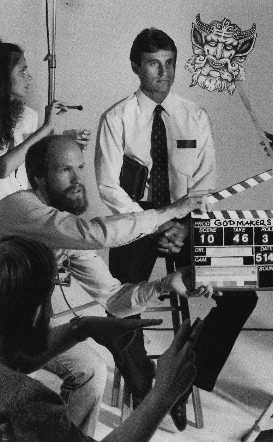
As the aerial camera pans across the white face of the beautifully situated Hawaiian Temple, a narrator begins the film by stating: “It looks beautiful from the outside but when you pull off the mask and talk to the victims, you uncover another part of the story. The documented evidence you are about to see may seem unbelievable but it is all true.” This opening comment thus introduces the idea that viewers will be watching a documentary, that some evil will be uncovered and that “evidence” and “truth” will be the instruments for making this evaluation. Ed Decker and Dave Hunt, in their recent book, The Godmakers , confirm that they consider the movie to be “a documentary film” ( 1984, 16). In support of the claim, we are told in the book that three years of research went into the film. Certainly one might expect this of a documentary effort. Furthermore, aspects of the film’s format suggest a documentary approach.
Before attorneys, two would-be plaintiffs, Ed Decker and Dick Baer, outline evidence for a proposed lawsuit. They maintain that the Church of Jesus Christ of Latter-day Saints is a dangerous organization bent on destroying people’s lives and apparently hope to stop the Church’s activities through the intended legal action. This setting offers the narrative frame for the film in which the rest of the evidence is presented.
Included in the evidence are brief excerpts from longer interviews held with a variety of “experts,” persons both in and out of, for and against, the Church. Typically, an orthodox Mormon spokesman will explain a Church principle or practice. Then a non-Mormon or former Mormon will give information intended to undermine or refute the previous claim. The primary intent is clearly to try to show the failings and anomalies of Mormonism. In some places, animation is used to dramatize Mormon beliefs. All of this material and the form in which it is presented could conceivably be considered a documentary.
And what are some of the “documented” findings and conclusions presented in the film? There are many and they are very wide-ranging. I have identified some of the major themes which follow roughly in the order in which they are shown: the character of Mormonism collectively and the character of individual Mormons; Mormonism as a satanic cult and practitioner of pagan temple rites; the credibility of Joseph Smith as prophet; Mormon sociological patterns; and the credibility of Mormon scriptures.
Within each of these themes, and others, pro and con arguments are developed and many pointed conclusions are drawn. Consider the merits of each of these claims, most of which are quoted directly from the film’s transcript or expressed as reasonable paraphrases or extrapolations.
1 . There are two aspects of Mormonism – the unreal one of friendly, loving, family-centered, Christian appearances (called the mask) and the other aspect of secrets and evil, the real Church described in the film as “one of the most deceptive and dangerous groups in the entire world.”
2. Mormonism is “incredibly effective in brainwashing” its people.
3. Mormonism is a cult and is tied “into [the] occult and Satanism.”
4. Mormonism is based on heretical doctrines, such as: “A worthy Mormon can become a god himself in the life hereafter, ruling over his own planet with a number of goddess wives.” “God is a perfected man.” “Their [Mormons’] whole doctrine comes from this [idea] about being gods.” “Mormonism is far removed from orthodox Christianity.”
5. Joseph Smith was a tall- tale teller and treasure-seeker who was involved in the occult. He fabricated visions and made up the fictitious Book of Mormon and book of Abraham. Joseph lied, made untrue predictions, and practiced polygamy behind his wife’s back; thus, he is not credible as a prophet of God. 6
. The Mormon Church pressures persons into divorcing spouses who do not measure up to Church standards.
7. Church members (women and teens are mentioned most) are under incredible pressure to be perfect. Because they can’t be, they become depressed, divorce and/or commit suicide. (The story of Kip Eliason, a sixteen-year-old LDS boy from Idaho who committed suicide because his sexual feelings conflicted with Church prescriptions, is especially forceful. )
8. LDS leaders know that church history, if fully known, could ruin the Church (the nine versions of the First Vision are cited as an example), so the true history is hidden from the members in order to protect the faithful.
9. Mormons rewrite their scriptures and histories to hide inconsistencies and reinforce unity of belief among present members.
10. There is no archaeological evidence to support the claim that the Book of Mormon is an actual history of a real people. It is, to quote a professed archaeologist, “a fairy tale.” Mormon claims of archaeological evidence are all untrue.
11. Likewise, the book of Abraham is not an authentic translation as claimed.
12. Unlike Bible scholars, Mormons test their scriptures with a “burning in the bosom” rather than with archaeological evidence and textual criticism.
13. Mormons who have received temple endowments have consented to having their throats slit, and heart and vitals torn out.
14. Temple ceremonies are occultist and include a “fanatical program to evangelize for the dead.”
15. Temple garments are magical and will protect faithful wearers from harm.
16. Mormons lie to achieve their ends. They also circulate false stories about former members while attempting to do them harm.
17. Utah, hence Mormon, society leads or is among the nation’s leaders in many societal ills including divorce, suicide, child abuse, teenage pregnancy, V.D., bigamy, bankruptcy, and stock fraud.
18. The Church is without love. Former members feel alienated and empty because Mormonism has undermined their faith in the Bible and other churches. Persons leaving the Church are in jeopardy of losing their spouses, children, friends, and jobs.
It is not uncommon for documentaries to make conclusions, even strongly worded conclusions. As I have watched such documentaries as Life on Earth and The Voyage of the Beagle , I have observed that, like most documentaries, these used the scientific, deductive process of searching for facts, objectively analyzing the facts, and producing defensible, tested conclusions based on the facts. Fiction plays little or no part in a documentary. And while conflicts may be presented, strong preexisting biases are subordinated to sincere investigative intent.
With The Godmakers , this process is reversed. A strong anti-Mormon mindset seems to have been firmly in place before the project began. Consider that in meetings of Saints Alive/Ex-Mormons for Jesus, the three stated goals of the Deckerites are said to be : to teach the true gospel to Latter-day Saints and bring them to Christ; keep people from joining the Church by negating the Mormon missionary effort; and offer fellowship to those who have left the Church and help heal their psychological wounds.
Given these underlying purposes, was there any chance for a positive or even balanced result? Probably not. The three-year search seems to have concentrated on gathering information to support a predetermined conclusion about Mormonism. Rather than objectively weighing the evidence and letting it suggest possible conclusions, the filmmakers have manipulated and shaped the evidence to support the anti-Mormon theme.
The Godmakers is really a one-sided expose, a term incidentally, used by the authors in both the film and on the cover of The Godmakers book.
Redefining The Godmakers as an expose rather than a documentary allows us to revise our expectations and better prepares us for the film’s sensationalistic content. For in The Godmakers we find faulty assumptions, flawed reasoning, over-simplification, innuendo, hyperbole, failure to distinguish between canonized doctrine and speculative theology, distorted interpretations of social statistics, unethical use of Church spokesmen, proof-texting, representing the unusual to be typical, and inflation of qualifications of “experts.”
For examples, advertisements for Decker represent him as “a former member of the Mormon hierarchy” (Sword, 23). To Mormons, this would imply that he had been a General Authority, not merely one of the tens of thousands of ward or stake officers. Non-Mormons, too, must get the impression that Decker occupied a very high ecclesiastical position, one allowing him to become entirely familiar with the inner workings of the real Mormonism. Obviously, it would be more faith shattering to Roman Catholics if a cardinal denied his church than if a local priest were to do so. There seems to be deceitful intent here.
And what about the undesignated expert “doctors” (Smith, Sales, and Crane) interviewed for their views on Book of Mormon archaeology? Do they have academic doctorates in the fields they are commenting on? No, at best they are ministers with doctorates of divinity; at worst they are armchair experts cooperating in discrediting Mormonism.
Testimonies of the Mormon experts such as mission president Harold Goodman, are often presented in isolated statements with no context or recording of the questions they were responding to. Non-Mormons are usually quoted at greater length.
It is inferred from state and federal reports on the state of Utah, that Mormons have a higher than average incidence of divorce, teenage pregnancy, suicide, child abuse, alcoholism, etc. This assumption does not acknowledge that better than 30 percent of the state’s populace is non-Mormon. Even more importantly, no account is made of the varying levels of religious activity among Mormons. Given that perhaps 50 percent of Mormons are not actively practicing their faith ( a higher rate of activity generally than in other Christian churches), as much as 65 percent of the state’s population (including the nonMormons) would not be expected to be fully committed to LDS tenets.
A careful review of social statistics among committed Mormons underscores this point. One study, for example, shows that temple-married Mormons are five times less likely to divorce than LDS couples married outside the temple and three times less likely to divorce than couples married nationally. It should also be remembered that Utah’s divorce rate is usually the lowest in the Mountain States, a region in which liberal divorce laws have led to nationleading divorce rates. And while Utah has a higher rate of teenage marriage than exists nationally, temple-married couples under nineteen have a divorce rate five-and-one-half times lower than the national average for the same age group (Bahr 1981 ).
It is clear, then, that the point made by The Godmakers is true in reverse. Rather than being the cause of higher than normal divorce statistics, temple marriages and religious behavioral orthodoxy are most closely correlated with much lower than average rates.
In an attempt to portray Mormonism as a cult far removed from mainstream Christianity, the filmmakers represent numerous statements to be Mormon doctrine, emphasizing those ideas which would seem most anomalous to Christians. No attempt is made to distinguish between doctrine found in canonized scripture or official pronouncements, and those highly speculative theories originating in obscure or nonauthoritative statements circulating through the Church in oral tradition and folklore. Ideas of this latter type may offer interesting insights but deal with unrevealed matters and open questions not considered binding on members or essential for exaltation. Here are some statements misrepresented in The Godmakers as being official Mormon doctrine :
1. Jesus, according to Orson Pratt, had at “least three wives and fathered children, a direct descendent of which was Joseph Smith.” This statement seems to be a mistaken reference to Orson Hyde’s theorizing that Jesus may have been married to Mary, Martha, and Mary Magdalene (JD 2:79-83). However, Hyde’s view is obviously not an official Church position. Even if both Hyde and Pratt personally espoused and commented publically on this hypothesis, these men are only two of many Church leaders, past and present, to speculate on theology and history.
2. “Husbands and wives who have successfully achieved godhood will be required to populate their own planet by procreating as many spirit children as possible.” Latter-day Saints do accept that God is literally the father of human spirits, but descriptions of divine marital and domestic arrangements are not doctrinal. Neither are speculations about the state of human beings who may be exalted to godhood in the future. By adding the words “required” and “as many … as possible” to a popular Mormon notion, the filmmakers push the idea to an extreme never intended by its creators.
3. Elohim, conceived by “an unidentified god and one of his goddess wives” as “a spirit child,” later received a physical body from mortal parents. Then he became a god “through obedience to Mormon teaching and death and resurrection.” Whether doctrine or not, this concept of God is considered heretical by many non-Mormon Christians. But the wording here makes it seem even worse by implying that God exists after or is subordinated to Mormon teaching.
4. On Kolob “the god of Mormonism and his wives, through endless celestial sex, produced billions of spirit children.” To make an idea seem absurd, the scriptwriters again describe a familiar but noncanonized theory in profane and hyperbolic language.
5. “Elohim and one of his goddess wives came to earth as Adam and Eve to start the human race.” Later Elohim came to earth again “to have sex with the Virgin Mary in order to provide Jesus with a physical body.” The first statement seems to have reference to the “Adam-God Theory,” an idea taught by Brigham Young but found unacceptable and thus non-doctrinal by leaders after him. The content of the next sentence will ring true for many members but the spectacular, single statement, made without any contextual explanation, seems meant to profanize and offend.
6. A woman in the film says, “Without a husband that could take me through the temple, I wouldn’t be able to go to heaven and be with my Heavenly Father.” Later, another woman savs, “Women don’t even get out of the grave unless the husband calls them forth on the morning of resurrection.” These impressions bv former LDS women show a generalization and misunderstanding of the rather specific idea taught by some Mormons that on the morning of the first resurrection, husbands going to the celestial kingdom (or highest of many places in “heaven”) will, after being resurrected themselves, help with the resurrection of their wives. I know of no doctrine keeping women permanently in the “grave” or out of “heaven” (given its multiple “degrees”) if they are not with their husbands.
7. “Mormons are instructed to use Christian terminology when talking to potential converts.” The inference is that LDS and Christian terminologies are different; that LDS deceptively turn to the latter when useful. Actually, they both use similar terms but understand some of them differently. This is a cultural difference with no deceitful intent.
8. “One of the rules in the Mormon Church is that if you want to go to the temple, you can’t associate with apostate members.” There is no such “rule.” Actually, members are encouraged to love and fellowship former members and help them with their burdens. One may “associate with” without sympathizing with another. There is even a little-known Church program which attempts to bring “apostate” members back into the fold.
9. Bishops routinely advise divorce if a spouse does not conform to Church standards, according to the testimony of several former members in the film. In reality the opposite is true. Bishops rarely encourage divorce. The General Handbook of Instructions ( 1975, 21 ) counsels bishops to try and preserve marriages at almost any cost. Spencer W. Kimball has admonished leaders: “Never encourage your members to get a divorce. Encourage them to be reconverted, to adjust their lives, their own personal lives” ( Conference Report 1976, 21.) In fact, the Church has been criticized in some circles for going to extremes to preserve unsuccessful marriages. In any event, Mormon attitudes toward divorce are probably not unlike those of other conservative religions.
10. Putting together Utah suicide statistics and the tragic story of the suicide of Kip Eliason, the film implies that the Church is responsible for the suicides of many of its youth. Yet there is no concrete evidence to support this assumption. (Kunz, 1984). It is doubtful that the moral advice given LDS teens is significantly different than that given by other conservative Christian clergymen. Kip’s letter could have been written by any boy in any church. There is no reason to believe his experience was uniquely attributable to Mormonism. The Godmakers conveniently fails to mention that the main reasons for adolescent suicides are pressure to achieve academic success, declining participation in religious activity, and difficulty in acquiring a stable personal identity. The Godmakers also neglects to mention areas in social life, health, athletics, science, the arts, government, business and education where Mormons have been leaders.
11. One particularly troublesome misstatement is that Joseph Smith “claimed that he had done more for us than any other man including Jesus Christ.” This is a close rephrasing of Doctrine and Covenants 135:3, with the very important exception that John Taylor’s verse reads, “Joseph Smith has done more, save Jesus only , for the salvation of men in this world than any other man that lived on it.” The apparent paraphrase of Doctrine and Covenants 135:3 may be a conflation borrowing from “Address of the Prophet – His Testimony Against the Dissenters at Nauvoo,” an account of a speech made by Joseph Smith on Sunday, 26 May 1844. In it, Joseph repeatedly compared his “perils” and boasting to those of Paul, the ancient apostle. Thomas Bullock reports Smith as saying: “I have more to boast of than ever any man had. I am the only man that has ever been able to keep a whole church together since the days of Adam. A large majority of the whole have stood by me. Neither Paul, John, Peter, nor Jesus ever did it. I boast that no man ever did such work as I did” (HC, 6 : 406-7 ) . Joseph Smith was obviously speaking of his organizational ability, not trying to claim he was perfect or a savior, as perhaps implied by the statement the filmmakers attribute to him.
12. Another attempt to place Joseph Smith in a position superior to or at least equal with Jesus Christ informs us that Joseph “shed his blood for us so that we too may become gods.” This view seems to make the prophet an atoner in the same way Jesus was. Furthermore, in an animation sequence of the last judgment, Joseph is in the central dominant position flanked by the Father and Jesus Christ. Perhaps the filmmakers were again exploiting their misinterpretation of Joseph’s 1844 statement.
13. One of the most unsubstantiated claims in The Godmakers is that Mormons worship Satan. The more fantastic the claim, the greater the evidence needed to support it. With The Godmakers we find just the reverse. The only “evidence” offered in this instance is that in a satanic bible, which Baer and Decker show the attorneys, the word Mormo indicates a god who is “king of the ghouls”; and that in Chinese, a word sounding like “Mormon” means “gates of hell.” These coincidences do not constitute worship of Satan. No evidence of rites or rituals involving Satanism are presented. No interviews with persons involved in such behavior are given. In my acquaintance with thousands of Mormons over the years, I have never encountered the faintest hint of Satan worship, nor do I know of anyone else who has heard of such a thing. Certainly one must prove intentionality to justify such an extreme claim. Pointing to a word in a book does not constitute proof. Some lesser falsehoods reduce the film’s credibility for informed viewers but may seem plausible for the uninitiated :
– The Bible is mistakenly said not to be one of the standard works. – The Church is said to be a “major stockholder in the Los Angeles Times. It actually holds less than 2 percent of the company’s stock (Gibson 1983, 24).
– We are told that members pay “mandatory” tithing. In a church which emphasizes the importance of free agency, no behavior is “mandatory.”
– The Seventh East Press supposedly existed to seek “reform in the Church through exposing Mormon cover-ups.” While the Press did contain some investigative reporting and research articles, its raison d’etre was not to expose cover-ups. –
– The Godmakers maintains that Mormon teachings are so little known because “Mormons are embarrassed by their own doctrines so they don’t talk about them.” This seems to contradict the more typical image of Mormons as often talking about their religion and trying to convert friends and neighbors. If Mormon teachings are so unappealing and embarrassing to discuss, why do converts join? Why do members stay? Why do former members return?
The Godmakers implores us to take it seriously. At the same time it is, like most exposes, sensationalistic and melodramatic. It is hard to treat it neutrally or dispassionately. It almost forces us into personal responses. I would like to conclude with my personal response.
Manipulation and deliberate misuse of information aside, I was bothered by other aspects of the film. The makers of The Godmakers seem to have a monolithic view of Mormonism. Repeatedly we hear that “Mormons believe” this or that. But Mormons do not believe or behave uniformly. Recent surveys of LDS belief and behavior, letters to editors, disagreements in classes, the variety of ideas expressed in Church-related publications, and the known ideological differences among General Authorities all reveal some degree of pluralism within the Mormon tradition. It has been that way from the beginning.
The Deckerites seem to have an equally simplistic view of traditional Christianity. It is assumed that there is a unified core of Christian dogma. They draw a false dichotomy between Mormonism and Christianity, as if they were each internally consistent and coherent as well as mutually exclusive entities. To view them in juxtaposition is to see black and white. But if anything characterizes Christian dogma, it is diversity. Yet, The Godmakers has no qualms in advocating the replacement of a nineteenth century restorationist brand of Christianity (Mormonism) with a supposedly superior twentieth century brand of protestant fundamentalism.
Predictably, The Godmakers makes virtually no attempt to show the Christ-centeredness of Mormonism. Anyone familiar with Latter-day Saint theology and teachings, lesson manuals, music, art, sacrament, ordinances, temple rites, scriptures, and prayers should recognize the dominant position held by Christ in the religion.
Despite its purposes and flaws, The Godmakers may prove to be of some value to the Church. How? It may teach us something about ourselves. Why, for example, do some people seem to be vulnerable to this kind of presentation? Obviously, many are not adequately prepared to handle this kind of criticism of the Church. Many are disturbed while some are permanently disabled. I would like to suggest that there are a few lessons Mormons can learn from this film.
1. It seems clear to me that however well-intentioned, well-prepared, and slickly packaged, propaganda has drawbacks for any group using it. We should more thoughtfully examine the impact of Church films, TV, radio and magazine advertisements and other overt, image-forming efforts designed to persuade nonmembers.
2. High visibility, over-claiming, over-promising, and over-expecting also present difficulties. I suspect that what is perceived as the arrogance of claiming to be the “only true church” will continue to create barriers for many. A more ecumenical, tolerant spirit may win more friends by beginning from a base of mutual respect rather than moral superiority.
3. Attempts to provide authoritative answers to all problematic or unresolved questions may paint the Church into inescapable theological corners. While the emphasis always seems to be on “all that God has revealed,” I believe that by far the largest body of religious knowledge is unrevealed. Given all that we do not know about God, humankind, heaven, and earth after millennia of serious study and prayerful searching, we should accept more literally the promise that “He will yet reveal many great and important things . . (8th Article of Faith). By studying the important thinking generated by other religions, I feel some of these “things” could be revealed, but we must carefully avoid the tendency to merely adopt and readapt Protestant neo-orthodoxy, process theology, or any other “outside” school of religious thought which would distort or diminish the best aspects of Mormon ideology. There are advantages to our noncreedal, nondogmatic diversity just as there are disadvantages to trying to finalize or over-systematize our theology.
Throughout the film, the Church is depicted as an organization of such vast wealth, power, and influence as to be virtually unstoppable. It would seem to be to the Church’s credit, then, that this great force has not been marshalled against either the film or its makers. As far as I am aware, Church leaders have thus far largely been silent with respect to T he Godmakers and its creators.
Ed Decker and his ex-Mormon cohorts learned many lessons from the Mormons before their excommunications. It is ironic that both Mormons and Deckerites use emotional, propagandistic films to persuade people to follow them. Both groups send out full-time missionaries and hold annual conferences. Both have produced a considerable amount of polemical literature and both try to exploit the Mormon predilection for evidence, the need for tangible information to somehow buttress the temples of faith. Both groups lay claim to specialized knowledge and both rely on a doctrine of apostasy to create a need for their respective higher understandings. The mainstreamers in both groups tend to have a black-and-white, right-wrong mindset and hold to conspiracy theories about opponents. Given these strong dualistic parallels, it should not be surprising that for the leaders of Ex-Mormons for Jesus, Saints Alive in Jesus, and the makers of The Godmakers , turnabout is considered fair play.
Another strange irony to me is that while The Godmakers accuses Mormonism of devious and deceitful practices, the film is not above using the same tactics to accomplish its end of exposing the Church. In a personal conversation, Ron Priddis of the now-defunct Seventh East Press related that the filmmakers misrepresented his intentions by using only brief, out-of-context statements from a longer interview with persons claiming to be preparing a legitimate documentary. Presumably Decker used the same tactics in persuading Harold Goodman and Brian Grant, among others, to participate in what became a blatantly anti-Mormon production. Is their master and mentor Jesus or Machiavelli? For a group so adamantly insistent upon the Bible as its primary source of inspiration, why do we have a film which so radically departs from the loving, forgiving, constructive spirit of Christianity? While Jesus was not above criticizing errors in his society, his mission was almost entirely a positive one. And while Mormon missionary lessons discuss an apostasy, most of the teaching effort is directed at constructing what Mormons consider to be a positive religious framework. I think one could objectively portray The Godmakers film and book as basically negative and destructive in purpose and tone. From the Deckerite point of view, of course, being negative is thought to be a legitimate way of being positive, I suppose. But small wonder that many Christian churches have scorned the film and advised their members not to view it.
Lastly, The Godmakers causes us to take a closer look at Mormon perfectionism. The film criticizes the dangers of Mormon strivings for perfection while it simultaneously condemns the imperfect actions of Mormons. It’s a classic example of damned if you do and damned if you don’t. We should be more willing to acknowledge that there may be aspects of the Church’s history, thought, and practice worthy of criticism and that the Church, led at all mortal levels by fallible humans, is imperfect. Mistakes have been made and will be made again. The prophets have been the first to remind us not to expect perfection of the Church or its members. Joseph Smith instructed us that “a prophet was a prophet only when he was acting as such” (HC 5 : 265) . This principle has been held inviolate from Smith to Spencer W. Kimball.
Yet the Church seems always to have been interested in improving itself and its members. The law of eternal progression begins in the here and now. If there are weaknesses and errors, efforts can be made by everyone to make improvements and add to the body of truth. Unfortunately, except for some “consciousness raising,” The Godmakers will not help us on this quest. In seeking the truth of a thing, one ought not go to another whose only interest it is to disprove and destroy it. At the beginning of the film, the narrator stated that “the documented evidence you are about to see may seem unbelievable.” He was never more right. The Godmakers is more shadow than reality.