

 Back to full Issue

Articles/Essays – Volume 59, No. 3
Swift River Philosophizing | Ryan W. Davis, Dispatches from Mormon Zion
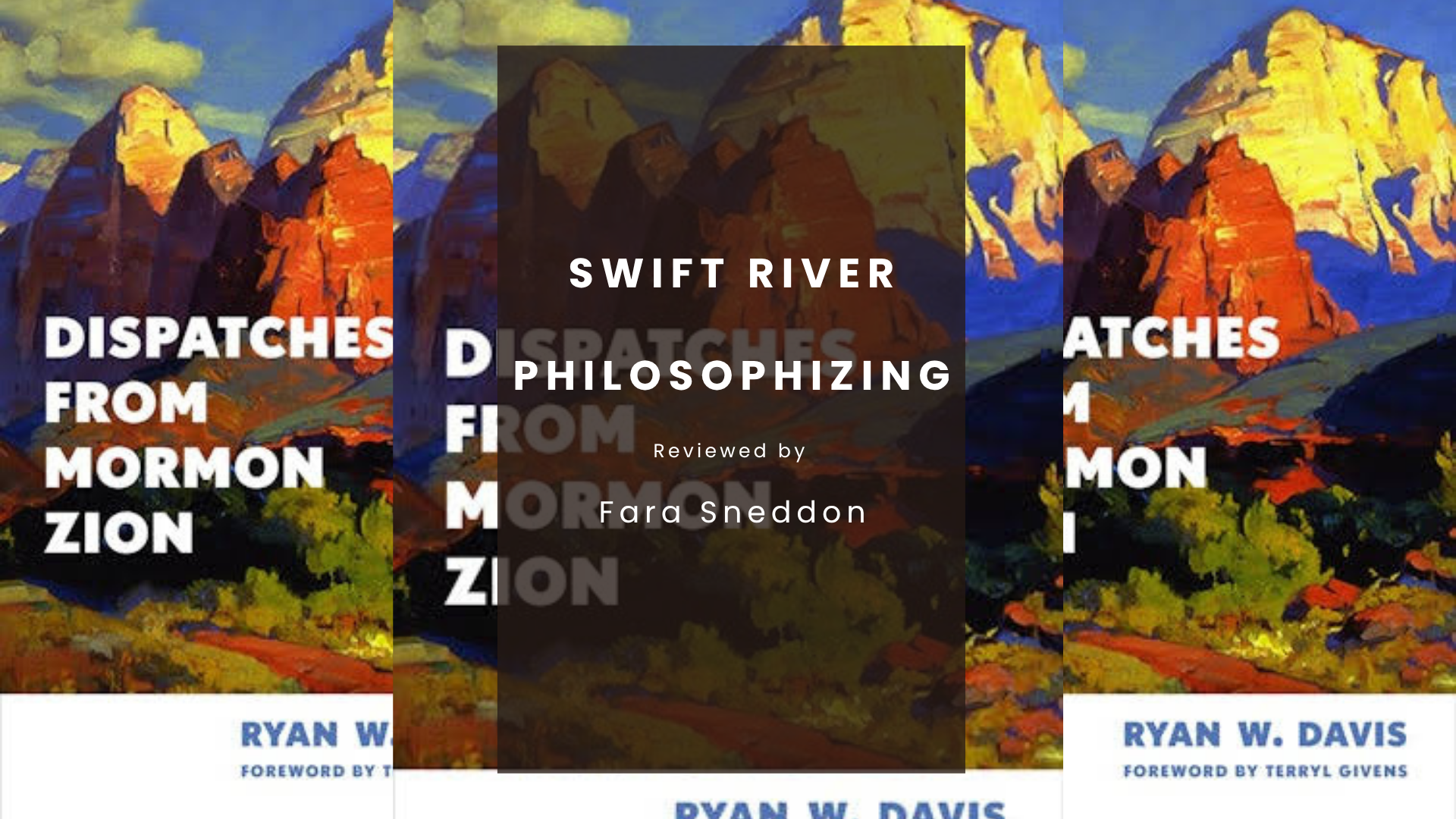
Ryan Davis’s new book, Dispatches from Mormon Zion, is a collection of ten essays, all connected by two central tenets: that Mormonism is magnified and made richer by considering it outside of the narrow confines of strict behavior rules and expectations. Mormon people, Davis shows us again and again, grow closer to a Zion-like life when love, not stricture, is primary. This is the “cultural experience” he wants to explore, and he does so through storytelling, personal experiences, philosophical exploration, and Taylor Swift.
Davis, an associate professor of political science at Brigham Young University, fills his essays with a variety of characters and personal interactions. He speaks of his divorce, of being friended by a small girl on a scooter who wants to learn how to fish, of colleagues he takes out to Strawberry Reservoir to teach how to fly fish. He tells about the men fishing on the Provo River who are aghast (almost offended) at Davis’s refusal to take his catch—instead, he releases his fish back into the river. In all ways, Davis comes across as deeply thoughtful, kind, and genuinely engaged in the wide-reaching act of making his community a home: “[H]ome is less in the geography of one’s origin that in the habits of one’s action.” Action is, of course, agency, and it is through what he calls “integrated agency” that he works to build a Zion of his own, maintaining “empathetic relationships with people who are otherwise strangers” (28).
Davis is concerned with both the moments when we rise above self-interest with kindness and love for the other, particularly the other for whom we have no responsibility or whom we may even actively dislike. He writes, “The ambition to build a Zion community could sometimes lead to moral disaster” (xiii). Certainly, this is evident in wards as the differences in our worldviews diverge. Davis explains that “The work of making Zion is the work of taking time and effort to see others the way they see themselves—or, maybe, to see the persons they want to become” (xx). This practice of setting aside our biases, judgements, and ego, of opening our world to larger love, kindness, and “relationships of empathy are what Zion is made of” (35).
Love is central to Davis’s book, particularly love without putting expectations on one another. In chapter 4, Davis turns to the lyrics of Taylor Swift’s songs. While this may put off some readers or risk dating the book in years to come, the chapter itself is an excellent bit of literary analysis. In the middle of his book, Davis shifts from the lofty ideas of Zion, love for the one unlike ourselves, love for community and learning and the fish in the water, and instead dissects love in a way that allows the reader to understand, for perhaps the first time, the pitfalls we all navigate (often quite poorly and solipsistically) when we grapple with the hope or the hate that comes with romance. As a reader who is not a Swiftie, I admit to rolling my eyes when I first saw the subject matter of this chapter. I have repented. Davis’s parsing and explanations regarding love in theory and love in reality are fantastic and truly helpful in understanding both oneself and one another. This is a chapter to share widely, to read with your teenager or spouse.
Part of what makes love and loving so fraught is the inability to know what the other is thinking: if they’re being honest, if they’re hiding things. This shifts Davis to the topic of guile: the misinformation we give about who we are, about what we want, and how we present ourselves in a way that gets us what we want. We as humans judge others based on how they look, how they speak, what comments they make in Relief Society. Almost all of us act with guile at times, and all of us harshly judge others at times. Davis holds up a mirror to our guile as he, with love and kindness, reminds us how Christ interacted with both those who loved him and those who did not.
The essays in Davis’s book are tight, thoughtful, and edifying. They encourage a reconsideration on the part of the reader, a nudge to learn and want to make changes that lead all of us toward something closer to Zion. This is the point from the very start of Davis’s essays: We are all included in world-building/disassembling/meaning and finding creative ways of being in a religious system whose goal is to elevate all humankind.
One last note from Davis: “[If] somehow or other, the universe deals you a chance to respond to someone in a way that affirms, understands, or even shares in the way they value themselves, then you are in a position to give them a very special gift” (175). Amen.
Ryan W. Davis. Dispatches from Mormon Zion. Eerdmans, 2025. 205 pp. Hardcover: $22.99. ISBN: 978-0802884695.