

 Back to full Issue

Articles/Essays – Volume 59, No. 02
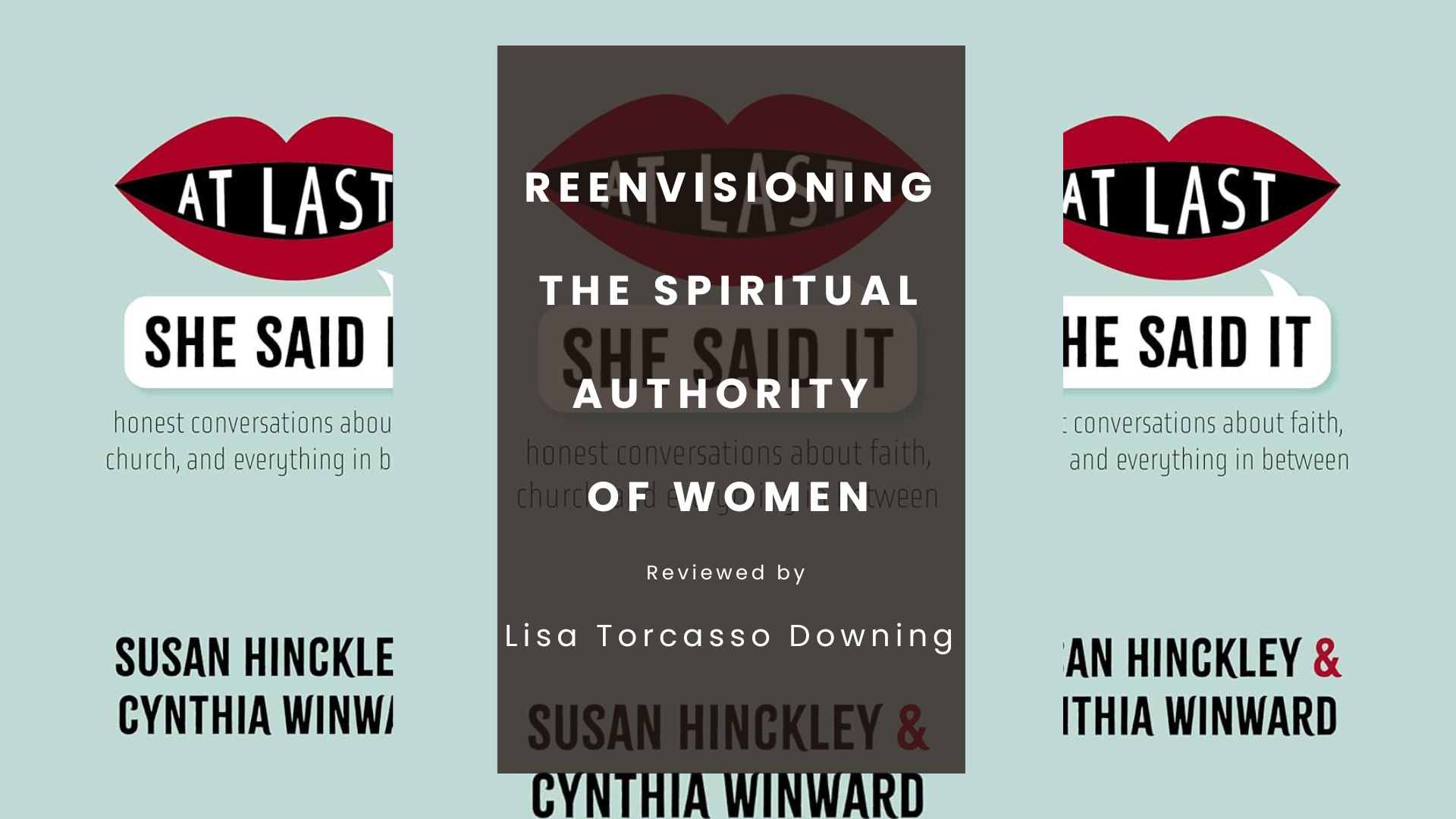
Reenvisioning the Spiritual Authority of Women | Susan Hinckley and Cynthia Winward, At Last She Said It: Honest Conversations About Faith, Church, and Everything in Between
The intersection of Mormon feminism and faith deconstruction among Latter-day Saint women is well established. That intersection has hosted a chicken or egg debate for as long as I can remember, often centering on which pops first into the female mind—religious doubt or feminist ideals? These are the questions of religious patriarchs who pause at this intersection, full of concern for themselves and their system. The answer they seek is one which, they hope, will explain how to keep women participating in a system that consistently overlooks and ignores them. For women who come to this intersection, the questions that arise are sometimes initially performative as they hope to satisfy the male voices burned into their psyches which have told them to stay small and, for their eternal well-being, safely inside the patriarchal box. However, the LDS women who reach this intersection face an internal wrestle with God that eventually drowns out the tomfoolery of living for an eternal life of submission to male dominance, a wrestle that allows them—us—to discover a truer voice in the divine cosmos—our own—and to understand more fully what it means to be a daughter of God. Today, women gather at this intersection and openly talk about our concerns, saying them out loud, without shame, under an open sky.
Enter podcast hosts turned authors Susan Hinckley and Cynthia Winward, who have taken the internal struggles of women living under LDS patriarchy and given them voice in their breakout book At Last She Said It: Honest Conversations about Faith, Church, and Everything in Between. The authors, who self-identify as “women of faith, discussing complicated things,” challenge the status quo of the Church of Jesus Christ of Latter-day Saints and its culture while laying claim to LDS Mormonism as their chosen faith practice, their heritage, and as an identity they love. Having both been raised in LDS homes, Hinckley and Winward were handed a familiar life script, a one-size-fits-all plan for women to follow that promises them an eternal reward. And follow that script they did. But life often leads us to unexpected intersections, as it did Hinckley and Winward. Every page of their new book flips that one-size script this way and that, candidly examining it for its strengths and weaknesses, and yet they never disparage the chosen path of any woman. Their book, like their podcast of the same name, is, in its own way, a fresh gathering place for the new LDS woman.
The authors separate their text into five sections: “Dancing with the Patriarchy,” “Outside the Box,” “What about . . .?,” “It’s Complicated,” and “Embracing Your Journey.” Each section is fleshed out with several titled subsections that brim with personal stories and insight. Their explorations include, but are not limited to, grappling with the doctrine of the heavenly mother, the often painful lifestyle of women who live under patriarchy, the ordination conundrum, the place imagination and creativity have in developing spiritual understanding and connection to the divine, as well as the inadequacies they’ve found in the typical framing of Mormon concepts like obedience, blessings, repentance, and worthiness. Winward, in particular, offers their readers a stellar treatise on grace, a vital gospel tenet that often seems buried under the weight of LDS dogma. “Forgotten,” she writes of grace, “but delicious.” Indeed. On every page, their love for both the Mormon story and way of life is ever present. They practice the grace that Winward salutes.
The book’s greatest strength is in the authors’ vulnerability and their firm insistence that their shifting beliefs are a sign of spiritual growth, not backsliding (or, in Mormonspeak, not “choosing a lesser eternal kingdom”). They have embraced their “not knowing” as open space in which there is infinite room to explore, discover, imagine, and grow. Their prose often reads as the psalms which are part celebration of life’s journey and part confession of tensions that have expanded their understanding of both God and themselves. Their tone, however, is casual, even chatty as they strive to mirror their podcast’s conversational format. They volley essays back and forth, often giving us two perspectives on a given topic.
Hinckley, a gifted wordsmith, demonstrates the book’s vulnerability as she shares how her faith life was upended when her adult children left the church she had raised them to love, thus shattering her expectations:
And now, what good was a church that was not big enough to hold my own beautiful children? Without my family, the box I’d expected to always contain our shared god felt hollow, echoing and suffocating all at one. . . . It seemed I’d invested a lifetime in guarding the box only to find that what I assumed was inside maybe wasn’t there at all. Once my children left the God Box we’d all lived in, they somehow took everything I recognized as God with them. . . . I found myself alone, unable to breathe there.
Did I ever really know God at all? What about my decades of careful observance, my willingness to swallow big questions rather than endanger myself, and everyone around me, by speaking them out loud? Suddenly I felt I’d been grasping at god-straws forever, knowing all along they probably couldn’t save me. Had my own potential ability to experience the Divine in the way my spirit yearned to—as large and small and mysteriously both personal and universal—been hampered by the box that my religion had built? A result of one man’s very specific experience with God? A box I’d not only been willing to accept on faith but had spent a lifetime trying to make my own? (48)
Hinckley’s yearning to discover how God would show up for her, a woman, as opposed to an early nineteenth-century boy prophet, felt like exploring a garden in its varied seasons. The foliage is brittle at the start, as in the above passage, but, when watered with introspection, soon buds and then blooms into new hope and understanding.
This book is a gift to today’s LDS woman who claims for herself her own authority over her spiritual life. It may feel like first aid to women who’ve been bruised and broken living under LDS patriarchy, but it’s not a how-to guide, not some fix-me manual that explains how to erase the tensions women experience through their association with the Church of Jesus Christ of Latter-day Saints as presently structured. Rather it is a we-can illustration that empowers its readers to trust their own compass, their own process, and their own ability to reimagine a theology that lifts them rather than subjects them. Importantly, it is a thoughtful text that will benefit readers, regardless of their gender. Men, after all, shouldn’t be the only ones heard talking at the intersection of theology and feminist thought.
Susan Hinckley and Cynthia Winward. At Last She Said It: Honest Conversations About Faith, Church, and Everything in Between. Signature Books, 2025. 265 pp. Paperback: $24.95. ISBN: 978-1560855217.