

 Back to full Issue

Articles/Essays – Volume 59, No. 3
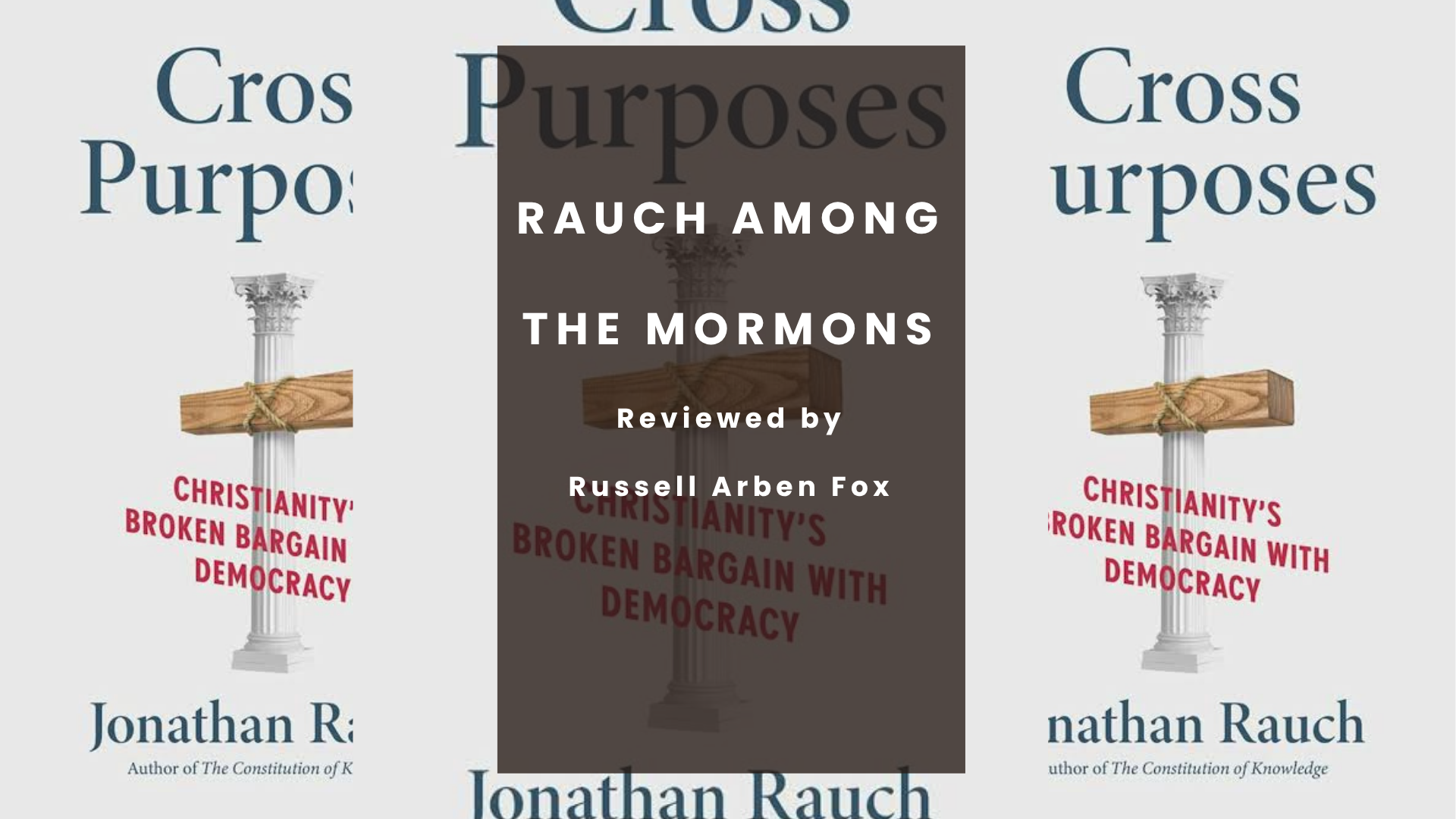
Rauch Among the Mormons | Jonathan Rauch, Cross Purposes: Christianity’s Broken Bargain with Democracy
Jonathan Rauch’s Cross Purposes, the latest book by the longtime policy journalist and public thinker, presents two broad arguments: first, that throughout American history, Christian churches have played an essential role in enabling our liberal democracy to properly function; and second, that America’s Christian churches (mostly, though not exclusively, Protestant ones) have of late abandoned this role, and by so doing have contributed to the breakdown of liberal and democratic rules and norms in American life. In addition to those two broad claims, Rauch makes a third argument: that the Church of Jesus Christ of Latter-day Saints has continued to model exactly the sort of role that, historically, American Christian churches once played. Therefore, he asserts, the more the rest of American Christianity can learn from and perhaps even emulate the Mormons and the ways their discourse has created space for a pluralistic civic theology, the healthier America’s democratic culture and institutions will be.
Given the praise contained in that third point—and given the philosophically liberal, politically moderate presumptions that underlie it and are generally embraced by the university-educated—it’s not surprising that Rauch and his book have received a positive, bordering on enthusiastic, reception among intellectually-inclined mainstream American Mormons.[1] In contrast, a small, philosophically (as opposed to merely politically) conservative minority have viewed Rauch’s arguments far more suspiciously.[2] Who is right? Assessing that requires considering Rauch’s claims in greater detail.
Rauch is well-known as an advocate of classical liberalism and political moderation; indeed, a large part of his reputation as a writer has been built on the fact that he is both an unapologetic atheist and a gay activist, yet neither reasons nor votes the way most Americans would stereotypically assume a gay atheist would (he has mostly been associated with wonky, politically moderate causes throughout his career). Over the decades, he has written thoughtfully about how government programs, however well-intentioned, tend to lessen both the government’s legitimacy and efficiency,[3] how the attempt to make language and procedures more inclusive only introduces an inquisitorial mindset that is harmful to all,[4] how the legalization of same-sex marriage would strengthen the cultural importance of marriage rather than encourage sexual liberation,[5] and how—in his most recent and very philosophically ambitious book—a free society depends upon embracing the achievability of objective knowledge, even when that involves delegitimizing certain revolutionary alternatives and choices.[6] Throughout it all, Rauch has presented himself as a consummate pragmatist, always asking careful questions and eschewing any kind of controlling ideology.
Of course, as with pragmatism generally, this kind of evidence-based, practical-minded worldview tends to support a particular ideological position—namely, a classically liberal, utilitarian, and secular one, in the spirit of John Locke, Adam Smith, James Madison, Jeremy Bentham, and John Stuart Mill. Early in Cross Purposes, Rauch succinctly describes his ideological preferences (though without calling them that): “the modern tradition of freedom, toleration, minority rights, and the rule of law.” In support of such aims, he sees “three linked social systems” as essential: “liberal democracy to make political choices; market capitalism to make economic choices; and science and other forms of open critical exchange to make epistemic choices” (12). He is and long has been a consistent defender of responsible, thoughtful, but nonetheless total individual choice, in matters of politics and economics and religion, unfettered by custom or community.
But for all that, because he also accepts as both prudentially necessary and philosophically correct that choices must be made responsibly and thoughtfully, he’s not a libertarian. He knows that there are things that he does not and perhaps cannot know, and thus he needs to rein in his individual liberty and trust at least to a certain degree in the slow, patient work of ideas and options through society and culture. It is that conservatism in his nature that has led him, a nonbeliever, to take seriously the historical role that Christianity has played in the development of the American democratic system that he prizes. In the book, he repents of his one-time intellectual overreliance upon the separation of church and state when addressing social and political problems; he now views his youthful celebration of “apatheism”—the ideal of simply “not caring very much one way or another about religion”—as “superficial” (5). Instead, he now believes “not just that secular liberalism and religious faith are instrumentally interdependent but that each is intrinsically reliant on the other to build a morally and epistemically complete and coherent account of the world” (21). Secularism and freedom of choice cannot fulfill the human need for belonging and meaning, and the Christian religion cannot escape its inability to account for the physical laws and the moral horrors of the universe. Hence, what is necessary—and what he believes that “the United States has been generally good” at for most of its existence—is for both American Christianity and liberal democracy to do their part in holding up the walls of our civic home. Creating an environment wherein this balance can be maintained requires “that the Constitution be interpreted in a way which is consistent with the well-being of law-abiding faith communities, and that God’s work be interpreted in a way which is consistent with the well-being of democratic pluralism” (33). The rule of liberalism in matters of politics and law must always accommodate religious exceptions, he affirms; but at the same time, the rule of Christian faith in society and culture must always give way to liberal protections and rights. This is a complicated balance, but it is one Rauch has confidence in, and one that he seeks to persuade his secular readers to be confident in as well.
From this point, Rauch moves forward with an argument that aligns with a good deal of other contemporary sociological research and political observation. First, that over the twentieth century, mainline Protestant churches became less culturally distinct, losing their ability to mold their parishioners and implicitly direct them toward the virtuous role they had historically played in America’s civic order. And second, that Protestant churches that rejected the mainline’s compromise with secular liberalism gradually moved in an ever more partisan direction, adopting a paranoid and conspiratorial version of Christian teachings, which Rauch refers to as the “Church of Fear.” This transformation led them to acquiesce to—and eventually to triumphantly embrace—the vulgarity, immorality, and cruelty of Donald Trump’s paranoia and grasping defensiveness as their perfect political avatar.
While I will not deny that my personal political judgments are a factor here, I would still insist that the passages where Rauch brings the receipts, showing how thoroughly un-Christian it is to support Trump and the party he has built in his image, are really the best in the whole book. (One hopes that, by the time this essay is printed, Trump’s transformation of American democracy in an authoritarian direction will not be so complete as to prevent the previous sentence from being published.) Rauch shows how evangelical Christians dismissed their previous insistence upon personal character in judging candidates and ignored Trump’s criminality; how their gleeful identification with Trump as a culture fighter underscores how little faith they actually have in God’s providence; and how their embrace of what Rauch calls “sharp Christianity” prevents them from articulating even a semblance of adherence to the Christian imperative to forgive and love rather than fight and punish. It is, frankly, a damning indictment, and since he believes that those imperatives have been central to the development of the civic culture within which American democracy flourished, it is an indictment of Trump’s Christian supporters as un-American as well. As he concludes:
[S]ecular liberalism and Christianity have separate purposes. They do not need to ally (and should not); but they do need to align, at least well enough so that democracy’s wheels don’t come off. . . . In that respect, we seculars are entitled to hold the church accountable to the democracy of which it is part. We are entitled to hold it accountable for the choices it makes. While the church’s relationship with God is its own business, secular Americans are justified in reminding our Christian friends that the Church of Fear is toxic for them and for us. We are not out of our lane to suggest that what Russell Moore calls “confident Christianity”—one which “constantly reminds us that this life is less important than the next [and] demonstrates something of what it means to forgive and serve one another”—needs repair for all our sakes. In short, we have standing to hope, perhaps even insist, that Christians get their act together. (89)
Rauch believes American Mormonism provides a model of action that Christians could use as a blueprint to repair themselves. But should thoughtful LDS members accept as accurate his overarching historical account of American civic pluralism? Should we accept as correct what he sees within the Church of Jesus Christ of Latter-day Saints as contributing to it? And if American Mormons do not accept one or both of these, does that mean the conservative critique of Rauch is correct?
Let’s begin with what I assume to be the most obvious problem (at least for the likely readers of this essay; were Dialogue a Roman Catholic publication, Rauch’s Protestant-centric account of America’s civic culture would likely rankle even more). Any Mormon who can qualify the insistent celebration of Americanism that came to characterize the rhetoric and culture of the post-polygamy LDS Church of the twentieth century—an insistence that arguably is still far from truly fading—ought to be prompted to ask Rauch why his initial description of the American bargain between Christianity and democracy didn’t provide some explanation for the profoundly anti-pluralist attacks on Mormonism that defined its development for decades. After all, perhaps the single greatest piece of evidence from American religious history that the country’s liberal democracy was not, in fact, built within the liberal civic walls Rauch describes was the official exclusion and persecution that violently drove the Church of Jesus Christ of Latter-day Saints out of the United States entirely. And this is not a parochial point; placing nineteenth-century anti-Mormonism alongside slavery and Know-Nothingism as clear signs that America’s Protestant Christian civic culture was heavily dependent upon racial, ethnic, religious, and gender exclusion is broadly accepted as a key component of any historically honest consideration of America’s civic identity.[7]
Yet the only discussion of this defining example of religious oppression in American history that is present in Cross Purposes isn’t to be found in Rauch’s description of the intellectual components of America’s liberal democratic culture, as it should be; rather, it appears as one of the motivating reasons why Mormons, in Rauch’s reading, are so supportive of that democratic culture: “the modern church’s . . . memory of persecution has bred sensitivity to the importance of religious freedom and pluralism” (108). Contrary examples from Mormon history, like Brigham Young’s politically illiberal State of Deseret or the economically illiberal United Order of Enoch, receive no mention in the book. Joseph Smith’s Council of Fifty does get a mention, but even that rhetorical embrace of religious authoritarianism—however quickly abandoned—is instead presented entirely in terms of a defense of freedom and religious choice, emphasizing how “Smith went so far as to . . . propose constitutional revisions requiring ‘the armies of the government’ to enforce ‘principles of liberty’ for all people, not just the Protestant majority” (110). That Rauch passes over the complications of Smith’s not-always-coherent embrace of both religious authoritarianism and republican freedom,[8] to say nothing of other explorations of very real authoritarian alternatives present throughout American history is, perhaps, predictable but still unfortunate.
My point here is not to claim that LDS Church members or Americans generally must necessarily have some secret, ambiguous authoritarianism historically buried in our belief system. (Not that the rise of Trump hasn’t led some historians of American religion to suggest exactly that.[9]) Rather, it is to claim that Rauch’s understanding of America’s liberal democracy and its relationship to expressions of religious faith, both as a matter of history and a matter of theory, is simplistic, and it requires papering over many ideas and actions that cannot be neatly arranged into a straightforward argument against the terrible choices Trump-supporting Christian churches have made, however worthwhile such an argument may be. There are thoughtful, historically grounded accounts of the development of LDS doctrine and practice that provide support for Rauch’s thesis, seeing in LDS revelations various prophetic statements in support of freedom of conscience and secular moderation.[10] But there is plenty of similar scholarship that makes the opposite case—that Mormonism, both theoretically and practically, is half-hearted at best in its accommodation of liberal freedoms, rational procedures, and cultural pluralism.[11] Rauch’s recruitment of the Church of Jesus Christ of Latter-day Saints into his invocation of a more liberal, less Trumpish Christianity is bound to attract much support from faithful Mormons frustrated with our religious culture’s recent political turn, but it needs more work than he provides.
To give Rauch credit, he does make thoughtful use of the LDS doctrine of agency, employing that doctrine (which, under Rauch’s reading, stipulates that, as all of God’s children have the ability to make choices, the process of choice—if not necessarily the end result—must itself be respected, tolerated, and negotiated with) to persuasively elaborate upon several passages in sermons and speeches given by President Dallin H. Oaks. He summarizes: “Oaks argues for an alignment between God’s moral constitution and Madison’s political one. Speaking for the church, he sees patience, negotiation, and compromise . . . as social and spiritual ends unto themselves” (96). There is a quality to Rauch’s writings here that can only be described as heartfelt; there is no doubting his sincerity, and his deep appreciation of some of Oaks’s comments on the matter, when he writes about how he found the surprise passage of the “Utah Compromise” in 2015—which provided protection against housing and employment discrimination to Utah’s LGBTQ population—as “inspirational” (100). But still, it is difficult to square his praise, for example, for Utah governor Spencer Cox when he apologized to LGBTQ Utahns for his past offenses in 2016, with his silence regarding Cox’s vocal support for Donald Trump and opposition to the interests of trans individuals in 2024. Or for his quotation of polls from 2016 and 2020, showing comparatively low levels of support for Trump among LDS Republicans, and using that as support for his assertions about the supposed liberality of Mormon Christianity, while failing to note more recent polls that show that support for Trump increased among all Mormon demographics in 2024. True, all these snapshots are part of a complicated story. But a complicated story about LDS history and culture—one where our appreciation of personal agency and public-spiritedness is deeply entwined with our own particular, often partisan, prophet-idolizing Church of Fear—is not what Rauch wanted to tell.
In some ways, the critique of Rauch made by conservative (or “post-liberal”) Mormons is thus correct. For those wanting to accept Rauch’s conflation of being a good Mormon and being a good (that is, non-Trumpist) modern American, Ralph Hancock’s pointed challenge is a hard one to deal with. Hancock asks, “How can religion ‘align’ itself with liberalism . . . without at some level in or some way ‘supporting’ Rauch’s liberal (that is, atheistic and ‘scientific’) understanding of truth and of humanity?” Hancock’s fierce dismissal of Rauch’s key theological claim about Mormonism (“[Rauch’s] understanding of ‘agency’ is neither a remotely adequate phenomenology of human choice nor a serious rendering of LDS belief”) is also very much on point.[12]
But overall, Hancock’s conservative rebuke of Rauch’s longed for (and simplistic) rapprochement between liberal principles and Christian churches in America is also, in its own way, superficial. Rauch’s summation of the message of Christianity as “Don’t be afraid. Imitate Jesus. Forgive each other” is obviously incomplete and designed to point out an easy alignment between Jesus and Rauch’s hero, James Madison. But it is a substantive message, nonetheless, one grounded in a deep conviction of and commitment to Jesus’s loving, sacrificial gift of grace. To claim, as Hancock does, that the characteristics of Christianity that Rauch correctly condemns many Christian churches for having abandoned in their partisan, paranoid embrace of Donald Trump—namely, humility, forgiveness, and tolerance—are actually insufficient to allow for “substantial participation as Christians in public life” is nonsense. Or at least, it is nonsensical if one accepts such profoundly pluralistic giants of liberal Christianity from Dorothy Day to William Sloane Coffin to Fred Rogers to Gene England as Christians, which I assume Hancock would, though perhaps only grudgingly.
To be fair to Hancock, none of those Christian leaders had to explicitly confront what he considers to be the primary challenge to substantive Christian belief today: namely, gay marriage and other assorted issues pertaining to the rights of LGBTQ individuals. Rauch himself frequently underscores how difficult these concerns—including his own marriage to his gay partner—are for certain Christian believers. This takes him back to the LDS Church and how he believes its chastening failure in the fight against same-sex marriage made it rededicate itself to its supposed inner liberalism: “After its Proposition 8 debacle in 2008, the Church of Jesus Christ of Latter-day Saints has foregrounded those elements of its faith which harmonize with America’s constitutional order” (120). Rauch believes, in short, that even Mormonism’s illiberal elements (which he does not theologically explore at all) point in the direction of a Christianity at peace with pluralism and negotiation. After all, he argues, the LDS Church changed regarding plural marriage and the priesthood and temple ban on people of Black African decent, and yet it remains a substantive religious community. So why shouldn’t the rest of Christianity follow its example and make its way through a culture supportive of gay rights respectfully, too?
And it is this prospect which most horrifies conservative critics of Rauch’s vision of Mormonism. Hancock is dismayed at the possibility that “LDS church members have been insufficiently appreciative of the positive cultural and evangelical effects of the church’s alliance with Roman Catholics and others” in opposing gay marriage; that the institutional church, in its drive to “participate in the fashioning of legislative compromises” over LGBTQ issues, will not fully attend to the “trade-offs of these compromises and their long-term effects”; and that Mormons will take a little too seriously the idea of “peacemaking,” which comes “perilously close to endorsing not only the fundamental dignity of all God’s children, but even the ideological self-understanding of those with whom we find that we must compromise.”[13] These are the sorts of terrors that will keep those who insist that the substance of the Christian faith is entirely bound up in a few passages from Paul’s letter to the Romans (or Spencer W. Kimball’s The Miracle of Forgiveness) awake at night. The “Church of Fear,” indeed.
As a cynic in most things related to the ecclesiology of the LDS Church, I surprisingly find myself thinking that President Oaks’s words perhaps provide a better guide than Rauch or his critics to the complexities of maintaining a binding Christian faith in the midst of a world of individual choice, as well as a better guide to the doctrinal imperatives behind such supposedly banal principles as showing respect to and nonviolent acceptance of those with whom one disagrees. Rauch celebrates Oaks’s comments at his University of Virginia lecture in 2021, “Going Forward with Religious Freedom and Non-Discrimination.”[14] However, that speech leaves aside explicit consideration of LGBTQ issues, mentioning them only in passing, preferring to avoid any direct reference to doctrine (whether religious or constitutional) and endorsing instead the view of a colleague of his that informal, practical trade-offs work well in addressing questions about compromise where “abstract principles sometimes cannot.” Oaks has obviously addressed balancing abstract religious imperatives with secular necessities many times before, and sometimes harshly, but there is reason to see his rhetoric as having moved away from strict constitutional interpretation over the decades, as have the positions of the Church leadership as a whole.[15] In an interview with Rauch, Oaks acknowledges that, in adjusting some (though obviously not all) of its language about and approach to LGBTQ individuals and interests since 2008, the Church of Jesus Christ of Latter-day Saints has “left some evangelicals behind” and can no longer count on the same level of “Catholic support” to say nothing of no longer “track[ing] well with conservative Republicans” (102). Given the strong support Utah continued to give Trump in 2024—and the fact that Utah’s entire congressional delegation is Republican—one can doubt Oaks’s comments to Rauch were entirely accurate. Yet they remain far from providing the sort of perspectives post-liberals might wish for.
For his part, Hancock describes Oaks’s sermon “Balancing Truth and Tolerance” as a “classic address,” highlighting its martial language: “We are cast as combatants in the war between truth and error. There is no middle ground.” But he seems to fail to fully appreciate the sermon’s very next sentence: “We must stand up for truth, even while we practice tolerance and respect for beliefs and ideas different from our own and for the people who hold them.”[16] This sentiment is not at all aligned with Hancock’s own post-liberal rejection of Rauch’s version of Mormonism, a rejection founded upon a supposed distinction between respect and tolerance, between people and the beliefs they hold. Hancock states that it simply isn’t possible for religious believers to function honestly in an environment of democratic compromise while holding to the understanding that their opponents are “profoundly and disastrously wrong”—yet that difficult thing is pretty much exactly what Oaks is calling the Mormon faithful to do.
Rauch is too much of a secular liberal, too committed to open inquiry and the philosophical premises that require open inquiry, to automatically assume that any one view is “profoundly and disastrously wrong.” In contrast to the paranoia of the post-liberals, Rauch’s view of Christianity—even that Christianity which he believes has been horribly twisted in advocacy for authoritarianism—is neither dismissive nor domineering; on the contrary, he feels it highlights what he calls the “exilic mindset,” the position of being a minority, as profoundly honorable (135). Rauch understands the virtue of those who see the world in accordance with a different truth than he, an understanding that Oaks at least sometimes seems to share. (In his address, Oaks insisted that, even when believing Mormons enjoy a majority position in a community, “they should always be sensitive to the views of the minority,” something that those members of the LDS Church who have become convinced that they alone are defending Western civilization against the woke and homosexual hordes should probably be reminded of.) So, while Rauch’s articulation of that virtue is far from philosophically satisfactory, he has nevertheless perceived something about kindness and respect, compromise and forgiveness, that too many Christians in America have forgotten. If this gay atheist has found a way to use Mormonism—or at least one small, rather insufficiently developed part of it—to call those Christians (including some members of our own tribe) to remember those classic virtues, we owe him our thanks and ought to listen to him as well.
Jonathan Rauch. Cross Purposes: Christianity’s Broken Bargain with Democracy. Yale University Press, 2025. 153 pp. Paperback: $20.00. ISBN: 9-780300-273540.
[1] See Peggy Fletcher Stack, “Why an Atheist Gay Jewish Writer Believes Mormonism Could Save Democracy,” Salt Lake Tribune, Jan. 25, 2025; Tad Walch, “The Remarkable Message a Brookings Senior Fellow Gave to BYU Students about the Civic Theology America Needs,” Deseret News, Jan. 25, 2025; “Can Mormonism Save American Democracy? A Conversation with Jonathan Rauch and Terryl Givens,” Wayfare, Feb. 14, 2025, https://www.wayfaremagazine.org/p/can-mormonism-save-american-democracy; Jonathan Rauch, “Latter-day Saints Can Save America,” Wayfare, June 30, 2025, https://www.wayfaremagazine.org/p/latter-day-saints-can-save-america.
[2] Ralph Hancock, “Moral Agency and Sustainable Liberalism: Rauch’s Proposed Liberal-Christian Alliance” and “A New Political Theology of ‘Agency,’” June 4 and 5, 2025, Public Discourse: The Journal of the Witherspoon Institute, https://www.thepublicdiscourse.com/2025/06/98066/ and https://www.thepublicdiscourse.com/2025/06/98068/.
[3] Jonathan Rauch, Demosclerosis: The Silent Killer of American Government (Crown, 1994).
[4] Jonathan Rauch, Kindly Inquisitors: The New Attacks on Free Thought (University of Chicago Press, 1995).
[5] Jonathan Rauch, Gay Marriage: Why It Is Good for Gays, Good for Straights, and Good for America (Holt, 2005).
[6] Jonathan Rauch, The Constitution of Knowledge: A Defense of Truth (Brookings Institution Press, 2021).
[7] See, among many other sources: J. Spencer Fluhman, “A Peculiar People”: Anti-Mormonism and the Making of Religion in Nineteenth-Century America (University of North Carolina Press, 2014); Megan Sanborn Jones, Performing American Identity in Anti-Mormon Melodrama (Routledge, 2013); Patrick Mason, The Mormon Menace: Violence and Anti-Mormonism in the Postbellum South (Oxford University Press, 2011); and Donald Scott, “Mormonism and the American Mainstream,” National Humanities Center, https://nationalhumanitiescenter.org/tserve/nineteen/nkeyinfo/nmormon.htm.
[8] See Benjamin E. Park, Kingdom of Nauvoo: The Rise and Fall of a Religious Empire on the American Frontier (W.W. Norton, 2020), and Russell Arben Fox, “Religious Liberty and Joseph Smith in Park’s Kingdom of Nauvoo,” By Common Consent (blog), Feb. 9, 2020, https://bycommonconsent.com/2020/02/09/religious-liberty-and-joseph-smith-in-parks-kingdom-of-nauvoo/.
[9] Michael J. Christensen, “‘No Kings’: The Rise of Religious Authoritarianism In America,” Religion Unplugged, June 14, 2025, https://religionunplugged.com/news/2025/6/14/no-kings-the-rise-of-religious-authoritarianism-in-america/.
[10] See R. Collin Mangrum, “Mormonism, Philosophical Liberalism, and the Constitution,” BYU Studies 27, no. 3 (Summer 1987): 119–37; Rodney K. Smith, “James Madison, John Witherspoon, and Oliver Cowdery: The First Amendment and the 134th Section of the Doctrine and Covenants,” Brigham Young University Law Review (2003): 891–940; and Frederick Mark Gedicks, “No Man’s Land”: The Place of Latter-day Saints in the Culture War (Indiana University Press, 1999).
[11] See Steven D. Smith, “The Promise and Perils of Conscience,” Brigham Young University Law Review (2003): 1057–66; D. Michael Quinn, “Exporting Utah’s Theocracy Since 1975: Mormon Organizational Behavior and America’s Cultural Wars,” in God and Country: Politics in Utah, edited by Jeffery E. Sellis (Signature Books, 2005), 129–68; Gordon and Gary Shepherd, A Kingdom Transformed: Early Mormonism and the Modern LDS Church, 2nd ed. (University of Utah Press, 2016).
[12] Hancock, “Moral Agency and Sustainable Liberalism.”
[13] Hancock, “A New Political Theology of ‘Agency.’”
[14] Dallin H. Oaks, “Going Forward with Religious Freedom and Nondiscrimination,” 2021 Joseph Smith Lecture at the University of Virginia, Nov. 12, 2021, https://newsroom.churchofjesuschrist.org/article/president-dallin-h-oaks-speech-university-of-virginia/.
[15] See Mauro Properzi, “LDS Understanding of Religious Freedom: Responding to the Shifting Cultural Pendulum,” Journal of Mormon History 38, no. 3 (2012): 128–47.
[16] Dallin H. Oaks, “Balancing Truth and Tolerance,” Church Educational System, Sept. 11, 2011, https://www.churchofjesuschrist.org/study/ensign/2013/02/balancing-truth-and-tolerance?lang=eng. Italics added.