Broken Vessels: A Series
March 13, 2018A series of six found poems derived from “Agency, Disability, and Atonement” by J. Mark Olsen.


A series of six found poems derived from “Agency, Disability, and Atonement” by J. Mark Olsen.
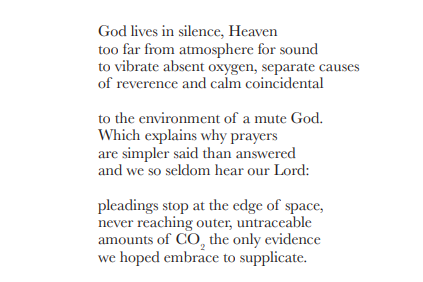
God lives in silence, Heaven
too far from atmosphere for sound
to vibrate absent oxygen, separate causes
of reverence and calm coincidental
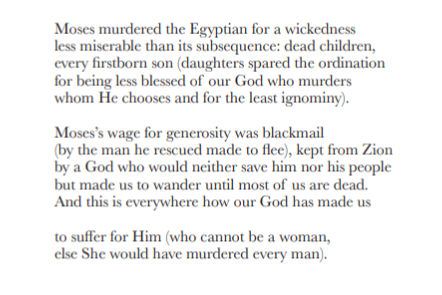
Moses murdered the Egyptian for a wickedness
less miserable than its subsequence: dead children,
every firstborn son (daughters spared the ordination
for being less blessed of our God who murders
whom He chooses and for the least ignominy).
For the premiere production held in the Cafritz Foundation Theatre at the University of Maryland, College Park on December 10–12, 2014. The production was supported by the Clarice Smith Performing Arts Center’s Second Season Program…

Psychologist William James referred to personal identity as psychology’s “most puzzling puzzle.”The oracle of Delphi’s most famous charge—Know Yourself—affirms that human puzzlement over the nature of identity goes back to the early days of civilization, since the oracle would hardly find this counsel significant enough to utter if everyone already knew themselves as a matter of course. Descartes thought he had solved the problem by locating identity itself in the irreducible fact of consciousness, or the cogito of I think, therefore I am, but in our own day, philosopher-theologian Paul Ricoeur points out that the I implicit in Descartes’s first-person verb presumes itself, rather than proves itself, so that Descartes’s assurance only demands that we ask, “. . . what is this ‘I’”?A person’s very first step toward a definitive declaration of identity—in terms such as I am . . .—has no ground on which to land. Insofar as what constitutes any identity, or human identity, per se, still baffles us, we find ourselves unmoored even before we consider a question such as what constitutes a specific kind of identity.
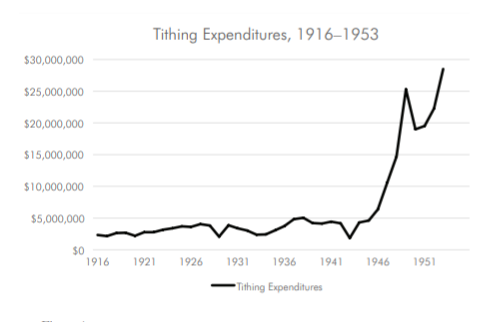
Every April in the Saturday afternoon session of its semi-annual General Conference, the managing director of the Auditing Department of the Church of Jesus Christ of Latter-day Saints (LDS Church) reads his department’s report for the prior year. The annual report invariably concludes that “in all material respects, contributions received, expenditures made, and assets of the Church . . . have been recorded and administered in accordance with appropriate accounting practices, approved budgets, and Church policies and procedures.” Presenting the Church Auditing Department’s reports at General Conference dates back at least to 1906. And today, this annual report provides the sole window into the global finances of the LDS Church.

My mother died recently from complications of Alzheimer’s. Because four of my siblings live near my parents and were helping my dad with arrangements, my sister Carol and I decided to fly on Sunday for the Tuesday morning service and then stay longer after the funeral. We arrived at my dad’s apartment Sunday afternoon, anticipating some quiet hours of reminiscing or just relaxing.

I somehow lived my first twenty-nine years never having heard of Fascinating Womanhood, a how-to-save-your-marriage manual cum-lifestyle popularized by a Mormon housewife in the early 1960s. Thanks to historian and author Julie Debra Neuffer, that…
The term “liberalism” with all its rhetorical permutations—self-identifying as a “liberal,” defending principles of “liberty,” showing “liberality” in one’s interactions with others, etc.—is a contested concept in America. It’s both an adjective and a noun.…