DiaBLOGue

Evenings in October

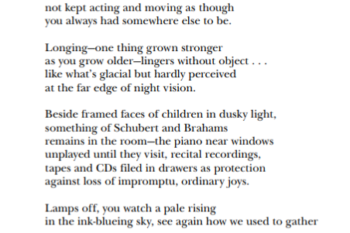
It’s the Schubert piece that does it . . .  
tonight you are moved into the dark to come  
where white roots are suddenly remembered,  
growing beautifully out of soil walls of a cellar  
gone half a century . . . white roots  

Not Far Off Trail, Late Summer

Where deep water widens and silks past 
the river island, you move through tall grasses  
downhill riverside, crouch through overhang  
and find yourself beneath a great  
low catalpa, broad leaves 

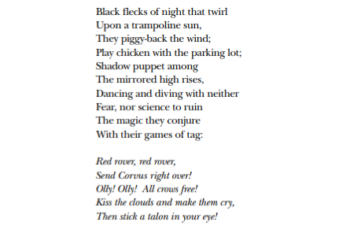
Crow Games

How high fly the crows? 
Thirty stories up I’ve seen them 
Swimming in currents of air, 
As confident as children in puddles. 

Haiku for the Cat

The fever is on me now.  
Since morning I can do nothing  
but crack pistachios between  
my thumbs and listen  
to the woody tinkle of their shells  
hitting the floor.  
I mutter haiku at the cat 
who bats them as they fall. 

Blood Cries

Sometimes you speak 
and I hear 
the words between us, 

Oblation

Death does not 
disturb me, nor fear 
of death. 

Sinners Welcome Here (2002)

Driving past the humongous brick building set way back from the street, I do an instant double take. Did I just see what I thought I saw? Did that sign say, “Sinners Welcome Here?” While I’m supposed to be negotiating traffic on my way to Costco, I’m rubbernecking, and I see that the sign says what I thought it said. The words are painted on a shiny plastic, weatherproof banner attached near the top of the building. 

Manly Virtue: Defining Male Sexuality in Nineteenth-Century Mormonism

Sexuality in antebellum America constituted a set of contradictions. Men should be steely, resolved, and assertive; women ought to be reserved, flighty, and, under the right conditions, sexually explosive. As historian Karen Lystra has observed, “There are no sexual absolutes. Sexual experience is time-bound,” a fact that holds true for the Mormon experience as well. 

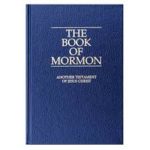
Hospitality in the Book of Mormon

Dialogue 47.1 (Spring 2014):24–57
his article will examine hospitality as it is found in the Book of Mormon. We will look at instances when a person (or group) invites an outsider (or group of outsiders) into the home or community, making note of how the hospitality is exercised, what motivates it, what role it plays in the Book of Mormon narrative, and what spiritual or religious dimensions it is assigned.

The Book of Mormon, the Early Nineteenth-Century Debates over Universalism, and the Development of the Novel Mormon Doctrines of Ultimate Rewards and Punishments

Dialogue 47.1 (Spring 2014):1–23
This conclusion is obviously problematic, as it implies that the early Church repudiated teachings from the Book of Mormon immediate￾ly following its publication. Thus there is a need for a reassessment of the relation between early nineteenth-century Universalism and the teachings of the Book of Mormon and subsequent revelations.