DiaBLOGue

“Wholesome, Hallowed, and Gracious”: Confronting the Winter’s Night

In northern Europe, where our celebration of the Christmas season has its roots, the winter nights are long, dark, and foreboding and, at least in myth, teeming with unwelcome mysteries. It was against this backdrop that the early Christian monks and missionaries transformed the pagan Yuletide festivals into our modern Christmas celebration. Be that as it may, there can be no doubt that the physical and spiritual darkness of winter seemed, for many, to be lifted at the Christmas season. 
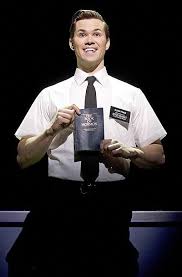
Elder Price Superstar | The Book of Mormon (Broadway musical)

I’ll never forget the first time I heard my mother swear. I was in my thirties and had finally decided to talk to her about her second husband, whom she’d married when I was eleven, divorced two years later, and about whom, as if by a silent contract, we never spoke. “So tell me what was going on in that marriage,” I said to her. She bit her lip, paused, then said, “It was really shitty.” And that was it. This woman from whose mouth I’d never heard a “hell” or a “damn,” a woman who read her Daily Light devotional every morning, listened all day to Christian radio, and kept a pocket-size New Testament in her glove compartment, had now, deliberately and with great care, spoken a word I could never imagine escaping her lips.

Inside the “Loyal Opposition” | Philip Lindholm, ed., Latter-day Dissent: At the Crossroads of Intellectual Inquiry and Ecclesiastical Authority

Few books convey the pain and poignancy of Mormon ecclesiastical discipline as compellingly as Latter-day Dissent: At the Crossroads of Intellectual Inquiry and Ecclesiastical Authority, a newly published paperback from Greg Kofford Books. The volume is the product of editor Philip Lindholm’s conversations with several prominent Mormons whose writings and speeches have provoked the ire of the LDS Church. While these dissidents’ recollections and reflections take center stage in Latter-day Dissent, Lindholm uses their stories to advance a reinterpretation of Mormon intellectual history.

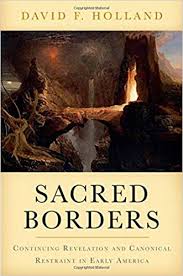
Canon: Open, Closed, Evolving | David F. Holland, Sacred Borders: Continuing Revelation and Canonical Restraint in Early America

Sacred Borders represents a rigorous and compelling consideration of various traditions about the state of the biblical canon in American religion. For bookish Latter-day Saints, this volume will provide much-needed context for early Mormon beliefs about their open canon as well as a subtle and sympathetic view of both sides of the debate over the closed canon.

Walking into the Heart of the Questions: An Interview with W. Grant McMurray

Greg: I’d like to start by talking about the Community of Christ (and its predecessor, the Reorganized Church of Jesus Christ of Latter Day Saints) in the early twentieth century. My recollection is that your faith tradition, like mine, went for a long time mostly holding onto traditions and not worrying too much about substantive change. Is that an adequate way of putting it? If you go back to 1860, you have basically a century where holding the line was primary? 

Grant: I think that’s fair to say. For Community of Christ—or the other names that have been used for it, but we’ll just use that name as representative of the entire period of time—the formative identity of the movement was built around two principles. One was an opposition to the practice of polygamy, which was a key identity element of the LDS Church in the West for most of the nineteenth century; and the second principle was a support for lineal succession as the proper mode of succession for the Church. There were various other modes—seven or eight of them—that can be documented historically as being expressed at some point by Joseph Smith Jr. Of course, the Mormon Church in the West accepted the mode of succession through senior leaders in the Council of Twelve Apostles.

Scaling Never

There are so many kinds of never. There’s the never that Jacob’s Mum uses when she says, “Never talk to strangers; it’s dangerous,” and there’s the never his Dad uses when he says, “Never play…

Vitae

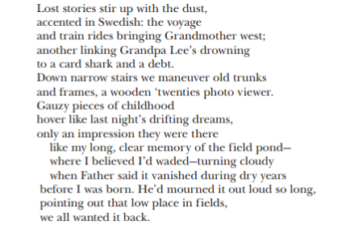
Lost stories stir up with the dust, 
accented in Swedish: the voyage 
and train rides bringing Grandmother west; 
another linking Grandpa Lee’s drowning