Letter to the Editor
March 16, 2018Kyle D Williams, Time for Galatians 3:28?



Kyle D Williams, Time for Galatians 3:28?
Roene Reeve was born December 21, 1946, in Hurricane, Utah, to Ora and Leo Reeve. She was welcomed into the family by her two older brothers, Stephen and David. Unknown to the doctor who delivered her, Roene was born with Rh disease. A postnatal blood transfusion prevents the disease from having negative consequences, but the doctor in Roene’s case was unaware of these procedures, and she went undiagnosed. By the time Ora and Leo took her to a specialist in Salt Lake City, it was too late. She was severely handicapped, both mentally and physically. When Roene was older, doctors recommended that she be institutionalized at the Utah State Hospital in American Fork. After only one month, Ora could not stand to be away from Roene and brought her home.
One of the most difficult and perilous times in a life is the transition from childhood to adulthood. Moving into the freedoms of adult life while still relying on parents to pay the bills creates tensions within the adolescent even as it brings frustrations for the parents. How does one make the leap from dependent to depend able, from reactionary to responsible? And will religious faith survive, go stagnant, or flourish through these changing roles and identities?
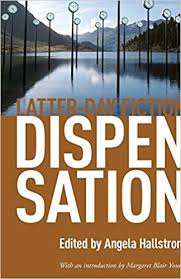
The cover of Dispensation: Latter-day Fiction shows clocks on long poles dipped into a blue lake surrounded by mountains. At first glance, the image symbolically suggests that this is the last dispensation and that all the…
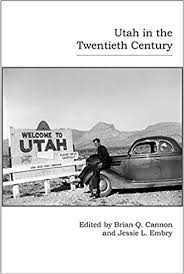
At the beginning of the twentieth century, the state of Utah had been marginalized and exotic; at the 2002 Winter Olympics held in Salt Lake City, however, it presented itself as central and metropolitan. Hailed…
In On the Road with Joseph Smith: An Author’s Diary (2d ed., Salt Lake City: Greg Kofford Books, 2007), we get a fascinating peek into Richard Lyman Bushman’s psyche immediately after the publication of his…

A mobile hangs from the ceiling above Phyllis Barber’s writing desk: tissue-paper ballerinas suspended in midair, light and delicate, twirling in currents of warmth from the nearby fireplace. As she labored to finish Raw Edges,…
In an article posted in September 2010 on Patheos.com, a website devoted to the discussion of religion and spirituality, Michael Otterson, managing director of Public Affairs for the LDS Church, wrote: “During the past few years, the Church of Jesus Christ of Latter-day Saints has navigated a period of intense public attention and scrutiny rarely seen during any other time in its history.” He buttressed this claim with the fact that for over a year “media attention far exceeded even the considerable interest generated during the 2002 Winter Olympics in Salt Lake City.” While Peculiar Portrayals: Mormons on the Page, Stage, and Screen looks at artistic productions rather than traditional journalism, its editors Mark T. Decker and Michael Austin agree with Otter son, stating that “Mormons and Mormonism have seen increasing scrutiny during the previous decade” (1). They even cite many of the same causes.
The title of this book may elicit wry smiles. Even casual consideration suggests that heterosexuality is doing just fine on its own, without the need for outside encouragement. The authors’ purpose, of course, is not to encourage heterosexuality so much as it is to discourage and disparage homosexuality based on their belief that it is a learned and chosen condition that can and must be changed because of its negative consequences for individuals, families, and society at large. The book is targeted primarily at a Mormon audience, although citations of LDS scriptural passages and statements by LDS authorities are presented as the words of “Christian prophets” or generic “church leaders.” Its pages provide self-help advice to parents about how to prevent or alter the unwanted same-sex attractions of their homosexual children.

Ronan: How did you become interested in New Religious Movements?
Massimo: I am from a Roman Catholic background but started being interested in other religions at a very early age. I think it was by reading novels from authors like Emilio Salgari who talked about the Middle East and Far East. He wrote a couple of Western novels, but most were in Hindu or Muslim settings. Also Kipling. Of course, I now realize that neither of these authors can be taken as good guides about the real East; but at the age of about seven or eight, I didn’t understand that they were not reliable sources.