DiaBLOGue

Thomas F. O’Dea on the Mormons: Retrospect and Assessment

I first encountered Thomas F. O’Dea through his book The Mormons which I read with considerable excitement. Here, it seemed to me, was a person professionally concerned with the development and enhancement of the scholarly…

Common Beginnings, Divergent Beliefs

Dialogue 11.1 (Spring 1979): 19–31
Within two years of his assasination, however, the Church was torn by succession struggles that led to dispersion. Almost a century and a half later, the whereabouts of many of these saints is still unknown.

“Cooperating in Works of the Spirit”: Notes Toward a Higher Dialogue

Communication is a matter of infinite hope. It is the emotion we feel when we send these fragile words however tentatively or forcefully out to others. Even those who write secret diaries, shrouded in cryptic codes, or who shout anonymous messages on subway walls, or who carefully hide parchment and golden plates in caves to come forth several millennia later all do so with the same expectation: that someone, somewhere will read and understand. 

Ten Years with Dialogue: A Personal Anniversary

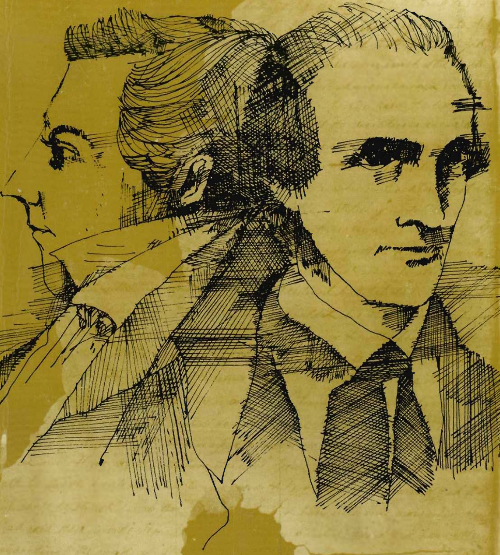
We looked a lot like the picture in the Dialogue logo, although, of course, we didn’t know it then. Gene and Charlotte England, Karl Keller and I were taking lunch on the lawn at the…

We Are What We Remember | Donald Marshall, Frost in the Orchard

Wright Morris once said, “The ‘subject’ of Wolfe, Hemingway, and Faulkner, however various the backgrounds, however contrasting the styles, pushed to its extremity, is nostalgia.” He should have included Fitzgerald, and even then the list…

A Tractable Tract | Gladys Clark Farmer, Elders and Sisters

Writing a book of short stories/sketches about a group of missionaries in France is picking a hard door to knock on—missionary work is surrounded with ideals, taboos, and nostalgia—but Gladys Clark Farmer makes it swing…