

 Back to full Issue


Articles/Essays – Volume 54, No. 4
Japanese Latter-day Saints and Personal Acculturation | Shinji Takagi, Conan Grames, Meagan Rainock, Unique But Not Different: Latter-Day Saints in Japan
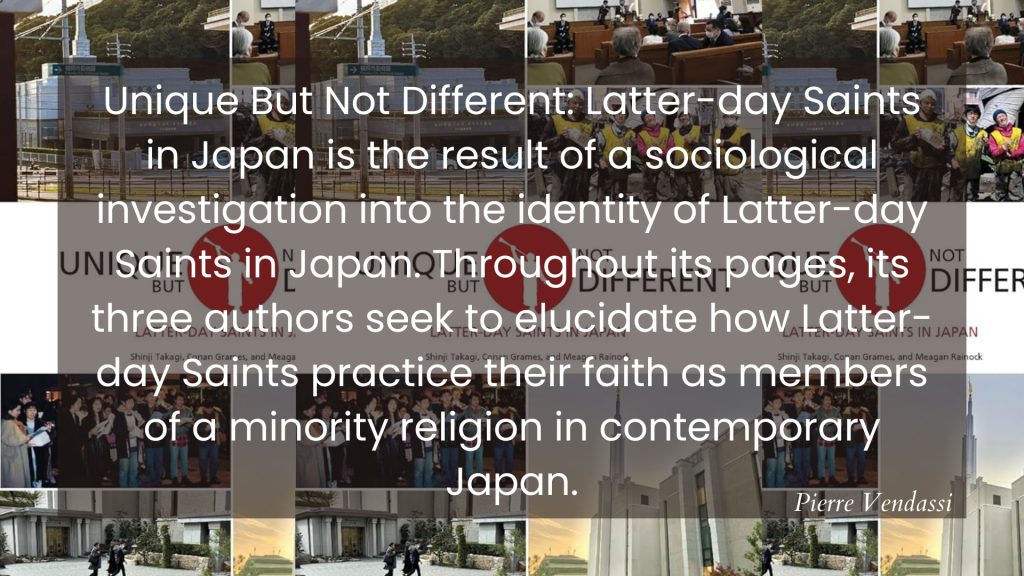
Unique But Not Different: Latter-day Saints in Japan is the result of a sociological investigation into the identity of Latter-day Saints in Japan. Throughout its pages, its three authors seek to elucidate how Latter-day Saints practice their faith as members of a minority religion in contemporary Japan (xi).
Shinji Takagi, Conan Grames, and Meagan Rainock’s work follows the current and much-needed movement growing in global Mormon studies to conduct sound, grassroots-level academic research to shed light on the various experiences of those who may be considered, in one way or another, on the periphery or margin of the Church.
On that account, Latter-day Saints in Japan are an ideal subject of study, since they occupy a numerically marginal position both in the Church and in Japanese society, with 130,192 registered members (as of 2021). This represents less than 0.1 percent of the Japanese population, among whom the authors estimate only 20 percent to be actively involved in the Church.
The data from which the authors drew for this book comes from the responses of 530 Latter-day Saints to a 56-question self-administered survey sent via email and advertised on virtual social network platforms in 2021. Due to its mode of administration, the survey focuses almost exclusively on active Church members who were willing and able to respond.
The book consists of a preface, an introduction, a theoretical and methodological chapter, and five chapters exploring in detail themes covered by the survey: social profiles, conversion, beliefs and practices, identity conflicts, and challenges and opportunities. For each theme, the authors analyze and interpret in detail the answers to the survey’s related questions, taking great care to contextualize the subject historically and socially for the nonspecialist reader. A seventh chapter of a dozen pages offers summaries of the main takeaways tailored for various kind of readers: scholars and researchers, the general public, Latter-day Saint missionaries and leaders, and other Latter-day Saints. It precedes a conclusion and appendices, including the original Japanese-language questionnaire.
The authors place their work within a framework of “identity theory.” Behind this term lies one simple and key idea: individuals, though strongly influenced by their national culture when making religious choices, are not consigned to act as their national culture dictates. Rather, they use the cultural materials at their disposal as a menu or toolbox to make choices and build complex, multiple identities that they are able to mobilize differently according to the contexts in which they find themselves.
This theoretical approach challenges the culturalist beliefs from which the book’s central question emerges, namely the idea that being both a Latter-day Saint and Japanese is a paradox or mystery to be elucidated. This culturalist bias, which many of us share to some extent, gives rise to the truism in the preface: “The survey thus provides prima facie evidence that it is possible to be both a Latter-day Saint and Japanese” (xiii). The actual existence of Japanese wards, stakes, temples, and converts seems to be insufficient evidence for some skeptical ethnocentric minds.
More broadly, the fact that individuals born and raised in a given cultural context may call on culturally exogenous resources spontaneously appears to most of us as a mystery when it is, in fact, an ordinary phenomenon of human societies, entirely constitutive of Mormonism since its origins. In fact, the book tends to show that despite prima facie oddities between Japanese culture and Mormon North American culture, Latter-day Saints in Japan are not so different from other Latter-day Saints regarding their religious beliefs and practices, and not so different from other Japanese people regarding most of their social practices. At least most of those who responded to the survey don’t find it too problematic to identify both as Japanese and as Latter-day Saints and to manage these identities in daily life.
The real contribution of the survey and the book, therefore, lies in understanding how Japanese Latter-day Saints embrace and live out their faith and mobilize their Mormon identity in a Japanese society that gives little credence to such a marginal identity.
We learn through the pages of the book that most LDS converts in Japan join before the age of thirty. A not-insignificant number of them have prior knowledge of Christianity or join the movement not only on the basis of doctrine but also because of the social and moral model embodied by the missionaries. This makes them quite conventional converts from a sociological point of view, i.e., converts who join on the basis of strong cultural continuity and the creation of socio-affective bonds. Active Church members tend to be socially and economically integrated in Japan, even though they are religiously active and fully embrace their minority religious identity. They report few conflicts related to their religious identity, apart from social drinking and tea consumption—two important social practices in their cultural context that they manage to make acceptable. Their ideological tendency is not uniform and reflects that of the Japanese population, from the most conservative to the most progressive. Their tendency toward conservatism on social issues is strong but not absolute, and they are more liberal than the national average when it comes to immigration, which goes hand in hand with a strong internationalization of their career paths. Rather highly educated, they tend to have more children than the average, but this number is declining. They also hold more professional positions than the average, which helps them avoid conflicts linked to Sunday religious practices. What’s more, the LDS population is aging at the same rate as the Japanese population.
From a religious standpoint, it’s worth noting that the population studied shows a high level of acceptance of the Church as it is, particularly regarding the preeminence of priesthood leadership over personal revelation and the role of women in the Church.
Throughout the book, the authors address the problem of acculturation, asserting that since the Church as an institution makes little effort to acculturate itself to the local culture, it’s up to individuals to negotiate their own identities in society—what the authors call personal acculturation. As they repeatedly point out, the respondents to the questionnaire may actually constitute the active, well-acculturated core of the LDS Church in Japan, characterized by a high degree of religious conformity and a high degree of social integration within wider society, with rather high levels of social and cultural capital. Consequently, they seem to have a less disruptive presence in society than their unusual religious choice (from a Japanese standpoint) might suggest. They are the minority who manages to adapt and accommodate.
The valuable quantitative approach adopted here calls for further ethnographic explorations in order to gain an in-depth understanding of how these Latter-day Saints manage the social tensions they are subjected to in real time. Further ethnographic work could also explore how most of their fellow Japanese Church members struggle or fail to manage those social tensions, eventually dropping out, never converting to begin with, or creating other kind of in-between identities.
To conclude, this book is a perfect complement to the work already done on Mormonism in Asia, and particularly in Japan, notably The Trek East by the same Shinji Takagi. It should also be acknowledged that this book originates from work prepared for a volume of essays edited by Laurie Maffly-Kipp and the late Melissa Inouye on Mormonisms in Asia. It is no surprise that Inouye was involved in the development of such an important project, and I have no doubt that this movement to study Latter-day Saints across the world will rightly continue to echo throughout the field of Mormon studies.
Shinji Takagi, Conan Grames, and Meagan Rainock. Unique But Not Different: Latter-Day Saints in Japan. Salt Lake City: Greg Kofford Books, 2023. 190 pp. Paperback: $20.95. ISBN: 978-1-58958-791-5.