

 Back to full Issue


Articles/Essays – Volume 54, No. 4
Haunted Houses
Content warning: This essay discusses sexual assault.
On a late October afternoon, as I stood on my parents’ driveway in the pleasantly chilled autumn air, a tree applauded me. I was twenty-one years old. Just days before, I’d returned home from my mission, too ill to be of any use in that regard. It had been a doomed endeavor from the beginning, but I didn’t know that then. What I did know was that I was home, wearing jeans and no nametag, companionless, and relieved beyond measure for my honorable and very early release.
I’d gone outside to retrieve the groceries from my mother’s Volvo. It was a glorious day, brisk and sunny and fragrant with crisp leaves, and I paused for a moment beside the car to drink in the loveliness. I stood as it were at attention, each hand holding a weighty bag, and allowed the peace of a perfect day to flow over me. The street was utterly deserted; there was no noise. No cars, no lawn mowers, no kids. Just silence and stillness, until I gradually became aware of what sounded like applause. It wasn’t the clapping of a single pair of hands, but the very particular din of an enormous crowd engaged in acclamation, that unmistakable white noise of cheering, the very human expression of joy and respect, en masse.
I looked around. Maybe a neighbor had a window open and a television on much too loud? But every window in every house was closed. There wasn’t so much as a frolicking squirrel in the vicinity. I was entirely alone in that cul-de-sac, hands full of groceries, taking in the echoing applause of a grateful crowd, when I realized the sound was alive. Applause was living within a large maple tree in a grassy lot across the road. Its copper-colored leaves were animated, undulating in time, waving and moving to a rhythm and a wind only it could feel. I detected no breeze; all other greenery remained unstirred. It was just that one, beautiful maple with its nodding head and shaking arms extended as if in exuberant praise, its spirit communicating with mine. I stood motionless with wonder and gratitude and received its ardent compliments and divine approval, allowing the material presence of God to envelop me.
In a way that was too personal, too holy to fully articulate, and despite my deep confusion on the matter, I knew that heaven accepted my fragile missionary offering, over too soon. I knew I had, unwittingly but not insubstantially, moved forward, upward. Though I couldn’t see how, I knew the nothing I’d achieved had in fact been fundamental and transformational. I knew it because the tree told me so, because God and Nature went well out of their way to shout hurray.
***
I’d never wanted to serve a mission. My parents converted to Mormonism in their young adult years; they indicated no mission regret for themselves and presented no mission pressure for their children. I was born in the early 1970s; missions for girls of my generation were by no means unheard of but generally ranked as quite a bit less than expected. By my junior year at Brigham Young University, most of my roommates and friends had gotten married, but I didn’t know any girls who’d left for a mission. I had a desire to do something with my life, something worthwhile and challenging in the wider world, not just in the fuzzy future but right then. I’d gotten a very short-lived wild hare that I wanted to join the Peace Corps until my brother (accurately, and with much amusement) reminded me that my idea of roughing it was a hotel without room service. With limited options for adventure, I decided there was no harm in praying about a mission, especially since I was completely certain the answer for me was no.
Well, the God of Surprise Responses said yes. The very first time I (half-heartedly) asked, he sent me an unequivocal, resounding, emphatic yes. Along with a smile and a thanks for asking.
***
A few months later I received my mission call and, a few weeks after that, my temple endowment. I hadn’t taken a temple prep course; I felt that was for new converts and those who hadn’t paid attention in Sunday School. The temple was an invitation-only affair, but I felt I had the gist of the thing and figured I’d have my parents and the temple matron to explain the rest. How different or difficult could it be?
Tremendously, as it turned out.
In a locker room that smelled faintly of disinfectant, I was undressed by strangers before being draped in a sheet with open sides to allow other strangers, posted in partitions, to touch my naked body. I was clothed in a garment so voluminous as to be ghost-like, led into a dark room filled with people in costume and covered faces, the door closed. I had a frightening sense of vulnerability despite being surrounded by friendly faces. There were inscrutable behaviors and strange, mild-mannered threats; reaching with arms and gesturing with hands for some kind of elusive deliverance; moving images on the walls, depicting the vast darkness of galaxies. And there was a curtain, through which a man whose face I could not see handled and judged me.
Afterward, my parents and I calmly ate a cafeteria lunch of spaghetti and Jell-O.
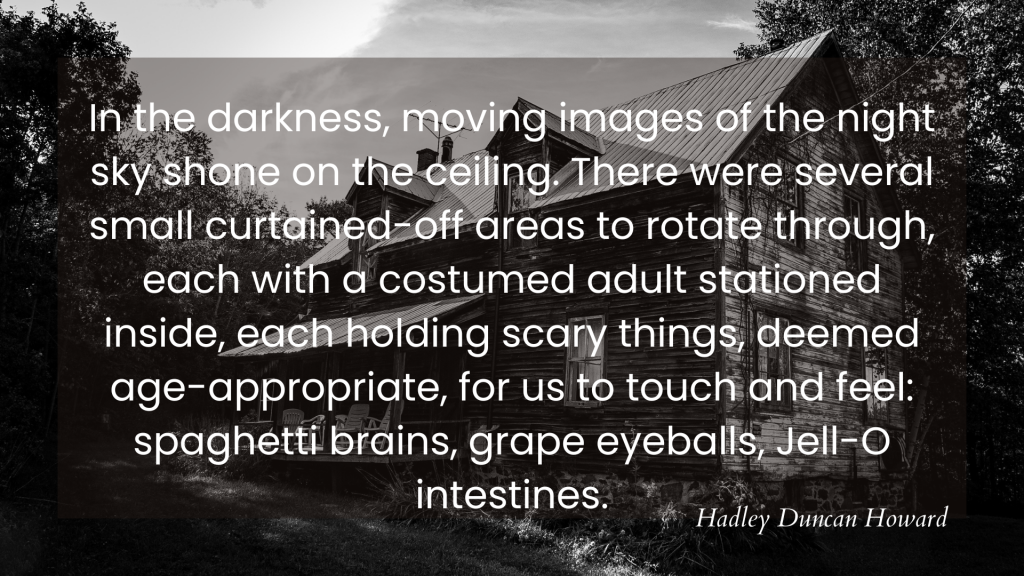
It was a devastating experience, harrowing, inexplicably torturous to my spirit. This was what my roommates had found beautiful? This was what my Church leaders had praised as the pinnacle of our religion? This was what my parents valued most of all? I found it terrifying in the extreme, a horror film made real. Equally acute was the unfathomable sense of utter betrayal by those I’d trusted to keep me safe.
It was, in every possible sense, a living nightmare—a haunted house. And it included the only thing in the world capable of keeping me there: the shame I’d bring upon my parents were I to run away screaming when given the chance. It was, alone, that unwelcome constraint that prevented me from shouting “hell no” and sprinting straight out the door, never to return.
The costumes, the touching, the curtain, the man—it wasn’t beautiful theology and the promise of heaven. It was trauma, ugly, violent, barely survivable. From that day on, I had a stomachache. From that day on, I didn’t sleep. From that day on, I held my breath.
I held my breath.
I held my breath.
***
Almost exactly a year after the tree applauded me, I had an every-other-Sunday morning calling in the copy center of my BYU student ward. I’d gone back to school, but it had been a challenging year, both physically, while I visited dozens of physicians trying to find the cause of my constant illness, and emotionally as I tried to make sense of my mission debacle. What had it all been about? Why had God commanded me to serve a mission he knew I wouldn’t serve? I still had no answers. On this Sunday I was where I should be, in a tiny cinder-block office on the top floor of the student center, waiting, as the not-actually-funny joke went, to be of reproductive service to someone. No one needed me, so to pass the time I pulled an abandoned copy off the Xerox machine and started to read. It was Isaiah 55:8–12:
For my thoughts are not your thoughts, neither are your ways my ways, saith the Lord.
For as the heavens are higher than the earth, so are my ways higher than your ways, and my thoughts than your thoughts.
For as the rain cometh down, and the snow from heaven, and returneth not thither, but watereth the earth, and maketh it bring forth and bud, that it may give seed to the sower, and bread to the eater:
So shall my word be that goeth forth out of my mouth: it shall not return unto me void, but it shall accomplish that which I please, and it shall prosper in the thing whereto I sent it.
For ye shall go out with joy, and be led forth with peace: the mountains and the hills shall break forth before you into singing, and all the trees of the field shall clap their hands.
In these verses, given to me that Sunday morning, God put his hand upon my cheek, looked me in the eye, spoke my name, and smiled. My situation did not change, but I knew some things that morning that I hadn’t known the night before: God was up to something. It was for a purpose and still in progress. He knew what he was doing and, difficult as it was, everything was just fine. Oh, and that tree? I didn’t imagine that; the Spirit didn’t lie. At the command of its God and mine, that stunner of a copper-colored maple tree full-on applauded me. The Lord would leave me hanging for a while longer, but to ease the wait, he’d moved heaven and earth to give me a hand.
***
At twenty-two and with my university degree in hand, I moved a thousand miles away and embarked on adulthood in earnest. I landed a job at an immensely stressful global PR firm, a place where jackets and pantyhose were required and eighty-hour workweeks were business as usual. I found a darling prewar apartment with original moldings and a sunroom. I opened a 401(k), bought a car, ordered a custom sofa, and hung real paintings on the walls. And I stopped attending church.
It was a combination of factors, really. The singles ward was filled with people I didn’t want to know, and the bishop wouldn’t transfer my records to the regular family ward whose boundaries I lived in. I worked until midnight seven days a week. But mostly, well, mostly the problem was me. Even with true effort, I couldn’t reconcile my traumatic temple experience with the doctrine I’d been taught. If something that viscerally distressing was the pinnacle of Mormonism, I didn’t see how I could be a Mormon. Jesus and I would always be the best of friends, but I needed to be excused from his church. His silence on the matter was comfortable and comforting; I knew he understood.
I put my garments in the bottom dresser drawer and walked away.
***
In late October of my fifth-grade year, I attended a Friday night lock-in at our local YMCA. My family didn’t have a membership and I’d never been to the Y before, but for a nominal fee I could dine on cheap junk food with about a hundred kids, wander through a haunted house in the rec room, and spend the night in my brother’s sleeping bag on the hardwood gymnasium floor. This sounded like fun to my ten-year-old self.
The indoor pool was off-limits for the evening, but the air in the building was humid and pungent with the scent of chlorine. It seemed just a bit damp, the sort of place with toilet paper stuck to the bathroom floor and dank towels piled in cinder block corners. The rec room was just to the right of the main entrance, across from the reception desk. Its door remained closed during dinner and group activities: no entrance until invited. I was dressed as a ghost, wearing the homemade white-sheet-and-flowy-headdress ensemble my siblings and I had been rotating through for several years.
Finally, it was time for the haunted house, the main event. My friends and I arranged ourselves in a makeshift conga line, each jittery girl holding the shoulders of the jumpy girl in front of her. I was last, right on the end of the column. Into the room we went, the door shut behind us. In terror, I held my breath. In the darkness, moving images of the night sky shone on the ceiling. There were several small curtained-off areas to rotate through, each with a costumed adult stationed inside, each holding scary things, deemed age-appropriate, for us to touch and feel: spaghetti brains, grape eyeballs, Jell-O intestines.
Last in line, still breathless and holding tightly to the girl in front of me, I was suddenly grabbed from behind, lifted, and taken to a corner behind the back curtain. A man I couldn’t see held me down, covered my face, and and and. I fought him with every ounce of terror and strength within me, kicking and punching until I was free.
I ran screaming from the rec room, bursting out the door and startling kids waiting their turn. I sat alone on a bench in the quiet locker room, holding my breath, for hours, unresponsive to friends’ entreaties to join the fun. Eventually, well after lights out, I found a spot on the edge of the gym and spent the night sitting up, on high alert, with my back against the wall.
In the morning, from the back seat of my mother’s station wagon, I told her that a man had sat on my lap and hurt me. Perhaps my insufficient understanding didn’t translate. Whatever the reason, my very good mother did nothing.
I began to have a recurring dream. It was always the same: it was the Kal Kan cat food commercial I’d seen while watching Little House on the Prairie. It went like this: with early eighties movie magic and a synthetic “zwoop” sound, a blue pill-shaped vitamin penetrated the top of a metal can of cat food. Every time, I woke up panting, unable to breathe.
I had that dream for years.
Until eventually, at some point, it stopped.
I didn’t notice.
***
When I was twenty-six, an emergency meeting was called at the advertising agency where I’d just started managing several national accounts. We were told that the company’s president was guilty of embezzlement and had bankrupted the business. We all lost our jobs.
It was the week before Christmas, and with Y2K global havoc anticipated in just a couple of weeks, the timing was not great to be unexpectedly unemployed. I had lots of contacts and a good professional reputation, so I wasn’t overly worried; I knew I was a catch. But I’d been working eighty-hour weeks for so long that I didn’t even own a pair of jeans—I had no place to wear them, as I was always in the office. I was so far past burned-out that I received the news of my abrupt unemployment with equanimity: finally, finally, a break.
The world, as it happened, didn’t come to an end that January 1. I packed up my car with clothes and CDs and drove four hours south to bunk up with Grandma Jo. She still lives in the town I grew up in. She’s funny and irreverent, her house smells like coffee, and she’s had the same “gentleman caller” since my beloved grandpa died in 1987. I’ve always adored her.
Jo arranged for me to work part-time in a darling upscale boutique owned by a friend. It was a quiet place, run as a hobby by a woman who didn’t need to live off the profits. For fifteen hours a week, I languidly faffed around the store, rearranging merchandise and creating displays. I did some low-stakes modeling for a laugh. With Jo, I attended the Methodist church my grandpa helped form (continually reminding myself that the recitation was the Apostles’ Creed, not Apollo Creed). I read a lot of books. I rode my bike, slept in late, rediscovered jigsaw puzzles, napped in the hammock, and refinished an antique table I found on the side of a road. I stayed for six months and gradually unfurled my tightly clenched soul.
While I was there, I also took a lot of drives. I enjoyed the music and the answering to no one, the solitude and the aimlessness. I drove out into the country or explored unfamiliar parts of the city or just tooled around my old hometown to see what had changed. I knocked on the door of the house I grew up in and chatted with the owner. I visited my elementary school and remembered the burning-hot metal death traps we used to call playground equipment. I stopped off at my former pediatrician’s office and requested my (mimeographed!) file. I went to Johnnie’s and Braum’s and The Cookie Jar. And one day, I happened to feel a distinct tug to turn right at an unexplored, uninspiring intersection and ended up at the YMCA.
I pulled into the Y’s parking lot to turn around, and as I did, I had a faintly itchy sensation that I’d been there before. I knew my family hadn’t been members, so I couldn’t imagine why I would have ever been inside, but the feathery idea was there, tickling the periphery of my memory, tickling, tickling, just enough that I could feel it, just enough to make me aware of it. I thought on it all the way back to Jo’s house and for the rest of the day. I thought on it the next day, too. Then, as I stood in her kitchen, the recollection ever-so-gently distilled upon me. Oh, that’s right, I softly said to myself. That’s right, I went to a party there once. What was it? Halloween? Yes, I remember now. It smelled like chlorine and there was a spookhouse with spaghetti for brains and grapes for eyeballs and Jell-O for intestines and a line of little girls and people in costumes and me as a ghost and a closed door and a dark room and a faceless man touching me behind a curtain and a locker room and a gymnasium wall and and and.
Soon enough, I began dreaming about Kal Kan cat food again. The same blue vitamin pill zwooping into the same metal can. Awakening with the same breathlessness.
***
It was time to leave the restorative tranquility of Jo’s house, move back into my apartment four hours north, and return to a real job in my regular life. I took a position at a very competitive communications firm, managing crisis communications for national accounts. I was back to pantsuits and dinner meetings and billable hours and poisonous colleagues, back to stomachaches and insomnia and an inability to catch my breath. A few months into my new role, I was assigned to direct communications for a historically demanding client.
It was the YMCA.
***
Healing, newly necessary for professional reasons as well as spiritual, came through an exceptional therapist. Libby was a diminutive woman, perfectly coiffed and groomed, with an office in the back of her country club home and a sweet nature that disguised her tough, tell-it-like-it-is style.
Her office was a temple to me, a house unhaunted, a place where God was so kindly, so powerfully present. He was gentle, but he was a force, there to do real work. He was in the air and in the light; he was on the sofa beside me. His love and peace were an all but tangible presence in that room. His comfort and truth and respect and friendship were not whispered to me—they were spoken clearly, with volume and intent, not to be missed or misunderstood: He ratified and rubber-stamped my goodness, my choices, my worthiness of everything he’d ever had to offer. He, better and more deeply and fully than I ever could, understood.
He taught me that experience is not linear, nor is the discernment of it, but a double helix of creation, twisting and swirling around itself in its convoluted becoming. He taught me that all things have purpose, that all circumstances and all people can eventually lead to him. He taught me that, through him, pain and confusion and suffering are beautiful and efficacious. He taught me that intent matters: mine and others’ and his. He taught me that all offerings to him are accepted when offered in purity of heart. He taught me to seek his love and his friendship and his approval, no one else’s, not even (and perhaps especially) his church’s. He taught me that his love is formless, capable of passing through anything at all to reach his children—like light to see, like air to breathe.
He taught me to breathe.
I learned, with God, to breathe.
***
I returned to church. It was hugely uncomfortable. Many, many years later it remains so. But I’m still here, present in a pew every Sunday and in my heart each day in between. I am active and faithful in my religious life, but I do not serve an institution—I serve God. Religion is only a vehicle for a relationship of tremendous trust in God, for a friendship that includes humor and talking back, laughter, sarcasm, frustration, inside jokes and shared shorthand, necessary silence and joyful reunions.
And we are in relationship, God and I, a living, changing, motivating, moving relationship—a relationship that breathes. I don’t often visit his house; when I do, it’s a very specific offering, received with very specific recognition. The temple no longer haunts me, but it also doesn’t beckon. It’s invitation-only, and I’m pleased to be invited even if I accept only infrequently. Instead, I chat constantly and casually with God, and he with me, in all locations of time and space, where mutual worthiness and faith in each other easily connect us. I’ll never again be last in line—God is always behind me, his hands upon my shoulders.
The love between us breathes freely.