

 Back to full Issue

Articles/Essays – Volume 54, No. 4
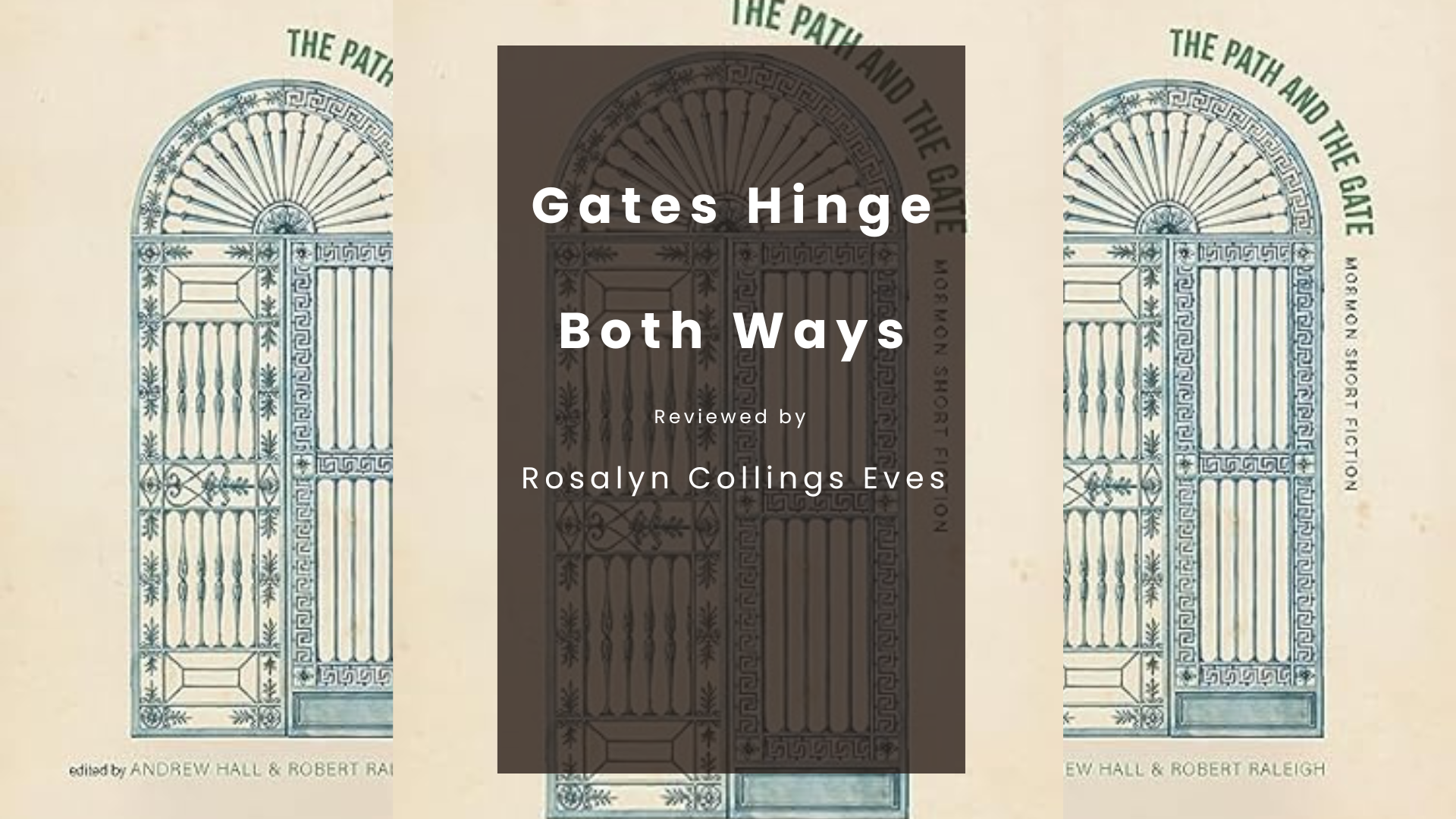
Gates Hinge Both Ways | Andrew Hall and Robert Raleigh, eds., The Path and the Gate: Mormon Short Fiction
Given the LDS Church’s recent emphasis on the “covenant path,” it seems fitting that this collection of Mormon short fiction takes up a similar theme: the ordinances (baptism, endowment, temple marriage) that operate as gates along a “straight and narrow path” (2 Nephi 31:17–21) leading individuals back to the kingdom of God.
From this seemingly narrow starting point, the twenty-three contributors of The Path and the Gate spin a vast array of stories, ranging from futuristic accounts of missionary work in the metaverse (William Morris, “Always to be Found”) to the comic journal of a newly minted and inept God (Ryan Shoemaker, “Barry Dudson: The God Journals”) to the seemingly mundane in both contemporary and historical settings. Gates, in these stories, might be literal and nightmarish gates (as is the case in Phyllis Barber’s “After Midnight”), or they might be entirely metaphorical.
While each of the stories takes as its starting point Mormon faith and culture, the resulting explorations have a wider audience appeal than just Mormon readers: the characters who inhabit the stories span the spectrum of LDS belief and behavior, and even seemingly orthodox characters can be surprisingly complex. Other stories offer illuminating (and heartbreaking) perspectives from characters outside—and sometimes inside—the faith who do not fit comfortably. Eric Freeze’s “Holy Ghost Power” follows an apostate father who lacks the officially sanctioned power to bless his daughter but who believes in and blesses her nonetheless, posing timely questions about the power we vest in institutions versus individuals. Other extraordinary believers include a coffee-drinking bishop in Joe Plicka’s “Natural Causes”; an older sister in Tim Wirkus’s “A Vision” who bears devout testimony to a capricious and merciless God; and a missionary in Mattathias Singh’s “Missionary Weekly Report” who abandons his mission precisely because he believes in the immanent (and imminent) message of God’s grace.
Some stories use humor to gently skewer orthodoxy, even as they find something to admire in sincere belief. Heidi Naylor’s “Mrs. Seppe” must wrestle with her priorities (her family, including her estranged drug-addict daughter) when she unexpectedly wins a lottery; the members (including the prophet) of Danny Nelson’s “Narrow is the Gate” are confounded by the arrival of aliens even more orthodox than they are; and the cybersecurity expert of Jack Harrell’s “The Mathematics of God” finds himself led by the Spirit to aid and abet a mysterious Ukrainian couple. In Theric Jepson’s “The Curse,” a third-generation member of the Church finds his life comically shaped by a too-specific patriarchal blessing given him as a young man.
Other stories are more critical of the LDS Church and its culture. Two of the most haunting stories in the collection feature young women who are constrained by their beliefs into paths (marriages, lives) not entirely of their own choosing: Charity Shumway’s “A Courtship” and Larry Menlove’s “Calf-Creek Falls.” Ryan Habermeyer’s “We’re Going to Need a Second Baptism” begins with a wryly funny look at ordinances and ends as a disturbing cautionary tale about the dangers of putting too much faith in our own illusions. David G. Pace’s “Lana Turner has Collapsed!” critiques the sometimes-shallow motives that can drive the performance of sacred ordinances, even ordinances ostensibly meant for others.
The stories also pick up quintessentially Mormon themes like agency and community. Alison Brimley’s “It’s a Good Life” fittingly riffs off a Twilight Zone episode to ask: If you could make other people do what you wanted, should you? Ryan Shoemaker explores agency from a different angle, imagining how a new god hilariously manages to undermine the very idea of salvation by trying to spare his children his own mortal humiliations.
Reflecting the inextricable link of faith and community in Mormonism, some of the stories poignantly explore how community can flourish even outside shared faith: in Michael Fillerup’s “Ghosts,” two widowers—one faithful, one doubting—find community and solace on a bitterly cold night. Other stories illuminate how heaven (both on earth and in literal heaven) can be built upon relationships: Jennifer Quist’s plague story, “Unhanded”; Annette Haws’s humorous look at the afterlife in “Planting Iris,” and Holly Welker’s depiction of complicated teenage grief in “The Funeral.”
The stories and themes are beautifully bookended by Todd Robert Peterson’s “The Investigator” and Steven L. Peck’s “Sister Carvalho’s Excellent Relief Society Lesson.” Peterson opens the collection with a postapocalyptic rendering that both calls out tendencies to insularism and violence in Mormon culture and points toward hope. In a post-pandemic world where gun-toting survivors have mostly wiped out their neighbors, a nameless narrator survives by following a stake map to a modest Mormon home, where he lives off canned goods and reads the Book of Mormon. What struck me most about this story was the Flannery O’Connor-esque ability to marry the grotesque with kernels of grace.
This same marriage of grace with the ridiculous shows up in Peck’s closing story, where a pair of non-Mormons who have respectively survived wars in Rwanda and Israel wind up in Pleasant Grove, Utah, where a clerical error assigns them the Carvalho name and a history of church activity. When a dispute over essential oils threatens to tear the ward apart, the wife tears into the sisters with a reminder of what true violence looks like—and, paradoxically, what love looks like as well.
Not all the stories will be for everyone (as a sometimes literalist, I found a few to be opaque), but there’s something here for nearly all readers. Ryan McIlvain’s sweet and funny meditation on the New York Times crossword puzzle and longtime friendships captures the expansive spirit of the collection, both orthodox and unorthodox. “It’s a useful exercise,” he writes, “to force your brain to work as the puzzle wants it to” (166). But “occasionally the pieces just won’t fit. . . And that’s okay, too.” This is as true of readers as it is the diverse characters who inhabit these stories.
Andrew Hall and Robert Raleigh, eds. The Path and the Gate: Mormon Short Fiction. Salt Lake City: Signature Books, 2023. 295 pp. Paper: $21.95. ISBN: 978-1560854678.