

 Back to full Issue

Articles/Essays – Volume 54, No. 4
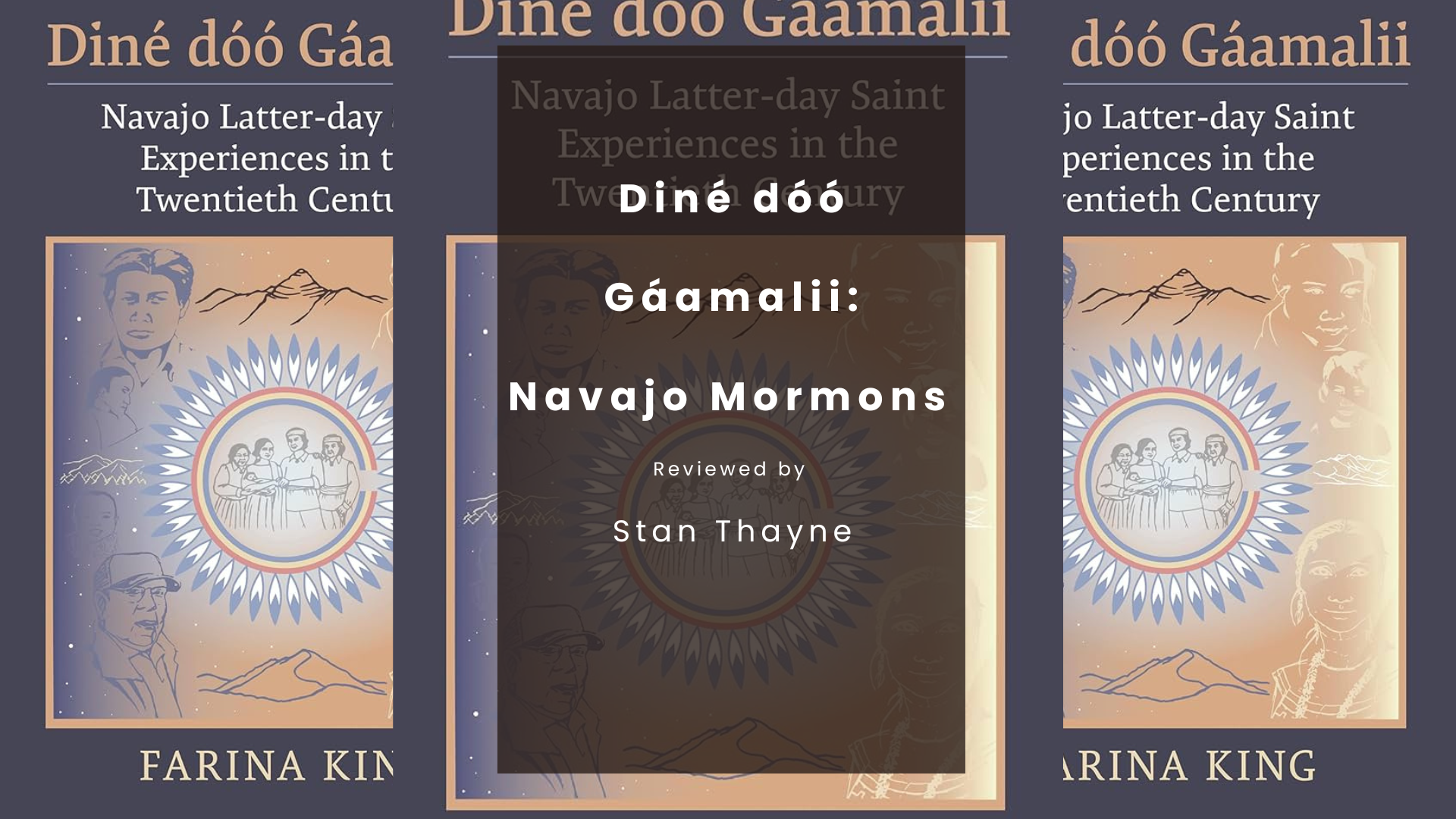
Diné dóó Gáamalii: Navajo Mormons | Farina King, Diné dóó Gáamalii: Navajo Latter-day Saint Experiences in the Twentieth Century
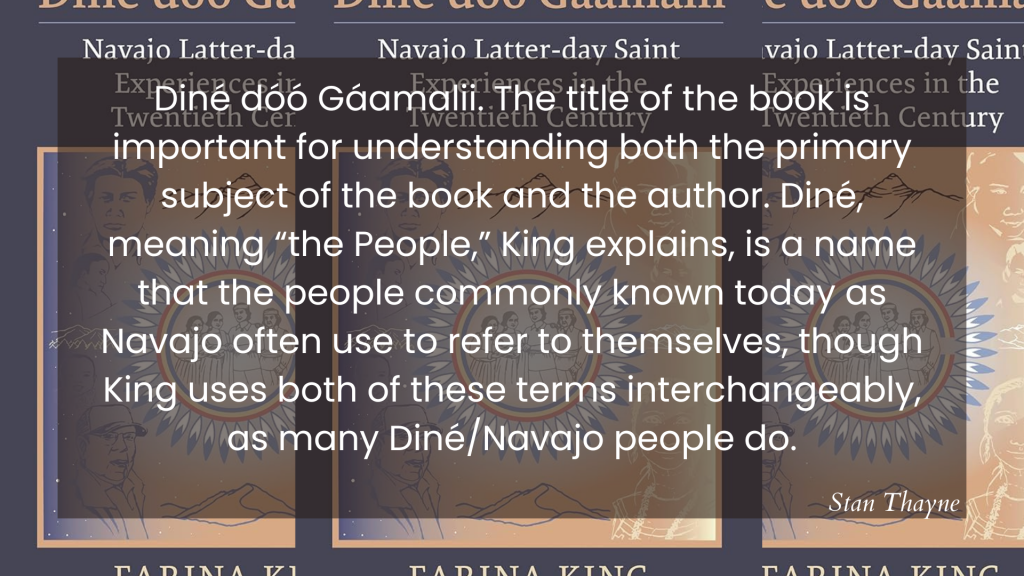
Diné dóó Gáamalii. The title of the book is important for understanding both the primary subject of the book and the author. Diné, meaning “the People,” King explains, is a name that the people commonly known today as Navajo often use to refer to themselves, though King uses both of these terms interchangeably, as many Diné/Navajo people do (219n1). Gáamalii is a Diné term for Mormons or Latter-day Saints. The subject of the book, then, is Diné people who are affiliated with the Church of Jesus Christ of Latter-day Saints, either through conversion (like King’s father) or by being born into a Mormon family (as King herself). This is a book, then, in which the author is herself deeply embedded. It is not your typical history. King describes the book as “a collective biography as interpreted through my own lens as a historian seeking to better understand my own people and family” (1). In the sense that King is writing about a group with whom she identifies—Diné dóó Gáamalii, Navajo Mormons—the work could also be considered autoethnographic, a term King uses only once in the text proper in the chapter “Red Power at BYU.” That chapter layers on one more dimension of embeddedness, as both King and her father are BYU alums. “Some people may consider such autoethnographic writing too subjective and biased, but I embrace my voice and closeness to the people, my friends and family, in this narrative to (re)claim and share our stories” (161).
King’s book is important largely because of who she is. Positionality is very important in this work, as is intersectionality, a concept that King also identifies as influential to her thinking (260n28). Rejecting binary assumptions that might depict being both Navajo and Mormon simply as a “clash of two worlds defined by race,” King understands Diné dóó Gáamalii as “representatives of multiple groups that affiliated along intersecting lines of indigeneity, race, gender, ethnicity, and religion” (158). These intersections prioritized some identities over others, as overlaps created bridges and generated community. That these identities are entangled with and within settler colonialism does not make them any less Navajo/Diné. (On “colonial entanglements,” see the work of Osage anthropologist Jean Dennison, whose work on Osage politics demonstrates the many ways Osage people continue to be Osage while entangled with colonial forms; indeed, entanglement is an important part of what it means to be Indigenous.)
While Navajo Mormons may strike many readers as a cultural eccentricity, Diné dóó Gáamalii are not wholly dissimilar from other intersections and entanglements, including Navajos belonging to other Christian denominations—or secular formations, such as nations, constitutions, race, etc. Part of the importance of this work is not only that it brings these little-known “intimate entanglements” (260n29) to light for readers, but that it helps to round out our understanding of Diné people as a diverse community who intersect with each other and those around them in various and often unexpected ways.
The book is divided into chapters that address different aspects and historical phases of the experiences of Diné dóó Gáamalii, such as missionary work, education, church services, Brigham Young University, and the lives and perspectives of Diné dóó Gáamalii both within and beyond Diné Bikéyah, the homelands of Navajo people. In keeping with the title of the book, King often provides Diné terms for Mormon institutions, such as Gáamalii Bina’nitiní for missionaries and Sodizin Bá Hooghan for church. A chapter on Ólta’ Gáamalii, “Mormon School,” provides a history of the Indian Student Placement Program (ISPP), a controversial program that removed Diné youth from their homes and placed them with (typically) white Mormon families, and which now faces lawsuits from former students who experienced abuse in the program. While acknowledging the violence the program perpetuated, King seeks to honor the voices of Diné dóó Gáamalii who experienced ISPP, many of whom had positive as well as painful experiences and built loving connections with their host families. In this respect, this chapter is not wholly dissimilar to K. Tsianina Lomawaima’s work on federal boarding schools in They Called It Prairie Light, which, while recognizing the structural violence of the boarding school system, focuses on the voices, experiences, and limited agency of Native students, including their friendships, community building, and resilience as well as their pain. King states that “instead of indexing or categorizing their experiences as negative/positive or good/bad, I consider the spectrum and variety of Diné experience on their own terms” (87). This includes students who have since left the Church and those who remain within it, many of whom feel both positive and negative feelings at the same time as they reflect back on these experiences.
Like many of her chapters, these experiences are drawn largely from oral history collections housed within the Redd Center collections at BYU and the Church History Department archives, though, again, King’s own personal reflections offer as much insight as the interviews she draws upon. For example, in demonstrating her frustration with blanket denunciations of ISPP, she relates an experience she had in a classroom when a fellow Indigenous student authoritatively denounced ISPP outright as a form of violent othering. King felt triggered by this, angered that such totalizing statements do little to honor the complex experiences of people like her cousins who actually experienced these things. King tries to honor those experiences, both the pain and the joy, by listening to their voices and attempting to weave a fuller tapestry of their varied experiences.
The idea of a “two-world” experience is one that emerges in many different American Indian contexts and scenarios as a result of assimilationist policies and the general force of Euro-American hegemony. The general idea is that Native people have to learn to get along in the white man’s world while also trying to hold onto and live their Native culture, which is always under threat of disappearance due to the compromising and dominant force of the other. Diné dóó Gáamalii are no different in this regard, other than that the assimilationist side of the binary is Mormonism (though never just Mormonism). Often this two-world balancing act is described in terms of Diné culture on the one hand and Mormon religion on the other, which are often depicted as incompatible or in competition.
While this is just the kind of binary that King strives to complicate and challenge, one thing that does come through over and over in the book is that many Diné dóó Gáamalii often experience the world through these terms and this sense of ongoing tension. But King does provide multiple examples of striking if limited hybridity. One that stood out to me, near the end of the book, relates the practice of a Diné and Latina woman who did not grow up with ancestral teachings and currently chooses not to attend Diné ceremonies but still continues some important traditions, such as safeguarding an infant’s nitsʼééʼ, umbilical cord. This Diné dóó Gáamalii woman did so by burying her grandson’s nitsʼééʼ on the Mormon temple grounds. As this example demonstrates, the Gáamalii/Mormon aspect of her identity—perhaps among other factors—may keep her away from certain aspects of Diné traditional life, but she may still continue to practice some Diné traditions. Though even those may be embedded, quite literally, within Mormon ground, if not within standard Mormon practice. Grounded, not just as Navajo or as Mormon, but as Diné dóó Gáamalii.
A point that King aptly demonstrates is that Diné dóó Gáamalii are a significant part of the Diné experience, historically and presently. In this way, the experience and position of Diné dóó Gáamalii is similar to the experience of many Hawaiian people, as Hokulani Aikau demonstrates in her book A Chosen People, A Promised Land. Describing a Hawaiian-Mormon hybrid site of cultural celebration centered on a canoe journey bearing the Hawaiian name of a Mormon missionary, Iosepha (Joseph), Aikau states: “Within a Hawaiian worldview we cannot move forward if we do not know where we came from. Thus the path ahead in many ways is dictated by how well we know the paths already traveled. For . . . community members affiliated with the Iosepha, a critical aspect of the path already traveled includes the LDS church and its history in Hawai’i” (174). Similarly, the story of the Diné dóó Gáamalii is not simply their story, but it is a part of the history of the Diné. One cannot fully understand who the Diné are today without including the Diné dóó Gáamalii in that story.
Diné dóó Gáamalii is an important work, and it joins with other voices that have also written about Indigeneity and Mormonism, such Hokulani Aikau, Elise Boxer, Gina Colvin, and Angelo Baca, some of whom are mentioned in the book. Surely there are others as well that I have overlooked. Pore over King’s notes and her bibliography and you will find them (the summer of 2021 issue of Dialogue is a special issue on “Mormonism and Indigeneity”).
Not unlike the tapestry of voices King has woven together in her book, King’s own contribution will perhaps be most illuminating when her voice is interwoven with the voices of other Indigenous people who have written and will yet write about their experiences with Mormonism, Christianity, and other colonial entanglements from their own positionalities and subjectivities.
Farina King. Diné dóó Gáamalii: Navajo Latter-day Saint Experiences in the Twentieth Century. Lawrence: University Press of Kansas, 2023. 312 pp. Hardcover: $44.99. ISBN: 9780700635528.