

 Back to full Issue

Articles/Essays – Volume 59, No. 3
A City Unheard
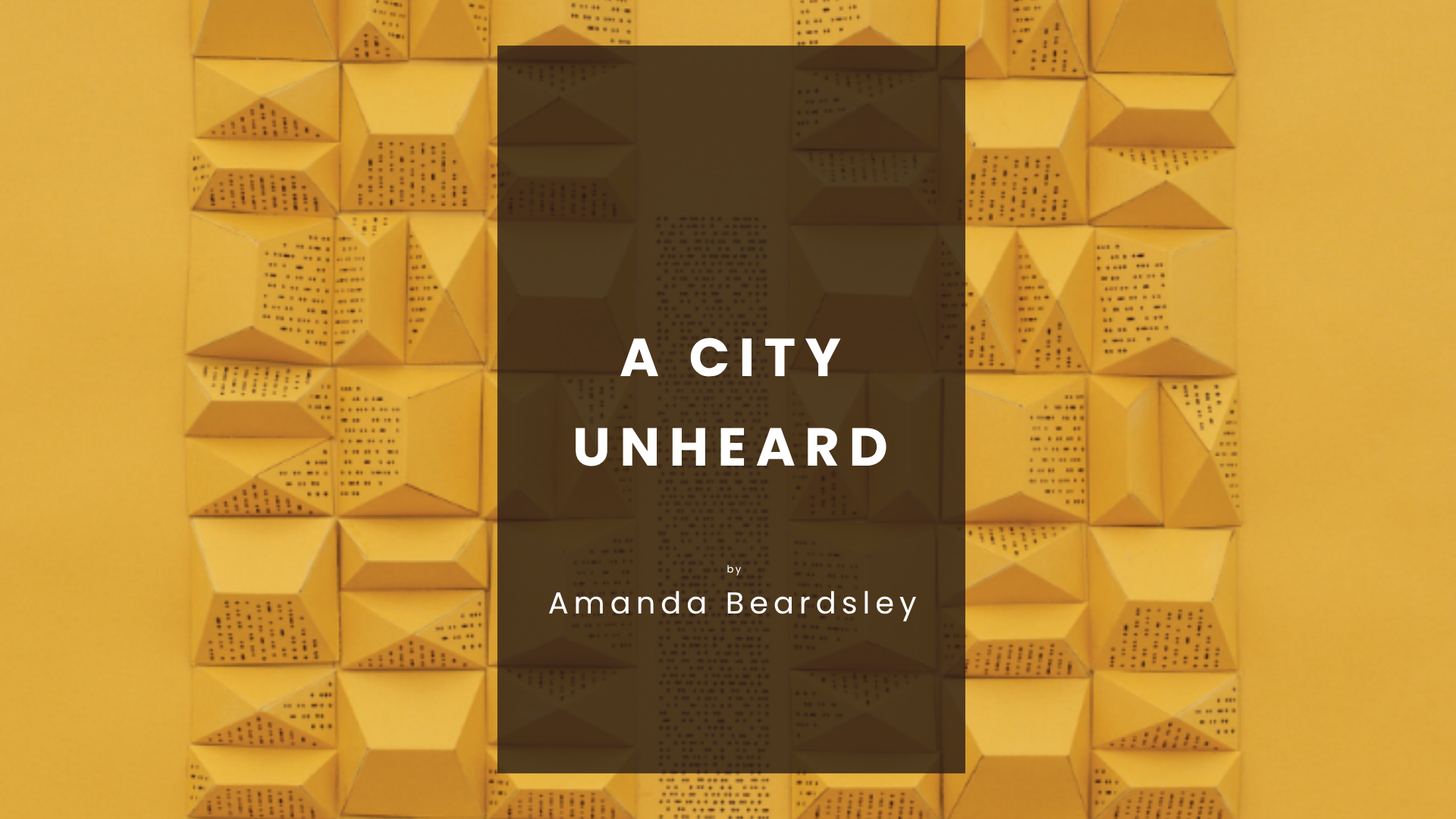
Golden yellow paper cubes extending beyond the two-dimensional surface of Susana Isabel Silva’s Partitura modular (2025) create an architecture of shapes resembling a bird’s-eye view of a village or urban center, lingering as a score for a city unheard. Punched holes in the angular surfaces amplify physical contrasts between surface and depth with the illusion of shading. A longer sequence of dots and dashes vertically cuts the composition in half, overwriting the smooth flatness of surface, offering a cryptic linear schism. The work names its terminology provocatively: partitura—a score where notation is as much about absence as presence in a modular topology of silence rendered through paper, cut edges, and the residue of algorithmic notation.[1]
Silva’s use of punched notation evokes the early computational technologies of IBM punch cards, Jacquard looms, and other proto-digital systems that translated human intention into machinic instruction.[2] In these technologies, meaning is never directly expressed; it is encoded and dependent upon interpretation by a system. In Partitura modular, this logic is made tactile. The work appears resolutely formal, even restrained. Its palette is limited, its geometry controlled, its surface immaculate. To read a system that refuses to resolve into sound is to inhabit an architecture of silence suspended between presence and omission.
This ambivalence between encoded instruction and sonic omission frames Instrumentos de silencio, a collaborative exhibition by Argentinian artists and siblings Susana Isabel Silva and Gonzalo Silva, in which Partitura modular was first presented. Supported in part by the Ariel Bybee Endowment (Center for Latter-day Saint Arts), the exhibition opened in August 2025 at Sargent’s Daughters Gallery in New York and has since traveled to the Graduate Theological Union Library in Berkeley, California, and the Utah Museum of Contemporary Art. Its movement from a commercial gallery to a theological library to a contemporary art museum mirrors the exhibition’s concern with mediation and context.
Much of the Silvas’ work is now being featured in this issue, as our contributors address a moment in American history and the Latter-day Saint faith that eerily grapples with various points of crisis (Prince), strategies of healing (Richards), unity (Jones), and alienation (Compton) that parallel the politicized Argentinian landscape evoked in Instrumentos. These themes reflect a broader anxiety within both nation and religion, including how to reconcile the digital witnessing of violence, inequality, and unjust death with traditions that claim moral coherence and communal care.[3] In this context, Instrumentos de silencio foregrounds technological, theological, and aesthetic infrastructures through which silence itself is produced and maintained. Gonzalo’s photographic series Liturgia eléctrica, for instance, documents the ruins of a “pipe organ in a 19th century Anglican church in Buenos Aires,” cropping it closely as a devotional object tinged by marks of time and human intervention.[4] Beyond sounding, the decaying organ is a technology of erasure and memory: a visual score that withholds performative sound whereby its existence insists upon inscription and archive.
The Silvas’ practice inherits a lineage of twentieth-century experiments that reconceived silence not as emptiness but as a structured auditory and political field. John Cage’s 4’33” (1952) reframed silence by foregrounding ambient sound and the attentive listener rather than the composed note. Cage demonstrated that absence can be framed, not as negation but as a socially awkward awakening to human conditions that performativity often obscures—that what we call “silence” is in fact saturated with the ambient sound of human existence: coughing, shuffling, and the listener’s own presence.[5] Often misread as a celebration of emptiness, the work transfers agency from performer to listener, insisting that listening itself is an active, socially conditioned practice. This insight was extended by Pauline Oliveros, whose notion of “deep listening” emphasized sound as relational, embodied, and political.[6]
Instrumentos de silencio both inherits and complicates this tradition. Where Cage sought to recalibrate perception, the Silvas platform the systems that precondition silence. Their scores cannot be played because the technologies they reference—punched notation, modular archives, and digital traces—are already implicated in histories of control and engineered silence.
Read against Argentine political history, this emphasis gains further weight. During the military dictatorship of 1976–1983, systematic disappearances erased bodies and records, producing what Diana Taylor describes as an archive of absence.[7] Documentation became dangerous, memory fragile, and silence often the only viable response. The Silvas’ invocation of the archival media of bureaucratic enumeration resonates with these histories even as it refuses legibility. These Argentine resonances gain additional urgency when placed alongside contemporary American concerns about digital surveillance, algorithmic governance, and data erasure. In the United States, the proliferation of digital technologies has produced new forms of witnessing in the form of viral videos, livestreams, data archives, while simultaneously generating new mechanisms of suppression. Content is removed, accounts are banned, histories are rewritten.[8] Silence, once again, is produced technologically.
As Latter-day Saints, the Silvas engage traditions in which genealogy and ritual documentation are central to religious life. Mormonism has long emphasized preservation of records as acts of care and continuity, yet these systems also rely on categorization, exclusion, and authority.[9] Difficult questions emerge: What happens when systems designed to preserve memory also enforce silence? When do archives become tools of discipline? The exhibition does not indict faith outright, nor does it romanticize technological neutrality. Instead, it stages a tension between belief and mediation, suggesting that silence can be both sacred and coercive.
Returning to Partitura modular, we encounter a work that functions as map and score, architecture and notation. Its refusal to sound is not a failure of execution but a deliberate demand to listen differently and to attend to what has been structurally rendered inaudible. The vertical fault line that bisects the composition marked by dots and dashes that both rupture and bind the surface stages silence as designed condition rather than absence. Gonzalo Silva’s works take up this logic and extend it into the domains of sound, circuitry, and digital residue, translating Susana’s visual grammar of interruption into sonic and technological form. Together, they construct an exhibition in which silence operates as an active force, shaped by systems of belief, mediation, and political history. Their instruments do not perform in the conventional sense; they bear witness to the infrastructures that organized what can be remembered and erased.
[1] Many thanks to Elzbeth and Carmen Islas for assisting with translations.
[2] Alexander R. Galloway, Protocol: How Control Exists after Decentralization (MIT Press, 2006).
[3] Recent deaths of Alex Pretti and Renée Good in Minneapolis by federal agents sparked ongoing anti-ICE protests and mass civil unrest (including general strikes and economic blackouts) as a concerned nation looked on via social media outlets. “Thousands rally against immigration enforcement in subzero Minnesota temperatures,” Associated Press, Jan. 23, 2026, https://apnews.com/article/minnesota-ice-immigration-protest-unions-faith-leaders-edc6c4884f8cc26be9ad34a28d82a7a5/.
[4] “Instrumentos de silencio,” Center for Latter-day Saint Arts, accessed Jan. 30, 2026, https://www.centerforlatterdaysaintarts.org/instrumentos-de-silencio/.
[5] John Cage, Silence: Lectures and Writings (Wesleyan University Press, 1961).
[6] Pauline Oliveros, Deep Listening: A Composer’s Sound Practice (New York: iUniverse, 2005).
[7] Diana Taylor, The Archive and the Repertoire (Duke University Press, 2003).
[8] See reporting on content suppression during politically sensitive incidents on TikTok, such as users alleging that Minneapolis shooting videos were throttled by the platform, Washington Post, Jan. 26, 2026, https://www.washingtonpost.com/technology/2026/01/26/tiktok-censorship-ice-shooting/; and accounts of Meta removing or restricting dozens of advocacy-related accounts, The Guardian, Dec. 11, 2025, https://www.theguardian.com/global-development/2025/dec/11/meta-shuts-down-global-accounts-linked-to-abortion-advice-and-queer-content; see also Congressional Research Service, Social Media: Content Dissemination and Moderation Practices (2026), discussing how platforms algorithmically filter and remove content.
[9] Amanda K. Beardsley, Celestial Mechanics: Technologies of Salvation in American Mormonism (PhD diss., Binghamton University, 2019). John Durham Peters, Speaking into the Air: A History of the Idea of Communication (University of Chicago Press, 1999); and The Marvelous Clouds: Toward a Philosophy of Elemental Media (University of Chicago Press, 2015).