

 Back to full Issue

Articles/Essays – Volume 59, No. 3
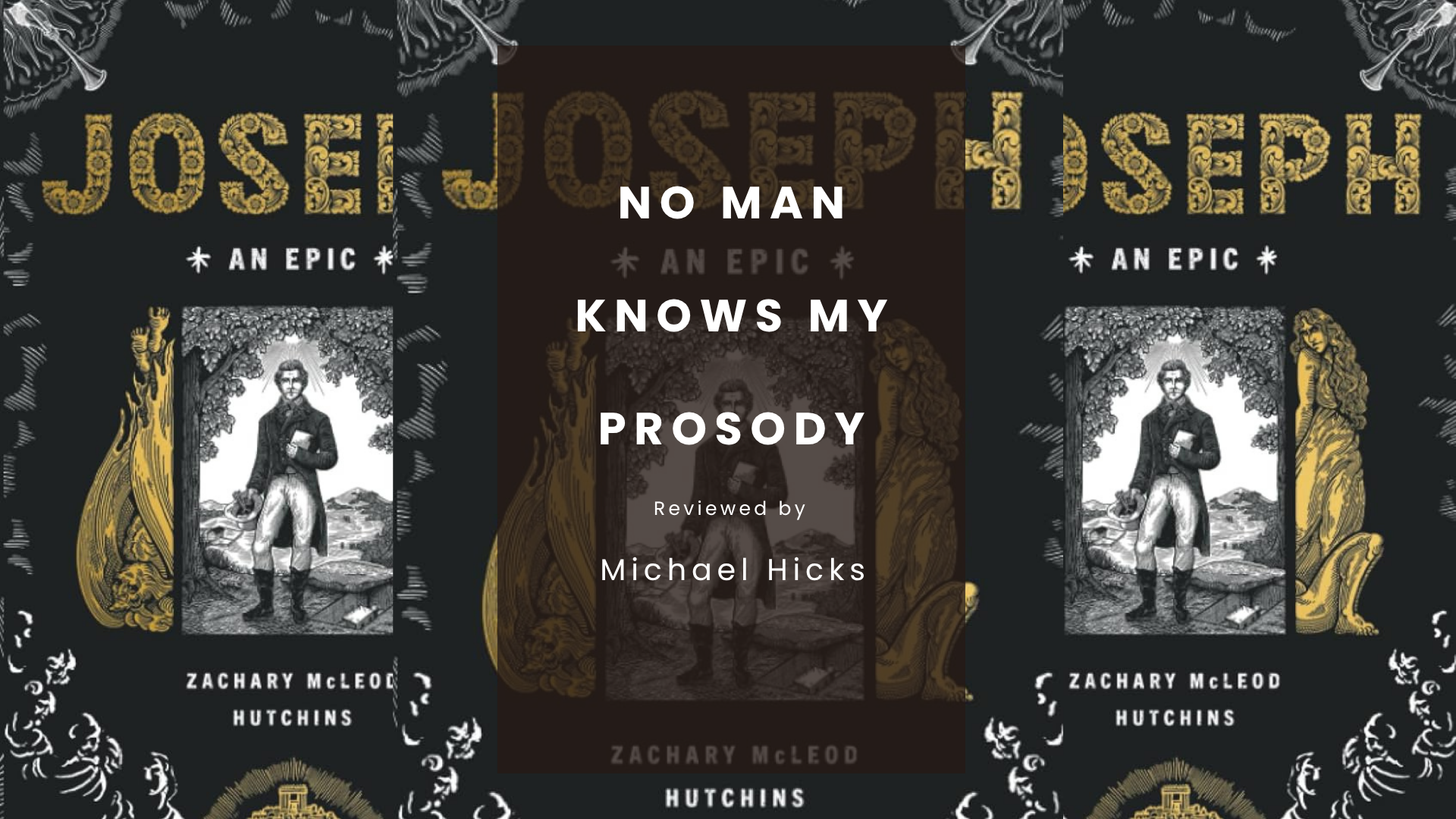
No Man Knows My Prosody | Zachary McLeod Hutchins, Joseph: An Epic
I got the book and felt both the chill of skepticism and a flash of jubilation—mostly at the derring-do of my old friend University of Illinois Press. I was eager to pat the acquisition editors on the back. Could I do the same for the author?
Consider this a warm but hesitant, heavily annotated answer to that question.
The basics: the book is an iambic pentameter ode to Joseph Smith Jr., from birth through his first days in Kirtland, Ohio. There are six “books,” apportioned 3+3 into two “volumes” named “Awakenings” (through his first, failed attempt to get the promised golden plates) and “New Covenants” (ending with a meditation on his family’s domestic life in Ohio). Each volume has a middle book drenched in some dazzling speculation: the first (Book II) about a council of devils plotting to thwart Joseph’s destiny, the second (Book V) a twenty-page poetic paraphrase of the 116 pages that Martin Harris “lost”—the Book of Lehi. Beyond the larger gauntlet this epic throws down by its very existence, these two speculative books will both daunt and entice readers.
Two more basics that carry their own heft: the illustrations and the preface. The thirteen full-page drawings by “Godwin” bewitch the reader with their re-envisioning of the art of Victorian storybooks, pitched somewhere between Dürer and Doré. These illustrations, to me, are worth at least ten thousand iambs apiece. Some of them playfully illustrate scenes such as Joseph courting Emma, while others go deeper—especially “Satan’s Congress in the Grove,” with its edgy echo of Da Vinci’s Last Supper, and “The Opening of Joseph’s Vision,” which delightfully torques one’s own vision of that fabled experience with a cross between William Blake and Buddhist temple art. Don’t overlook the gloss that Godwin’s work brings to the book.
Meanwhile, in twelve nicely crafted pages (including bibliography) the preface elegantly lays down footings for the epic proper. Its four footnotes tip you off to the range of this Mormon author’s mind—in order, Harold Bloom, Orson F. Whitney, Samuel Johnson, Michael Chabon. In the “sources consulted” list, I sensed a balanced, careful hand at work. The bibliography traces a rich, solid vein of Smithian lore. While I missed this or that source—why not Dan Vogel’s Joseph Smith: The Making of a Prophet, for example?—any such carping falls flat. Hutchins’s well of sources runs deep.
But one premise in the preface with which I take issue—and this quarrel infests my whole response to the book—is whether or not, as Hutchins argues, a sort of “more is more” quasi-Miltonic verbal elaboration of Joseph’s legacy is either apt or necessary. Too formal for this rambunctious seer? A bit too much holy water sprinkled on this God-appointed rascal? Doesn’t formalism tie up his intrinsic rowdiness? Obviously, my own vision of Joseph shines through—or shadows—those questions.
While Hutchins is an ace mythographer of early Mormonism—an appellation I hope he’ll accept as praise—concision and understatement might better fill the bill. (To quote the opening line of my own poem “First Vision”: “In the purest intellection / the word ceases.”) Again, does the formal constraint of rhythm and yardsticking of lines do violence to the real, full-blooded, wrestling, stick-pulling, rebus-making, joke-telling semi-prankster Joseph? On that question, the author and I differ. Which is why an epic along the lines of Whitman (or even Berryman) is what Hutchins’s epic makes me imagine. And maybe yearn for.
I could attempt a blow-by-blow of the epic: its opening a deep-dive origin story of a super(natural)hero; the evil grand council on how to undermine his quest; the story of Joseph’s first vision, including an avalanche of oratory (three pages’ worth) from Jesus’s mouth; etc. But that would quickly lapse into Cleanth Brooks’s “heresy of paraphrase.” And this book is really about language and how it’s used. Hutchins offers here a bewildering, eclectic, enthralling, tightly scaffolded structure that ranges from sublimity to soap opera, all of which makes it a bit like the Book of Mormon itself in its pre-postmodern hortatory mix of pretense and revelation.
So, let me talk about this work’s language, both wide-angle and microscopic.
In any flyover, one has to ponder the landscape, mountainous formations set against well-plowed farmland. One experiences something like that in this epic. I’ve mentioned the monolithic intrusions of the satanic congress and the faux-Book of Lehi. But relative proportions all throughout this epic are blissfully beguiling. Sudden inflations of moments into pages, followed by condensations of years into paragraphs shape the work. Truncations followed by ornamentations abound. A hyper-literate Emma Smith gives some of the book’s best head-patting orations to Joseph. Near the book’s end, Mary Whitmer’s encounter with Moroni unexpectedly swamps the narrative.
I’m a devout eclecticist. I like jangling juxtapositions. And they permeate this work, mostly via switches between the hieratic and the demotic—exalted oratory vs. boilerplate conversation. The latter dominates dialogue-based scenes of domesticity. Those clank more than resonate for me. But the hieratic is what one drinks up in this book. I smile at many clever moments, of course, such as, “By November, Joseph’s bag was catless.” But it’s formations like this—about the angel Moroni’s first appearance to Smith—that one can return to as to an archeological dig:
. . . light—
at first a solitary pinprick, like
a firefly come auditioning for work
as Joseph’s personal pole star; and then,
the prick expanded, took on human shape
and came like lightning to his bedside. (6)
Or, later:
. . . In retrospect,
the prophet recognized that this was a
mistake, that revelation is like salt:
a curative whose savor can become
a scourge if trodden into fertile ground
and not massaged into a votive flank. (99)
That last passage brings up the work’s constant seed-bedding of allusions and quotations, most from the Bible, but also from Latter-day scripture, along with countless other sources, from Shakespeare to Milton to Dickinson to Melville to Wordsworth, et al. (Were I better read, I’d catch more of them.) The profusion of allusion can garnish the meal a little too incessantly for me at times. But it’s never mere clutter.
To enumerate the attractive phrases scattered like shells throughout the work, though, misses the mark. This epic succeeds not so much by delectable, extractable lines as by the river of wonder the whole thing attempts. It’s contrapuntal, not monophonic; Handelian, not Gregorian.
That said, who should read it, how, and why?
Begin with Harold Bloom’s credo that we engage with literature as part of “the search for a difficult pleasure.”[1] That’s the onramp for this book. Although Borges said that there is no “essential difference”[2] between writing poetry and prose, this sort of poetry, in which the feet of the lines slow down the eyes’ pace, allows, if not requires, words to seep in gradually. That slowing down works less well in the demotic passages, which actually read better, for me, as “prose,” with the page’s margins being the only fences; the iambs enforce a rhythm that a surrender to “mere” prose would liberate. But difficult pleasure demands viscosity, whether in Paradise Lost, Ulysses, or On the Road. So, in the pursuit of difficult pleasure it’s fruitful to wrap oneself wholeheartedly in the sort of rigor this book provides—a formal voice that one must swallow without choking on it. In doing so, one will inevitably revel, I believe, in the play of shifting proportions and the spading up for display of obscure—and imaginary—incidents, many suppositional, yes, but convincing.
Another reason to read the book: it enters, with a confident stride, the evolving canon of Joseph Smith literature. If you care about Mormonism, from whatever perch, Hutchins’s book is obligatory to confront, a sieve one should push oneself through as a form of religious studies discipleship. Paradoxically, perhaps, it drives one back into the sources the author consulted—not to mention other (unconsulted?) literary treatments of Smith, from Fisher’s Children of God to Carmer’s The Farm Boy and the Angel to Taylor’s Nightfall at Nauvoo to Card’s Saints, etc. I think of this new entry into the field as a kind of “seer stone,” with the essential wordplay the term suggests: it’s heavy, but it illuminates. Indeed, it’s a relatively chisel-resistant boulder that glows.
One final reason to read the book: it is Mormon devotional literature. Here again, my hat tip to University of Illinois Press for brokering it. Despite Hutchins’s statement that “this poem begins and lingers in the interrogative mood” (xv), his standpoint is staunchly that of believer. Could a more skeptical, faith-grappling rehearsal of Smithian lore have yielded “better” results for readers like me? Maybe. But this volume certainly has the scent of faith promotion that the most dyed-in-the-wool Latter-day Saint will treasure.
In the end, all writing and reading is a kind of telepathy. As such, you can’t really argue with it, only receive it with thanks. Which I emphatically do in the case of Joseph: An Epic.
Zachary McLeod Hutchins. Joseph: An Epic. University of Illinois Press, 2025. 192 pp. Paperback: $24.95. ISBN: 978-0252089022.
[1] Harold Bloom, How to Read and Why (New York: Scribner, 2000), 34.
[2] Patricia Marx and John Simon, “An Interview with Jorge Luis Borges,” Commonweal Magazine, Oct. 25, 1968, available at https://www.commonwealmagazine.org/interview-jorge-luis-borges/.