

 Back to full Issue

Articles/Essays – Volume 59, No. 3
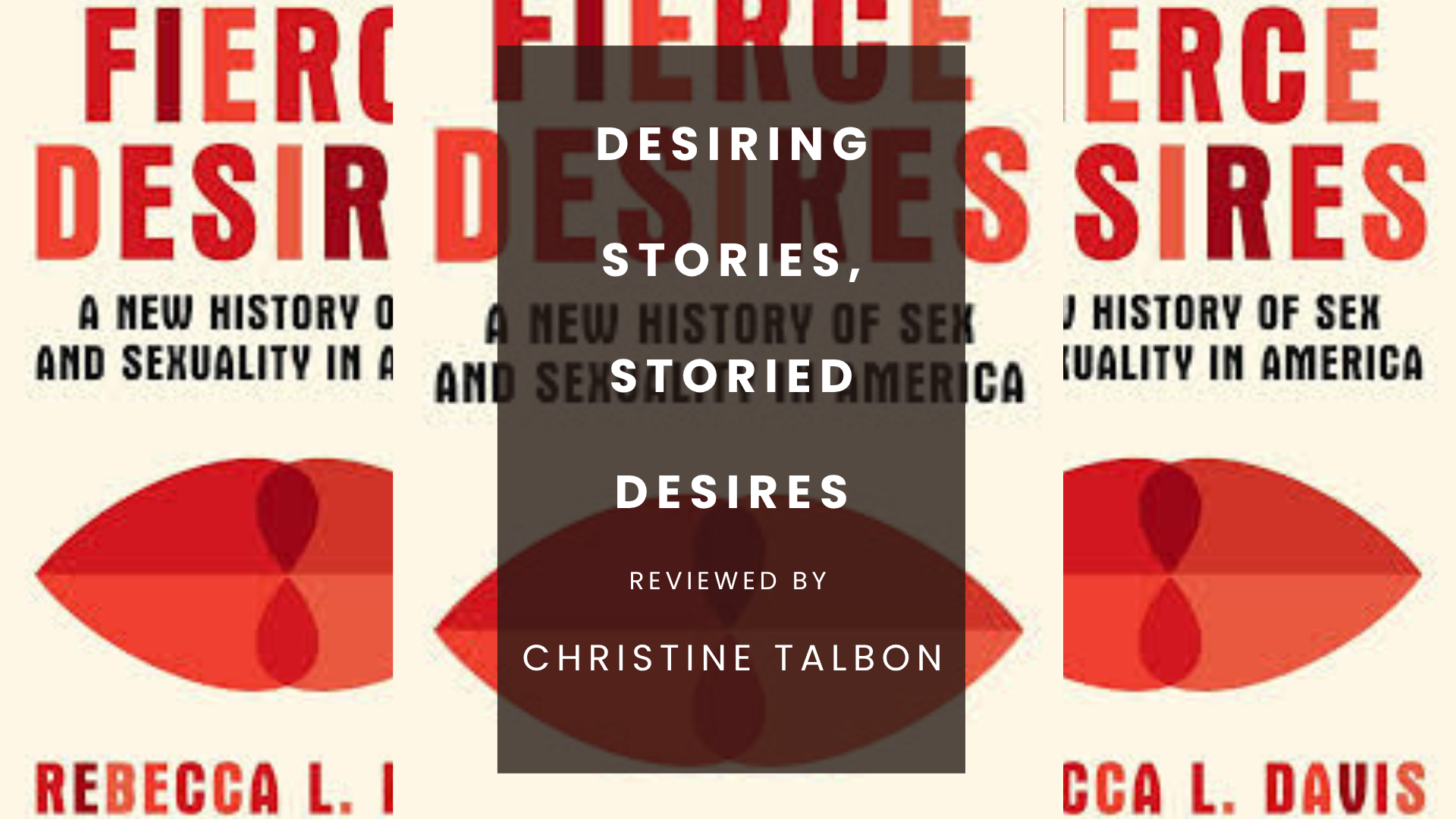
Desiring Stories, Storied Desires | Rebecca L. Davis, Fierce Desires: A New History of Sex and Sexuality in America
Rebecca L. Davis’s book Fierce Desires: A New History of Sex and Sexuality in America asks as its animating question, how have Americans valued, expressed, and contained their desires over the course of American history? The first comprehensive history of sexuality published in over thirty years, Davis’s book applies new paradigms and conceptions of the relationship between sex, gender, and sexuality to show that neither sexuality nor sexual identities are unchanging facts—they have a history we can and must learn from if we are to solve some of today’s most vexing sexual concerns. The book’s central conceit, and perhaps its genius, is its use of narrative and story to link individual and communal lived experiences of desire and sexuality to their larger context and to examine the role of historical context in shaping individual lives. This approach balances the individual and community with the national, agency with social structure, and the personal with the political.
Davis gives readers a long arc of American desires and intimacies in white, Black, Latinx, Indigenous, and working-class communities. It traces three broad periods beginning with the early years of settlement through the early nineteenth century, when Americans “organized their societies as hierarchies in which class, gender, status, and, increasingly, race, were supposed to determine a person’s sexual liberties” (5). Over time these liberties expanded for white men but contracted for others (5). Many of those others nonetheless asserted the value of their desires, as did Juana Hurtado, a woman of mixed Native and Spanish heritage captured by the Diné (Navajo) who later became a significant landowner in what is now New Mexico. Refusing to conform to the Catholic sexual demands of Spanish settlers, Hurtado had children with a man from the Zia Pueblo within a relationship that relied for its status on Pueblo kinship ties more than legal wedlock. In an early but splendid example of how Davis culls broad historical trends, shifts, and conflicts from sometimes ordinary narratives, Davis builds from Hurtado’s life a chapter investigating the sexual customs, beliefs, laws, and practices characterizing Indigenous sexualities as they conflicted with the processes of Spanish colonization in what is now the American West. In another chapter, the story of January Colbert, an enslaved young man forced by violence to cease courting a woman enslaved at a nearby labor camp, anchors a chapter about how enslaved people resisted white control to establish their intimacies in the context of sexual violence, family separation, sexual stereotyping, and the exploitation of enslaved women’s reproductivity. The love letters same-sex beloveds wrote to each other provide context for an exploration of queer intimacies in the early Republic. All of these stories illustrate the power of individual agency to create meaningful lives in the context of colonial, racial, state, and community violence and censure.
Part two of the book examines how, from the mid-1800s to the early twentieth century, many Americans explored sexual desire for its own sake and critiqued many of the forces keeping sex, sexuality, and sexual violence under wraps. This section begins with the story of Mormons who practiced polygamy, alongside other sexual radicals of the time, such as free lovers and the Oneida community that practiced complex marriage. Davis situates Mormonism as the most radical and long-lasting of these experiments. At the same time, increased contact between settlers and Indigenous communities illustrated other alternatives to monogamous, lifetime heterosexuality. In a series of late nineteenth-century legislations, the federal government asserted unprecedented control over Americans’ intimate lives, making “marital monogamy . . . the price of citizenship” (128). This section also covers concerns over obscenity that permeated late nineteenth-century America, when new sciences of sex defined “normal” and “deviant” sexualities, often identifying the desires of queer people and people of color as the latter. Likewise, stories of gender-bending and same-sex love, Anthony Comstock’s campaign against “obscenity,” the sexual risks and rewards of new commercial entertainments, and the development of early queer urban subcultures help readers explores early twentieth-century shifts toward more public expressions of hetero and queer desire. Davis also explores the development of “vice squads” meant to suppress various forms of sexual “deviance.”
Part three covers 1938 to 2024, looking primarily at post–World War II sexual modernity, when reformers and revolutionaries argued that sexuality is an expression of the self and a fundamental human freedom. This section begins with sex researcher Alfred Kinsey’s life and work as the narrative rooting an examination of sexuality in the 1950s. During a time often characterized by demands for sexual conformity and “traditional” family life, Kinsey’s research showed there was no such thing as a “normal” sexuality, challenging decades-long ideas about the supposed threat of deviance. His work “fundamentally changed the way Americans talked about sex” (217). Armed with challenges like Kinsey’s to the concept of sexual normalcy, queer activist Steven Kiyoshi Kuromiya makes appearances across several chapters as a queer youth persecuted for his sexuality in the 1940s and 1950s, then becoming a queer activist in the 1970s and 1980s. His story joins with those of other sexual reformers and revolutionaries in the 1960s, ’70s, and ’80s to ground chapters on the sexual revolution and gay liberation movements. The life of Betty Dodson, dubbed “Public Masturbator Number One” for her fierce advocacy of sexual empowerment through self-pleasuring, informs Davis’s discussions of the feminist contests over the meaning of sexuality to women’s liberation. These more revolutionary forces battled with more conservative perspectives, often couched in terms of “family values,” that valued desire as a force primarily to be contained and controlled, if necessary by the state. The final chapter illustrates a continuity between the backlashes of the 1980s and contemporary concerns about drag queen story hours, sex education, and trans visibility. No doubt with these and other contemporary debates in mind, the last sentence of Davis’s book takes a final (and deserved) dig at those who would censor sexuality and its history: “History is at the heart of Americans’ arguments about sex; resolutions to many of these issues depend on whether we deny or affirm that history’s existence” (343).
Davis’s work illustrates the relevance of the history of sexuality to the personal and political concerns of twenty-first-century America. Its focus on narrative encourages readers to connect with elements of some stories, to see new perspectives in others, and to place their own stories and sexualities in historical context. While readers of Dialogue will notice that Mormonism appears in only one chapter of the book, they will nonetheless find elsewhere much to enrich their study of history, especially as Mormon studies increasingly incorporates sexuality and the insights gained from its study into the field’s mainstream. The book is a tremendous achievement, offering readers of all kinds opportunities to explore how Americans have valued, shaped, and contained sex, sexuality, and desire across American history and, ultimately, the forces that have shaped and contained how we value our own desires and sexualities in the current historical moment.
Rebecca L. Davis. Fierce Desires: A New History of Sex and Sexuality in America. W. W. Norton & Company, 2024. 496 pp. Paperback: $19.79. ISBN: 978-1324116752.