

 Back to full Issue

Articles/Essays – Volume 59, No. 3
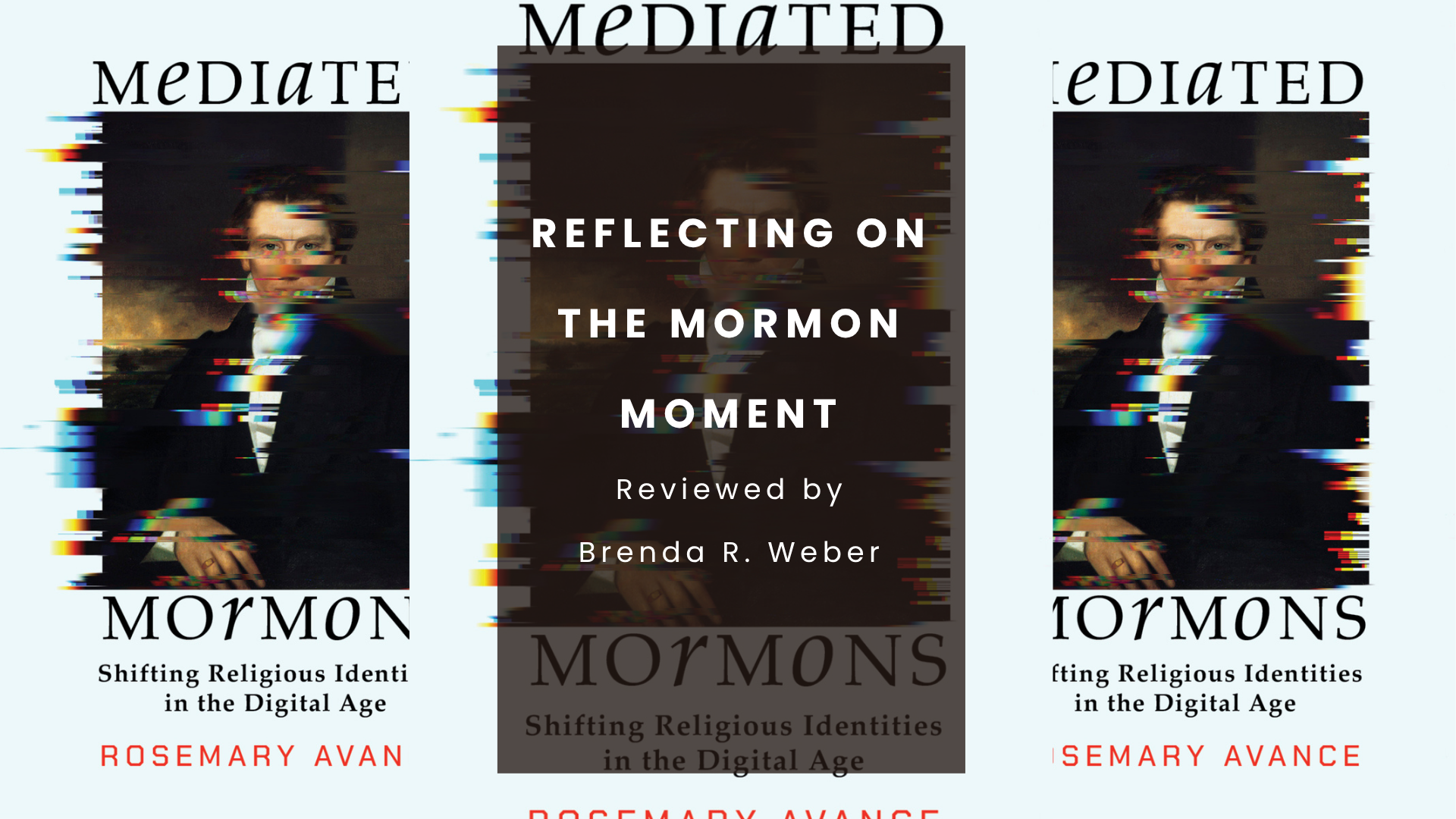
Reflecting on the Mormon Moment | Rosemary Avance, Mediated Mormons: Shifting Religious Identities in the Digital Age
Mediated Mormons: Shifting Religious Identities in the Digital Age is a thoughtful consideration of both the practices and belief systems of the Church of Jesus Christ of Latter-day Saints—colloquially referred to as Mormons—and the religious meaning that is often communicated and solidified through contemporary media. Drawing on a narrow band of time that has been termed the “Mormon moment” (roughly 2010–2012), Rosemary Avance, an assistant professor of media and strategic communications at Oklahoma State University, uses case studies and broader theories about religion and communication to better understand a basic question: What does it mean to be a Mormon in the twenty-first century? Critical to Avance’s discussion is both who and what Mormons are and who and what have the right to make that determination.
In many ways, as an American-born religion that was founded in 1830 and came of age in the twentieth and twenty-first centuries, Mormonism finds ready parallels in both the principles of Americanness (individualism, democracy, free agency, meritocratic upward mobility) and in a mediascape that, much like the religion itself, has expanded with lightning speed in the last two hundred years. The answer to knowing the meaning of “modern Mormon identity,” as Avance phrases it, is to recognize that Mormonism exists in a discursive and often contradictory arena, positioning the faith system and those who adhere to it as both insider (in this case, as the model American citizen) and outsider (as persecuted, wronged, and misunderstood). Media plays a central role in this representation, largely because Mormonism has been and continues to be a topic of fascination for non-Mormon creative producers, from The Book of Mormon musical to TV shows like Big Love and The Secret Lives of Mormon Wives. But as Avance and many other scholars have noted, Mormonism has also long been committed to using self-representation and public narrative both to sustain self-understanding and as a tool for recruitment to the Church.
For those familiar with Mormon studies, these are not original insights—but Avance’s book is helpful for the careful eye she brings to her case studies. Interested scholars will be richly rewarded by the extensive and persuasive archive of primary-source news items and Church pronouncements the author considers in her conversation. The tension between orthodoxy (right thinking) and orthopraxy (right action) is one that fascinates Avance and, indeed, two millennia of religious practitioners and scholars. In this case, however, Avance’s focus on Mormonism means she tries to sort out how much of Mormon identity is determined by a broader culture of socially scripted expectations (around tithing, baptismal rites, keeping the Word of Wisdom, wearing garments, etc.) and doctrinal belief. The fact that Mormonism is predicated on a “living doctrine,” which is to say that the prophet might receive divine inspiration and thus change the doctrinal code of the Church in the present moment, allows for a flux in the belief system of the LDS Church, a fact noted by many LGBTQ Saints, as one example, who live ever-hopeful for divine inspiration that will change the Church’s stance on queer folks, as the 1978 revelation did on Black men’s eligibility for priesthood status.
Again, this is well-trod territory for the Mormon studies scholar, and I say this as someone who sees herself as largely outside of this conversation. Avance’s greater contribution is in her communication studies background that allows her to look specifically at four case studies, organized as the chapters of her book. These are: (1) debates about the relative allowability of caffeine in the LDS dietary code, the Word of Wisdom; (2) discussion of Mitt Romney in 2012 when he was the first nominee for US president selected by a major political party who was also a Mormon (side note: Joseph Smith also ran for president but was nominated by the Quorum of Twelve Apostles, the governing body of his own church); (3) debate of issues around secrecy and surveillance of apostates (those choosing to leave the Church), largely through a discussion of the podcast series Mormon Stories; and (4) dissection of attitudes and restrictions on Mormon women, including a small but thriving Mormon feminist movement and the “Wear Pants to Church Day” campaign. It is through Avance’s evenhanded and trustworthy analysis of these case studies that she is able to flesh out a fascinating tapestry where media both makes and unmakes a larger sense of identity. The payoff of her book, it seems to me, is less in definitively knowing the meaning of Mormonism as in recognizing its endless vacillation and adaptability.
While Avance deliberately limits the scope of her analysis to Latter-day Saints (mainstream Mormons) from 2010 to 2012, further exploration of media in relation to Mormon identity beyond this time period and outside the media production of the LDS Church would be helpful. The Mormon mediascape, indeed, the Mormon moment, is bigger than the three years Avance identifies. While Walter Kirn famously captured the spirit of increased interest around Mormons and Mormonism in his 2011 Newsweek article called, aptly, “The Mormon Moment,” the American fascination with Mormon peoples and practices has been sharp since its inception. As just one example, consider Ann Eliza Young, one of Brigham Young’s fifty-six wives, who in 1873 “divorced” the Church’s second president and left the Church, making a career on the nineteenth-century lecture circuit and publishing a best-selling book Wife No. 19. Brigham Young’s multi-windowed house in Salt Lake City has been an international tourist destination ever since.
Kirn himself suggests that increased visibility of Mormonism was less the point of the “Mormon moment” than what the “quirky” and “wacky” American-born religion allowed a broader culture to understand through it. Specifically, Mormonism carries within itself a “legacy of marginalization” but also of “pluck” and hard work. Mormons are just like everyone else, declares the Church’s “I’m a Mormon” campaign, except in Kirn’s words, “they’re not. And it is their distinctiveness that is influencing the broader culture.”[1] Also, despite the efforts of the LDS Church to make the meanings of Mormonism unified, Mormons in the media are a far more varied and heterogenous group than Avance accounts for. For example, the protagonists of both HBO’s Big Love (2006–2011) and TLC’s Sister Wives (2010–present), two shows Avance understands to be instigators of the “Mormon moment,” hail from fundamentalist branches of the Mormonism, though they call themselves and are referred to in the media as Mormons. To think of Mormonism is always to operate in parallel intellectual chronologies, the time of now and the long history of the Church’s becoming, something the creators of these television programs fully understand (particularly given how characters, both in scripted and reality formats, struggle with the prophecy of polygamy in the context of the messiness of domesticity). Given this and many other factors that I do not have room to enumerate, the sign of Mormonism is much bigger than what the mainstream Church in Salt Lake City authorizes. I believe with her astute observations about media culture, Avance could and should have done more with understanding the heterogenous signs of Mormonism in the contemporary mediascape, even while her case studies are solid in their careful investigations.
Rosemary Avance. Mediated Mormons: Shifting Religious Identities in the Digital Age. University of Utah Press, 2025. 216 pp. Paperback: $29.95. ISBN: 978-1647692063.
[1] Walter Kirn, “The Mormon Moment,” Newsweek, June 5, 2011, https://www.newsweek.com/mormon-moment-67951/.