

 Back to full Issue

Articles/Essays – Volume 59, No. 02
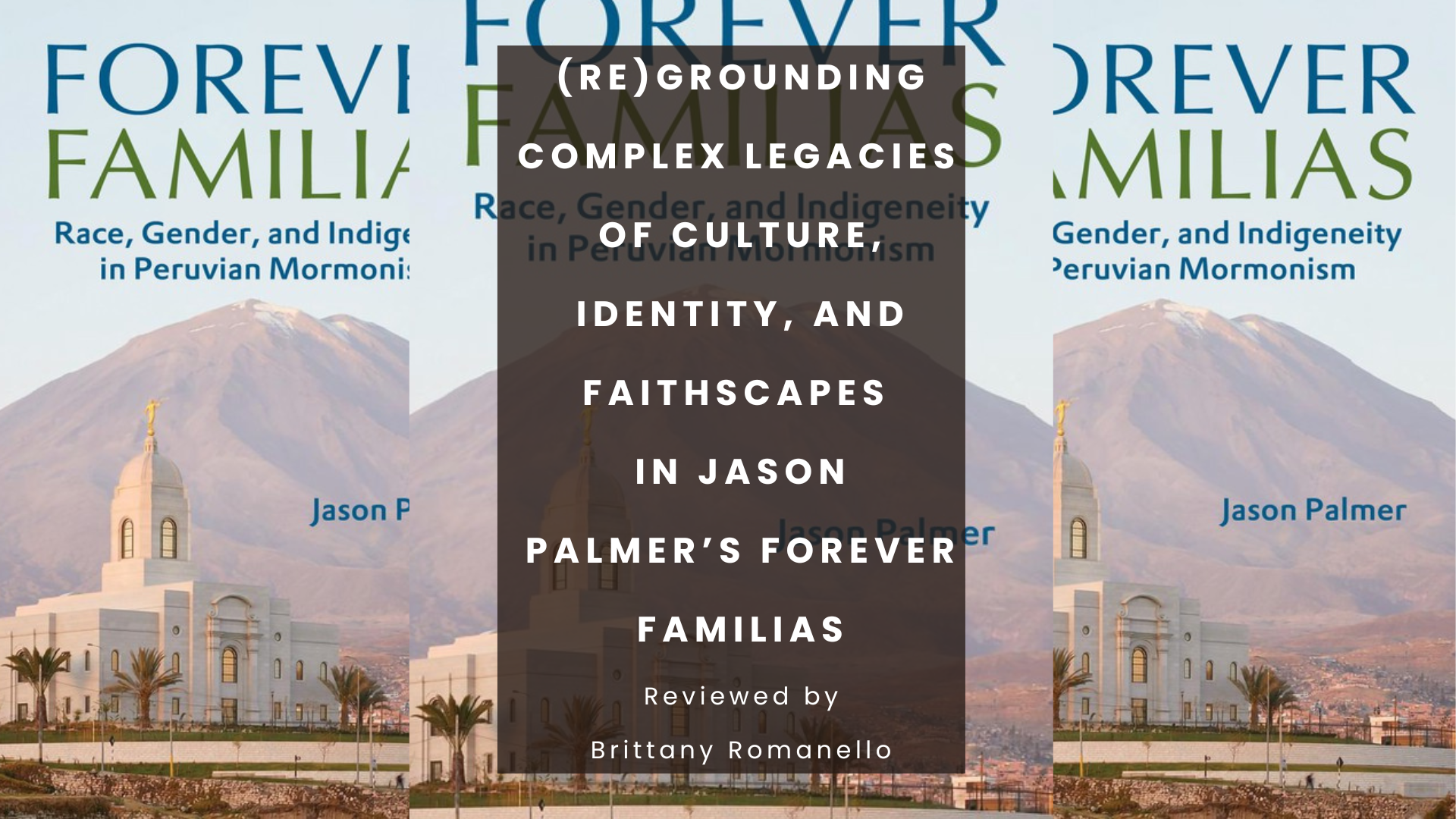
(Re)Grounding Complex Legacies of Culture ,Identity, and Faithscapes in Jason Palmer’s Forever Familias | Jason Palmer, Forever Familias: Race, Gender, and Indigeneity in Peruvian Mormonism
Jason Palmer’s Forever Familias: Race, Gender, and Indigeneity in Peruvian Mormonism offers a profound ethnographic exploration of how race, gender, and indigeneity intersect within the Mormon community in Peru, the migration process, and the United States, namely Utah. Through a meticulously detailed account of his seven years of fieldwork, Palmer unpacks Peruvians’ multifaceted religious identity in a context marked by colonial histories, migration, and challenges that counter dominant narratives within LDS theology and Mormon studies. Palmer’s work is not only a profound reflection on how Mormonism operates in a globalized, still-colonial world but also an examination of the uncomfortable racial and gendered realities that Peruvians face in their own religious lives as they navigate multicultural, multidimensional spaces of place and identity-making in Peru and the United States.
In a June 2024 interview with the University of Illinois Press, Palmer shared the resistance he encountered while writing this book, particularly from LDS peer reviewers: “Resistance from active LDS peer reviewers became an interesting case in point for some of the arguments I made in the book. . . . Experts on Mormonism . . . found most aspects of the manuscript intellectually and spiritually compelling, but refused to recommend publication even after I incorporated their revisions.” This pushback reflects the tension between Mormon studies as an academic field and the institution’s historical entanglements with racial and gendered dynamics that Palmer interrogates.
As someone who has also navigated pushback within the Mormon academic space, especially when examining the complex realities of Latina women’s experiences, I find Palmer’s challenges unsurprising. Like myself, Palmer occupies a liminal space, close to but not entirely immersed in the communities he studies. His positionality as a white citizen adjacent to and entrusted with the intimate lives of the communities he works with is crucial, as it highlights the responsibility and limitations of an outsider’s gaze while also emphasizing the complexities of white supremacy, nationalism, and androcentrism within Mormon studies and in anthropology as a social science discipline. Palmer’s work challenges the comfort of mainstream LDS narratives and forces readers to confront uncomfortable truths about white Mormonism and the US colonial legacy. Throughout Forever Familias, he provides a critique of the LDS Church’s power structures, the racialized dynamics at play, and the consequences of a globalized Mormonism that almost always marginalizes Indigenous perspectives and knowledge pathways that have existed since time immemorial.
Part I: Pioneer Indigeneity: Leaders, Government, Legacy, and Holiness
Palmer’s ethnography, consisting of hundreds of interviews and thousands of observations and interactions, would have never been easy to unpack. However, he starts strong and direct, beginning with examining colonial and anti-Indigenous power structures in Peru and focusing on how the LDS Church replicated colonial hierarchies that already existed there. One particularly striking example occurs when Palmer reflects on the division of labor in the LDS community, especially in terms of gender. In Peru, men and women often occupy different yet equally important roles within the community, and these gendered expectations are not automatically tied to notions of male superiority, as they are in Anglo-American Mormonism. Palmer highlights a moment when he was asked to police a female congregant’s modesty. This request deeply unsettled him, given the culturally ingrained notion in Peru that leadership should not be gendered in the same way it is in Anglo Mormonism. He writes, “In Peruvianess, gender, and stewardships did not overlap automatically. Leadership . . . was not seen as automatic, natural, or God-given” (54). This tension between Anglo and Peruvian gender norms is crucial to the power dynamics Palmer traces throughout his work.
These chapters also engage with the symbolic and material realities of Mormon “pioneering” in Peru as Indigenous Peruvians navigate the imposition of Mormon practices that often clash with their cultural traditions. For instance, Palmer draws attention to the problematic outsourcing of temple design to a white American architect despite the presence of qualified local professionals (68). This reflects the broader colonial dynamic in which Indigenous knowledge and leadership are not recognized within the LDS hierarchy, reinforcing the racialized infantilization of Peruvian members.
Part II: Forever Familia: Future, Marriage, and Independence
Part II of Palmer’s book focuses on the context of LDS marriage, kinship, and migration complexities. He examines how Mormon ideals of family and eternal marriage collide with the realities of life in Peru and migration to the United States. For many Peruvian Mormons, the ideal of an Anglo-American family, with retired couples serving missions and leaving their children behind, is both distant and painful. Palmer recounts a conversation with participant and friend Bishop Paucar, who acknowledged the impossibility of such aspirations for most Peruvian families, given their interdependent kinship structures: “He harbored no illusions that he and his spouse may one day be able to be like Anglo Mormons . . . living increasingly, not decreasingly, interdependent with their children” (177).
Palmer explores how these tensions manifest in the migration experience of Peruvian members, many of whom view their move to Utah as a way to provide a better future for their families. However, the reality of migration is fraught with legal, racial, and economic challenges. The migrant experience becomes a complex negotiation of religious ideals and the harsh realities of undocumented status. Palmer reflects on how these dynamics are gendered, noting that “being single was more socially and economically dangerous for females than it was for males” (216). This is especially true within Mormonism, where marriage and family formation are central to one’s religious identity, social capital, and “worth.”
The racialized hierarchies in the Church, both in Peru and the United States, become painfully apparent in the migration context. Palmer provides examples of how Indigenous Peruvians are often excluded from leadership positions in the Church while also being subjected to discriminatory attitudes from white American leaders. The pressure to conform to an Anglo vision of family, marriage, and service often leads to painful sacrifices for those involved in cross-border marriages or second marriages, with the hope that these unions might create an eternal “forever familia.”
A Witness To and For the Power of Discomfort in (Un)Learning
In the conclusion of Forever Familias, Palmer addresses the discomfort of confronting the deeply embedded whiteness within Mormonism. For Peruvian Mormons, this whiteness is a constant source of tension as they navigate their faith, given that they are subjected to racialized power structures that undermine their Indigenous identities, while also being exoticized in US church spaces and white Mormon gazes. Palmer argues that this discomfort, both personal and institutional, compels a reckoning with the enduring legacy of Mormonism’s colonial past. Palmer’s work is a powerful testament to the resilience and agency of Indigenous Peruvians who, despite the barriers placed before them, continue to find ways to overcome them in pursuit of spiritual fulfillment. Palmer, in that same 2024 University of Illinois Press interview, shared that his hope for this book is that it helps readers understand the destructive role that the United States, and by extension the LDS Church, has played in global colonization. But he also seeks to challenge the myth of “victimhood,” demonstrating how victims of colonization can reclaim and transform the tools of oppression into instruments of liberation.
Forever Familias is an impactful contribution to Latin American ethnography, sociocultural anthropology, and religious studies, particularly for its focus on race, gender, and indigeneity within Mormonism. I will not try to convince you this is an easy weekend read. It’s the opposite: heavy, challenging, and complex. It took me months to absorb the book’s multidimensional historical and ethnographic messaging. I knew the word count limitations for this review would not provide sufficient space to explore the deep investment in Palmer’s approach, grounded in personal relationships and years of fieldwork, which gives readers an intimate, complex portrait of how Mormonism functions within a Latin American, distinctly Peruvian context. The book’s power lies in its ability to reveal the intricate ways in which faith, race, gender, and migration intersect in the lives of Peruvian Mormons in a greater context of Latin American history and social forces, asking us to confront uncomfortable truths about the Church’s global impact and where it relies on those made vulnerable by the State for greater power and influence. Palmer’s transparent reflection on his positionality and the challenges he faced while writing this book also illuminate the power of ethnography, the necessity of critical engagement with colonial structures, and the potential for Indigenous and migrant communities to forge new paths within and beyond them.
Palmer’s work is not just an academic study but also a testament to the power of ethnography and its capacity to challenge deeply ingrained narratives, even within his own multicultural family structure, which he willingly analyzes alongside other participants. His analysis offers a more nuanced and inclusive understanding of Peruvian Mormons’ collective ingenuity, global reach, migration dreams, and life goals. Palmer also makes a tangible effort to recognize his own biases and never misses an opportunity to humanize Peruvian LDS romanticization and disappointments with the US Church. It is a compelling call for reflection and transformation, urging readers to consider how complex, often painful histories shape cultural, religious, and family identities and how they might be reimagined to pursue a more just and equitable future, including a more holistic representation of Peruvian and Indigenous realities within religious, academic, and transnational Mormon spaces.
Jason Palmer. Forever Familias: Race, Gender, and Indigeneity in Peruvian Mormonism. Urbana: University of Illinois Press, 2024. 324 pp. Paperback: $35.00. ISBN: 978-0252087950.