

 Back to full Issue

Articles/Essays – Volume 59, No. 02
Narrow Is the Gate
No man or woman in this dispensation will ever enter into the celestial kingdom of God without the consent of Joseph Smith.
—Brigham Young
The alien ship was beautiful.
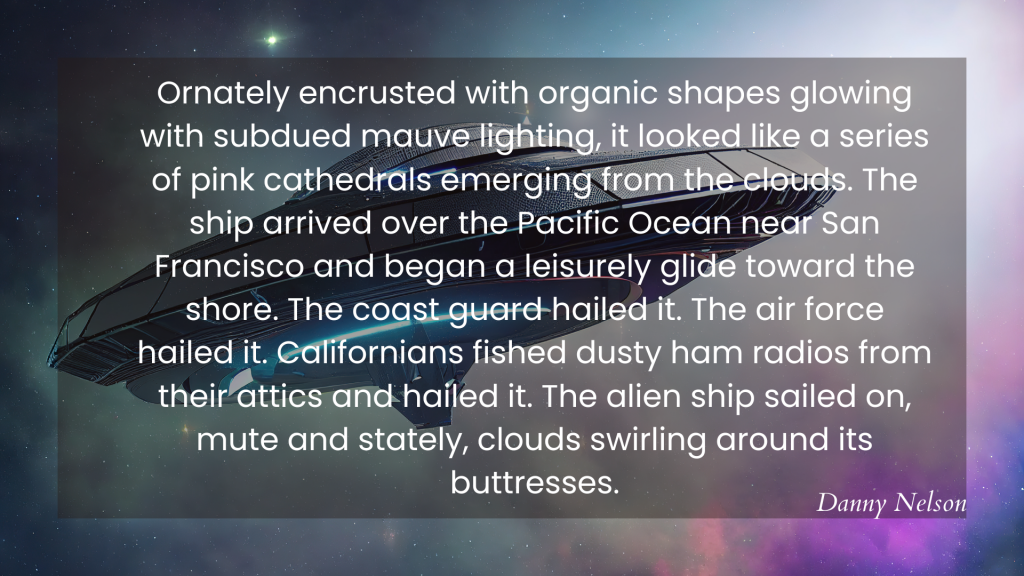
Ornately encrusted with organic shapes glowing with subdued mauve lighting, it looked like a series of pink cathedrals emerging from the clouds. The ship arrived over the Pacific Ocean near San Francisco and began a leisurely glide toward the shore. The coast guard hailed it. The air force hailed it. Californians fished dusty ham radios from their attics and hailed it. The alien ship sailed on, mute and stately, clouds swirling around its buttresses.
An hour after the first sightings, the president of the United States flew to San Francisco, holding press conferences the whole way. Times were difficult and her once fresh face had accumulated the wear of years with each month in office. World politics were nearer a breaking point than usual, and there was an election coming. In one press conference, she shook her head gravely when the topic of military action against the aliens was raised. Americans are calm, brave, and welcoming to visitors, she said. No one bothered to fact-check these claims.
By the time the president and her press junket landed in San Francisco, the ship had made landfall and was sailing serenely east over the scrubby deserts and mountain peaks. The president had a photo taken of herself listening to the city’s overexcited mayor while wearing a serious frown and then boarded the plane again.
The ship sailed on. Satellites tracked its movement. The internet roiled with speculation. Conquest and annihilation. Scientific expedition. Diplomatic envoy. The ship would land in Denver. Las Vegas. Area 51. There was no hope left. This was the salvation of the world.
Fifteen hours later, the ship came to a stop above Salt Lake City.
***
Herbertson was prophet that year. He was short and soft-spoken; gray and grandfatherly. The Church had enjoyed a contented period during his tenure. He did not thunder, as did his first counselor Holyoke, that the world had dragged the Saints’ standards down. When he spoke, he relied heavily on the Book of John. He often ruminated, publicly and personally, that God is Love. Those Saints whose religion originated in the Old Testament found him weak, but his vague goodwill made him an excellent spokesperson for the modern Church. He had the unflappable gentleness of a former middle school science teacher turned spiritual leader. His earnest modesty blunted the most pointed interview questions.
Unlike many prophets before him, Herbertson’s appeal stretched beyond the Saints. The Church may be a paranoid, controlling hotbed of outdated prejudice and petty cruelty, said those the Church used to call gentiles, but at least it was run by Herbertson and not Holyoke. To the gentiles, when he remembered to speak to them, Herbertson replied that the God of the Church was physically and materially incapable of being cruel to anyone. His sedate kindliness was such that few bothered to fact-check his claims.
It was a hazy evening in late spring when the aliens set down in Salt Lake City. The sky was smeared with white and gray, the air hot and dry. There was construction on North Temple, a narrow river of orange safety cones. A youth group was walking to the Family History Museum, their faces blank and cheerful. They pointed as the ship approached the spine of the Wasatch, its turrets and spires eddying the clouds as they boiled through. The ship slowed and came to rest fifty feet above the wide promenade between the temple and the tabernacle.
La Paz, the mayor, called the church offices. The call was not answered because the Church Office Building was emptying. A steady stream of men in blue and gray suits and women in knee-length skirts flowed up the hill to the Avenues. One of La Paz’s aides had a niece who worked for one of the senior staffers at the Church, so eventually the connection was made. The situation was a matter of city security, said La Paz, and the city would handle it with utmost respect for the Church’s property. The senior staffer who took the call was relieved. He had been promoted past his competence, and like many in his position, he was grateful to be told what to do. With genial force, he declared that the evacuation was officially sanctioned and organized his managers to make sure the masses of people proceeded calmly. At the last moment, someone remembered to call Herbertson and let him know the situation.
Herbertson took the call as he looked out the windows of his apartment, just across from Temple Square. A segment of the alien ship served as a pinkish backdrop to the familiar spires of the temple. He thanked the caller softly and hung up the phone, already planning what he would say if the public relations office asked him for a quote. “The truth of our religion speaks of a universal experience” and “we have faith in the security forces of our city” would be part of it. Or, rather, “the men and women of our city’s security force.”
Before the sun set, the aliens descended.
***
They came down on little hovering discs which seemed to wobble under them like hooked fish, but the aliens stayed still as statues. Drones buzzed them from every direction, frantically videoing, but the aliens were unperturbed by the bee-like activity. When they touched down, each seemed to genuflect, but it could have just been the impact of their landing. There were five of them, standing like conquerors in front of the temple wall, tall enough to easily see over it into the grounds.
The aliens were as beautiful as their ship. They had broad, thrown-back heads with three to four black, shining eyes. Their skin had the smooth vibrance of rainforest reptiles—olive green, mustard yellow, and ruddy purple. They wore flowing, colorful gowns of a material somewhere between cotton and feathers. On some, the gowns closed in the back under a hairy, sea-blue collar. They had short arms with many oddly jointed fingers and a retractable bone spur that seemed to function as a thumb. They walked with an eerie, swaying grace.
The city had cordoned off Temple Square and the surrounding streets, so the square was empty. It was impossible to tell what the aliens thought of the abandoned grounds. They looked around them with inscrutable expressions, blinking and winking their black eyes. One reached up and touched a jointed finger to a tree leaf with what looked to some observers like reverence and to others like hunger. The setting desert sun shone dramatically on the colorful, organic curves of their heads.
The president was in Salt Lake by then. In the calculus of elections, Utah was too predictable to be interesting, and she hadn’t campaigned there. She made cheerful noises to the press about the situation being a unique opportunity to see “this jewel of the West,” but in truth, she would have traded significant political favors to move the meeting with these interstellar visitors anywhere else. Religion was divisive, and despite its origins, most Americans were not quick to claim the LDS Church.
Her staff set up a small camp just north of Temple Square near the Conference Center. The media took pictures of her speaking, the spiky trees of the Conference Center’s rooftop gardens ringing her head like a crown. She said she would send a decorated general to speak to the aliens. A woman.
“Do you see this as a way to promote women’s profiles in the military?” asked one member of the press. The president pointedly looked right through him as she called on the questioner behind him. Being rude to reporters was the only portion of her job the president truly enjoyed.
The general, Margoyles, marched into Temple Square flanked by two young, burly military men dressed in dark fatigues. She was bone thin and rigid, cutting through the cheery ambiance of the square like a hot saber through a butter sculpture. She stopped a safe distance from the aliens and hailed them. One of the burly young men carried a computer meant to help with translation. The aliens were prepared, however. With great solemnity, they handed Margoyles a twisted box with several delicate coruscations. While holding it, which she did stiffly and uncomfortably, Margoyles could understand the aliens’ speech. It was not the sort of understanding that translates words into other words. It was like dream-understanding, the strange certainty of knowing impossible things. Holding the translator, Margoyles’s mind opened and fluttered like a papery flower, but it never showed on her face. She was an excellent soldier.
The people of Earth welcomed the aliens, said Margoyles. The aliens showed polite goodwill. The people of Earth were happy to meet the aliens as peaceful visitors, but they should know that the Earth was defended, said Margoyles. Of course, of course, replied the aliens, sending swirls of impatience through the device Margoyles held. If the aliens would reveal their purpose in visiting, perhaps the people of Earth could help, said Margoyles.
There was a disagreement among the aliens about their response. They each had two voices, a high reed and a low flute; they harmonized with themselves and each other as they spoke. They argued together for a moment in swift tonal snatches. At last, the one with blotches of yellow and mauve in lines along its elongated head responded.
Earth was very kind to offer help, it said through the box, which throbbed in Margoyles’s hands. Fortunately, human help was not needed. No—not that. Margoyle sensed that their meaning was closer to Earth’s help would be ludicrously insufficient. The aliens were not after anything material.
One of the aliens fished in its robes and pulled out a thin, metallic-looking square. Etched in lines of glowing blue was a picture of a man. He had a hooked nose, a high collar, and a strange, archaic bouffant of hair.
We must speak to the successor of Brother Joseph, buzzed the translator in Margoyles’s hands. Take us to the prophet.
***
The drones recorded the picture on the metal square in crisp clarity. It was unmistakably the image of Joseph Smith Jr., now long dead and—as far as anyone knew—as Earth-bound as any other religious figure from history. Frantically, the president declared a total media blackout. It didn’t work. ALIENS SEEK LDS PROPHET blared the news scrolls, followed by ads, and then TEN THINGS YOU DIDN’T KNOW ABOUT MORMONISM—#5 WILL SHOCK YOU.
In truth, very few people who clicked through were shocked. For good or ill, public opinion about the Church was set—congealed like over-refrigerated gelatin. Those who were already inclined to be incensed about the Church found energy to be angry again, while those already inclined to approve smiled in serene satisfaction. Most were merely puzzled. The LDS Church, that minuscule branch of a decaying Christian tradition, seemed the most random and specific thing the aliens could have chosen as their entry point to all of human expression.
“It’s like,” said a popular comic to his late-night audience, “going to a buffet and asking to have a closed-door session with a green bean.”
The apostles called an emergency session. Holyoke was the loudest voice in the room. It was a confirmation of the universality of the Restoration, he said. It would lead to a flowering of missionary work. What a testimony to the foundation of the Church. An ensign—not just to the world, but to the universe. The Church was justified—not that it sought justification, but just the same! No human soul could doubt the truth now.
In the heat of inspiration, Holyoke was impressive and beyond questioning. Under the soft lights of the meeting room, his bald forehead shone like a halo. The Brethren prayed together and, as was so often the case, a sweet sense of rightness and comfort prevailed in the room.
Herbertson, his stomach uncertain, visited the bathroom after the meeting. It had a picture of the First Vision. Looking at the familiar painting, Herbertson wondered. No matter how he tried, he couldn’t insert aliens into his understanding of the scene.
***
The government brought Herbertson to speak to the aliens. They had no choice. The aliens refused to communicate anything substantive without him.
Herbertson knew the layout of the temple complex more intimately than his own apartment. He knew the order of the yearly flowers that bloomed and then were rooted out to make way for the next season’s flora, knew the cheerful Holas and Ni Haos from the smiling sister missionaries, knew the slightly medicated smell of the standing pools and fountains. Swarmed by military personnel, though, the temple grounds suddenly seemed strange and overlarge. Herbertson himself felt shrunken and old, leaning heavily on his cane while the two guards walked with careful steps to match his pace.
The government had set up a white pavilion in the grass between the Lion House and the Church Office Building. Its spires soared to the sky, a little sister to the granite temple to the west. It hosted the aliens, shading their uncannily curved heads from Utah’s relentless sun. Electrical cords snaked everywhere along the ground, feeding into boxy machines—translators and bio-indicators, radar machines and a full field hospital kit. Someone had set out a folding chair facing the aliens for Herbertson. The aliens stood in a grand, multicolored group. As far as anyone had seen, they didn’t sit.
The chair was uncomfortable, but Herbertson was grateful for it. Years of going from apartment to temple tunnels to private airplane made the heat of the day unfamiliar and unpleasant. And he was old. His knees complained as he gripped them in hands mottled with russet spots. Steadiness was one of Herbertson’s virtues, though, and he willed the irritation of the sweat away. He would meet these emissaries of the stars with serene goodwill.
The aliens turned toward him with the unnerving collective grace of a flock of birds as he sat. They raised their hands and rattled at him. Herbertson smiled blandly. He had visited Ghana, India, Peru. He knew how to arrange his face when he didn’t understand the local customs.
Perhaps the aliens’ culture deemed the translator box inappropriate for first meetings, for they did not offer it. Instead, they merely spoke to Herbertson, first the one with yellow and ochre on its head, then the one with deep-sea blue and turquoise. Their two-part voices dipped and swelled. At a certain point, they paused impressively.
Herbertson, sensing it was his turn, replied with a short speech he had prepared during his morning shower. The church of Earth was pleased to welcome the guests from the stars—fellow believers. What a joy it was to see that the good news of the gospel had touched more than this tiny planet, to know that God could transcend the narrow limitations of man’s sight. There was much that each group of—he stumbled on the word souls, recovered—could teach each other. The unrelenting rules of gravity were like a tether keeping humanity’s feet planted on Earth, but their faces were pointed to the stars, grateful to meet fellow travelers in God’s vast creation.
The exchange was being taped by the government and Herbertson didn’t notice the camera technician, whose lips quirked at his final sentence. Those who paid attention to these things would recognize the line as inimitably Herbertson’s. He tended to start practical and crescendo into floridity. The pattern was more pronounced under stress. The blank stares of the aliens were oddly aggressive and discomfiting. Herbertson wished for a glass of ice water and a teleprompter but reined in his expectations. Brigham Young had stood on a stump and preached to a crowd boiling tar—he could sit on a folding chair and speak calmly with aliens.
The ritual seemed to be complete, if it was a ritual at all. The aliens rattled again, snapping their bone spurs against their hands like castanets. Then the translator was handed to Herbertson, and for a second, he was overcome with nausea as the alien communiques soaked into his mind through his fingers. He gripped the translator too tightly and the messages swirled over him in see-sawing pulses of urgency.
We are pleased to meet Brother Joseph’s successor, the aliens intimated between Herbertson’s fingers. He felt their pleasure—their utter delight, alien and consuming and pure—and wondered at it. It made him think of snowball plants blooming, of popcorn popping on the apricot tree. He shook his head, and his glasses slid down his nose. Of course, he was pleased to see them as well, he thought back, hoping to use the same mechanism. To his unease, the thought traveled through his fingers into the machine like a physical thing, and with it trailed all sorts of other thoughts, like fish swimming in the wake of a shark—his pleasure, his unease, the discomfort of the flat planes of the chair against his buttocks.
The aliens accepted the confused response with dignified inclines of their heads. Perhaps they expected this muddled reply. Kindly, they sent, It takes some time for purity of thought to be achieved. No doubt you have more elegant ways of sharing your [something] with your own kind. That something was a concept near to soul but also, somehow, close to the concepts of kidney and doormat. Herbertson nodded patiently and realized the action was likely to be as inscrutable to them as the hand-rattling was to him, so he sent his willingness to keep listening through the machine. This thought went through more cleanly, though a regret from his teenage years bubbled up before it sent. The sweat was heavy on his forehead now.
The aliens conversed among themselves, their dual voices sounding like a flock of flamingos arguing with a herd of cows. Was there dissent in the group? Herbertson blinked. There didn’t seem to be disagreement, exactly, but the aliens certainly had personalities. The yellow-tinted one piped up when no one had spoken to it for several breaths, and the turquoise one’s voices sounded harried and businesslike. There was a larger alien in blue and black that rarely spoke, staring instead at Herbertson with unreadable eyes. The two whose heads were slashed with green spoke to each other with the easy back-and-forth of couples or siblings.
The aliens’ conference stopped as abruptly as it had begun. The turquoise one turned again to Herbertson.
We abase ourselves, it sent through the translator. It is our planet’s never-ending honor to be in your presence.
Herbertson gasped a little at the intensity of feeling that coursed through him with the alien’s words. An emotion like exalted reverence radiated like a tiny sun from the machine on his lap. The aliens, pulsed the translator, believed. Such deep love, awe, and esteem poured from it that Herbertson blushed and tried to clean his glasses—an old trick from his teaching days to cover discomfort—nearly dropping the translator in the process. He resettled everything carefully but left his glasses askew on his nose, giving him a slightly drunk look.
At last, uncomfortable, Herbertson sent I am honored to meet you as well.
The aliens glanced at each other, their throats swelling and pulsing and—in the case of the two green-headed ones—flushing purple. It took a moment for Herbertson to recognize the flood of feelings, but then he saw clearly. The aliens were crying for joy, or rather, the alien equivalent of that human action.
Herbertson had been to Ghana, India, Peru. He knew how to turn the adulation of those who saw him as a savior back toward God. Without hesitation, he sent The Lord loves you. It was the cleanest thing he’d sent through the translator, and he meant it.
The aliens sent the feeling back to Herbertson fivefold. Herbertson felt his eyes grow wet. The translator between his hands buzzed with a transcendence of certainty and divine love.
Please, give me the message you have brought with you, sent Herbertson, still rapt.
The sending turned the moment sour. Spiky waves of uncertainty and confusion shot through the translator. The turquoise alien again stood as spokes-creature.
We have no message, it said—or was it, It is impossible for us to have anything to tell you?
Herbertson blinked, his own confusion swirling around the aliens’. We have questions, pulsed the translator in his lap. We have so many questions.
***
The president felt that the military and the Mormons had the alien visitation handled. She wanted to be in Washington planning infrastructure, not stuck in a Salt Lake Marriott running attendance on these very foreign dignitaries. She had plans for a transcontinental network of supertrains.
Americans don’t want supertrains, said her advisors. They want to know someone is taking control of the alien situation.
Irritated, the president followed their advice. She held press conferences, visited Hill Air Force Base, gave visiting lectures at the University of Utah. She even went to a BYU football game, though she sensed the entire stadium had voted for her rival in the last election. The marching band played “I Love You, California” in her honor, and she smiled and waved while the crowd cheered part-heartedly.
The president was not comfortable being confined to Utah. There were too many surprises, little backward eddies in the way the people behaved. She would settle into conversation with some Utahn, sailing forward on the small talk of politics, and then, suddenly, there it would be—some conversational artifact from another age, some impression or attitude untouched by the twenty-first century, bobbing up into the conversation as if it belonged. If she called attention to it, the Utahn’s face would smooth over, wide, friendly, blank. They couldn’t hear the anachronism in their own voices, couldn’t process her discomfort. She spent longer than she should in phone conversations with her husband, enjoying the direct East Coast tones of his voice, his total lack of circumlocution.
So, it was not her favorite state. She strongly suspected it had never been any president’s favorite state. But the president had three children, and not all of them were her favorite, either. That didn’t mean she didn’t care. She made an effort. She toured Temple Square, spoke to the protesters standing in their small clumps outside the walled grounds. She took easy hikes up the mountain, learned to know the smell of the Great Salt Lake tainting the air. She discovered, surprisingly, that there was excellent coffee to be had if one was willing to search for it. And she learned to love sipping that coffee while standing in front of one of the wall-length windows in the Marriott, watching the sun pulse pale yellows and pinks over the edge of the Wasatch early in the morning.
There are compensations for everything, she typed into the document where she kept notes for the inevitable book she would write following her presidency. The thought buoyed her through almost three meetings with representatives of the local legislature.
***
Herbertson was, broadly speaking, looking forward to answering the aliens’ queries. He was a great answerer of questions, and he had lived in the soft-edged universe of the Church long enough that there were very few subjects he didn’t have answers for. In his younger days he had spoken with the pope, and during one of the rare occasions when the camera’s gaze didn’t force them to be friendly and noncommittal, the two gray-haired men had talked theology. Herbertson had initially been nervous to speak with the pontiff but had since felt he had won the conversation. It was, of course, difficult to tell when working through translators, but he trusted his instincts. He felt some of the same thrill of confident apprehension when he contemplated his interviews with the aliens.
The scores of attending military and scientific experts were less confident. It was time, they said, that the aliens made some concessions to the rest of the population of Earth. By this, they meant America and, more specifically, their own fields of expertise. Religious conversations were all well and good, but Earth had some very pressing questions about the aliens’ visit. The scientists wanted to know how, the military wanted to know why, and the president’s PR representatives wanted to know if there was an approved term for the species, because the word alien sounded a little nineteenth century and was exciting the sort of people who scream on cable news shows.
If they could have insisted on having their questions answered, the experts would have done so. But the aliens didn’t so much refuse to communicate with the scientists and generals as ignore them. If they managed to get a question mediated through Herbertson, the aliens would answer it to the best of their ability, but they had little patience for any matters outside their faith. At one point, pressed by the head of the scientific team, Herbertson had asked how the spaceships were fueled. The answer that swam through the translator was incomprehensible and terse—something about gathering a foam or mist that swirled around certain kinds of stars, then compressing and distilling it as fuel. The aliens said they didn’t know the details, and the feeling pulsing through the translator was that they weren’t at all interested in learning them. There were engineers who knew these things, but they hadn’t been brought on this most important mission. Their ships worked; that was the main thing. If something went wrong, there was a station not too far from Earth’s solar system that could solve mechanical problems.
The military and scientific leaders wanted to know a great deal more about that, but the aliens were already plying Herbertson with their own questions. The most the scientists and soldiers got after that was a short statement from the indigo alien who, with stately but clearly manufactured patience, pointed out that they had traveled a long way and that civility (a confusing concept in the translator, teetering between the ideas of wind tunnel and box of souls) dictated that they be able to complete their mission before gratifying everyone’s idle curiosity.
The scientists and military experts withdrew, not entirely graciously. At least, they told each other, they were allowed to record the proceedings. And who knew, perhaps some snippet of the religious discussion would reveal something important about the alien’s biology, technology, or whether (as the military experts believed) they were the advance scouts of an invading army.
Transcripts of the aliens’ questions to Herbertson were therefore dutifully filed away in a smooth black safe, though the transcribers were uncertain about their usefulness. Herbertson did his best to describe the questions coursing through the translator, but was generally at a loss to comprehend, let alone put into English, the alien concepts flooding his brain. A typical sequence of questions punched into the transcription went like this:
The prophet said that hot drinks are to be avoided. Does the [unintelligible] count as a hot drink, or does the fact that it [unintelligible] and sometimes [unintelligible] make it safe to drink, no matter its temperature?
We are supposed to hold things in common, but [unintelligible] cannot be split among [unintelligible] without negative effects to [unintelligible]. Is it right for us to decline to share [unintelligible] with other believers, or is this sinful?
Many [unintelligible] may be joined as [unintelligible] but does [unintelligible] or [unintelligible] counteract [unintelligible] or confirm it?
This last question turned out to be about polygamy, and that was where the trouble began.
The aliens reported themselves to have three biological sexes—though the number was possibly four. There was debate on their planet as to which of the two or three “attendant” sexes should be a plural partner for the “presiding” sex.
As far as Herbertson, gripping the translator with sweaty fingers, could understand, some theorists in the alien culture claimed that one particular sex—was it those with green striping on their heads?—was the only acceptable one for polygamy, while others argued that the other attendant sex was the true polygamous one. Still others argued that any sex that wasn’t a presiding sex was available for polygamy. No one in the aliens’ culture seemed to question which sex was the presiding one.
The question was further complicated because the aliens couldn’t clearly communicate their concept of marriage to Herbertson. It was somewhere along the lines of legal contract of affection and life partnership but it snarled together with other concepts such as a severed root, and the flash of sunlight on a pane of glass, only eternal, and the ache of the bone of the back after sleep. Even more confusingly, these barnacle-like meanings shifted around depending on which alien was speaking. So, for the turquoise alien, the root aspect was more pronounced and carried along the dizzying idea that the fruit is the seed is the fruit is the seed. The yellow alien also spoke of butchery when it spoke of marriage. For the dark alien, marriage was primarily the war that has no enemies. And hidden deep within the green-striped aliens’ concept of marriage, so slight it was almost imperceptible, was air escaping from a biological sphincter, though whether that meant whistling, farting, or some process unavailable to humans Herbertson couldn’t tell.
It took several hours of intense decoding for Herbertson to arrive at an understanding of the question, and he gave himself a few moments to consider it. The aliens peered at him as he sat sweating in the Utah heat, their black eyes expressionless. Inwardly, Herbertson prayed for guidance, but no immediate answer came.
I am sorry, but there is much that I still do not understand about your question, he sent through the translator.
The aliens looked at each other. Perhaps you can use your own translator, they sent through the device in Herbertson’s hands. A communication of Earthly design may provide you a more accurate picture.
We sadly lack your powers of technology, Herbertson sent back with a rueful smile.
Flickers of uncertainty radiated between the tall alien forms and seeped into the translator. But the translator is Brother Joseph’s design, it thrummed.
Herbertson sent back a blank wall of ignorance.
Something like panic surged beneath the aliens’ communications. The flashing, black-eyed glances they gave each operated in concert with the feelings crawling into Herbertson’s hands, giving him an almost native understanding of their facial expressions. At last, the dark alien pulled its personal translator from a knapsack slung about its shoulders. Pressing at its edges, the alien opened the translator, which came apart in two halves like a cracked egg. Embedded in its glowing blue machinery was a set of wire-rimmed spectacles, stones where the lenses should be.
***
ALIENS USE MORMON MAGIC TRANSLATOR blared the headlines, followed with BUILDING A URIM AND THUMMIM—IS IT POSSIBLE? AN ENGINEER AND RELIGIOUS HISTORIAN WEIGH IN. More reputable and less popular news sites showed the president in an unguarded moment, pinching the bridge of her nose with a pained expression as she read the news.
The apostles called another emergency meeting. They had to find the original Urim and Thummim used by Joseph Smith. But it had been kept so safe—packed up with seer stones, dowsing rods, and other nineteenth-century bric-a-brac that had become embarrassing over the years—no one really knew where it had ended up.
After a frantic search, the artifact was located. They brought it to the apostles on a white cloth. It sat on the table, inert, the lamplight reflecting dully on the cut stones. Herbertson regarded it with trepidation. When he was a young apostle, he had thought of searching out the history of Joseph’s Urim and Thummim, but it was the sort of project that gets shoved aside by other, more pressing matters. He wished now that he had made the study a priority.
Holyoke insisted that the Urim and Thummim be used—it was inconceivable that the aliens could make use of one of God’s artifacts while they, his Earthly inheritors, could not. One by one the apostles tried on the Urim and Thummim, peering through the milky stone lenses, and one by one they reported no additional inspiration or influence. Finally, it was Herbertson’s turn. He settled the glasses on his nose, feeling foolish and oddly transgressive. The spindly wires of the nose- and earpieces dug into the flesh of his face, and the stones were opaque and poorly cut, presenting his eyes with faceted, but blank, walls. He did not feel the familiar warmth of inspiration. Slowly, he took them off and forced himself to face the apostles’ expectant faces.
Undaunted, Holyoke suggested they bring the Urim and Thummim to the next interview with the aliens, to demonstrate that the Earthly Church was equal to theirs. Herbertson nodded noncommittally, but when the Brethren disbanded he quietly asked an aide to return the artifact to storage. He was a prophet of the modern Church and had found from long experience that these items were much more comfortable when they were out of sight.
***
After nearly ten days, the president was fighting the feeling that she was going to spend the remainder of her presidency in Salt Lake. Rather than depress her, however, the feeling galvanized her. She was a remarkably resilient person, but inaction made her anxious.
She woke early one morning with the familiar, crushing “Utah” feeling hovering around her thoughts, and resolved as she curled her hair to accept the feeling and do something with it. For whatever reason, she was halted here—trapped like the smoggy air that lay some mornings like a blanket, straining at the lip of the mountain peaks, unable to disperse. The forces keeping her arrested couldn’t be changed, so they were inconsequential. There must be something she could do, even in Utah. She sent one of her aides on an errand, pressing a folded square of notepaper into his hand. He returned three hours later laden with enormous maps of the state and sacks of markers and rulers. Overjoyed, the president canceled her afternoon meetings.
In the quiet of her Marriott room, she sorted through the maps and selected the largest: an almost archaic map that covered most of the floor when she unfolded it. The president kicked off her heels and stood astride the map for a few moments like the Colossus. She traced the delicate lines of streets and rivers with her eyes, noting the sprawling jumble of the Wasatch Front; the wide, empty deserts studded with minuscule towns; the southern-border growths of retirement havens. Having seen the whole, she focused on Salt Lake City. Though she didn’t know their history, she appreciated the utopian grids lying cheek by jowl with the curves of prosperous western subdivisions, saw in her mind’s eye the self-assured, self-righteous suburbs’ drain on the city proper.
At last, she nodded in satisfaction. Utahns had been clever in the way they solved their city’s transportation difficulties, but they had not been so clever that their designs weren’t blatantly, laughably wrong. Here, at last, was something she could do.
The president sat cross-legged on the map and leaned over Salt Lake City. Drawing out a thick red marker from the sack, she put her tongue between her teeth and began to design a transportation infrastructure.
***
The aliens were willing to move on from the Urim and Thummim discussion, but they were less willing to drop the subject of polygamy. As far as Herbertson could ascertain, the debate about the proper configuration of the attendant sexes was the closest their culture had come to religious strife. From the glimpses he had of the historical roots of the question, the promise of a resolution to the polygamy problem was one of the ways the aliens had justified the expense and complexity of their interstellar journey. They would not leave Earth without some sort of definitive answer on the subject.
Other prophets in the Church’s history might have relied on spiritual promptings to arrive at a concrete answer and been perfectly comfortable giving an edict with no real understanding of the situation. But this was not Herbertson’s style. He believed in detailed research, reflection, and serious contemplation—intermingled with prayer—before making any sort of prophetic pronouncement. He would not give the aliens a decree until he understood its implications and impact. And so, the discussions dragged on, both parties growing more and more befuddled.
At last, the indigo alien, who had been taking over more and more of the conversation, sent with characteristic impatience, Perhaps you can tell us the Earthly Church’s approach to the problem of polygamy.
This was a question Herbertson was prepared to answer, and he leapt for it. In fact, it was so well-worn in Herbertson’s mind—honed after years of being asked by reporters, religious leaders, and the faithful alike—that he began sending the answer almost before he realized it. He told them of the Saints’ expulsion to Utah, the years of political strife, the 1890 Manifesto, and then—with some habitual pride—the Church’s current strident policies against polygamy. He told them more than he meant to, fumbling a bit with the translator, of the success the Church had in distancing itself from this embarrassing chapter of its history.
Suddenly he faltered as he recalled his audience.
The aliens stared at him, black eyes wide, horror and confusion crashing through the translator in Herbertson’s hands.
You—countermanded—Brother Joseph’s prophecy? came the first articulate question, countermanded flirting with treason and blasphemy. Herbertson, stung from an unfamiliar corner, replied too swiftly and too much by rote: It was a political necessity at the time. Those who opposed the Saints would not let us live peacefully unless we adapted. He was sweating heavily now, his fingers twitching nervously around the translator in his lap.
The aliens continued to stare at him, their contempt for the concept of political necessity welling up through the translator.
There must, thought Herbertson desperately at them, have been those in your culture who resisted Joseph’s prophecy?
Again, horror and confusion bled through the translator.
At last, the indigo alien stepped forward in a swaying, mammoth movement. Why would anyone resist the Prophet’s words? it sent. What he spoke was the Truth.
Truth in the translator was rocklike and impressive, as solid a fact as the certainty of gravity or the heat of the sun.
Not everyone can see the Truth for what it is, sent Herbertson uneasily.
The indigo alien blinked at him. Then what good is the Truth? it sent. There was fear and confusion in its words, but something else was growing beneath it, something hard, apprehensive, and accusatory.
Herbertson stared at the alien, his fingers hovering above the translator.
We are confused because two opposing Truths cannot exist simultaneously. Either Joseph’s words are the self-evident Truth, or your adaptation is. In the translator, adaptation was neither a lovely nor congratulatory concept.
The Church must adapt to survive, sent Herbertson. His communications were becoming messy and inconsistent again—his deep, unexamined feelings slipping out as he attempted to gain control of the conversation. Surely, on your planet, adjustments had to be made—
This thought went through the aliens like a sea swell. They flashed glances at each other while shock, worry, and befuddlement burst like fireworks through the translator. At last, the indigo alien quelled the others with a single sweep of its arm.
This is our people, it sent. Herbertson gasped as a vision of the alien planet and its inhabitants burst into his mind. He could not make sense of the alien architecture, culture, and ecology that roared through his head. But he could manage the religion, for it was familiar in its nineteenth-century formation—its orders of administration, its fascination with the mythic past and the patterns of the universe. The aliens were not mindless drones in their faith. He saw flashes of genius and individuality—artists and architects, politicians and poets—but in one thing they agreed, and that was the divinity and accuracy of Joseph Smith’s words. The uncountable billions of aliens that lived and worked and sang and died on that faraway world would be as likely to deny Joseph Smith as they would to declare that water and food were unnecessary. The aliens believed—uniformly, passionately, and securely.
Herbertson found himself clinging to the metal frame of his chair as the vision passed. How is it possible, he sent, that all of you believe?
How is it possible, sent the indigo alien, and Herbertson had the crawling feeling that it was looking at him the way a doctor might look at a pathogen under a microscope, that all of you do not believe?
***
The aliens called for the president. TAKE US TO YOUR LEADER, SAY ALIENS reported the news sites, though in fact what the aliens had sent was We must speak to the foremost representative of your culture, which the military and scientific representatives figured meant the same thing.
The president was unprepared for the interview. She had stumbled upon a casual club of women city planners in Salt Lake Valley and had gotten herself invited to their weekly bar night. Two glasses of red in, she had—with uncharacteristic bashfulness—told them of her sketched-out plans for the Wasatch Front’s infrastructure. The evening had ended with the five women in her hotel room, speaking in excitable and too-loud tones about how clever her plan was, and how with a few modifications it could revolutionize the snarling traffic corridors, reduce the persistent smog, and even—after a few more glasses of wine—raise the profile of the state. The president suspected the city planners were buttering her up, but that was something she was used to.
So, it was a dangerously hungover president that met with the aliens, sitting carefully on Herbertson’s former seat with her legs crossed—something she only did when her head and stomach were uncertain. She had no idea what she was going to say. All she could gather from her advisors was that something had broken between the aliens and the Mormons, and she was supposed to fix things so that the military and scientists could finally ask their burning questions. How she was supposed to do that was not touched upon.
“You’ll be amazing,” the aide had said instead as she propelled the president toward the tent. “Focus on collaboration. Ways we can be mutually beneficial. Our shared—um—whatever we share.” Even hungover, the president made a mental note of the aide’s exact phrasing. It would be an excellent anecdote for her book.
She had been under the impression that the aliens spoke democratically, so she was surprised when the alien with dark indigo and blue patterning stood forward while the others huddled together, stroking each other’s backs with their strangely jointed arms.
Are they alright? the president sent through the translator, struggling to master it though she’d been talked through the process by scientists and Margolyes alike.
The indigo alien’s communication was short and brusque. They are—What? Lost? In mourning? Betrayed? The president shook her head empathetically. Whatever the exact meaning might be, it was bad. I am sorry, she sent.
The alien made a movement with one of its fingers, and the translator beamed the concept of a resigned shrug.
I’m ready to speak as a representative of Earth, said the president. Sorry, I should have started with that.
The indigo alien stared at her, dark eyes flashing. At last, with a weird sort of articulation that the president interpreted as very considered communication, the indigo alien asked, Why has your planet perverted the words of Brother Joseph? Every concept coming through the translator rang with raw hurt.
Who? the president sent back.
The alien reacted as if it had been slapped. Brother Joseph, it repeated.
Through the haze of her aching head, the president remembered. Oh, the Mormon founder. Yes. She wracked her brain for any information. She had done her master’s thesis on the Quaker influence on American politics. Perhaps there was something there. But—no, nothing beyond some footnotes that were mostly snide. She bit her lip and tried harder, her head reeling.
The indigo alien was aghast. You don’t know Brother Joseph? it sent. In the translator, know was understanding and love and reverence and gratitude.
The president laughed.
The indigo alien stepped back. Shock, outrage, and offense bubbled up from the translator. If her last comment had been a slap, this was a body blow.
I’m sorry, sent the president swiftly. I was unprepared for the question. I didn’t mean to be disrespectful. It’s just—. She fumbled, trying to force herself to think diplomatically. The church that Joseph Smith founded is—what word is best? Small? Inconsequential? Comically backward? A joke? Unsettlingly ludicrous?
A hissing sound caught her attention, and she glanced at the aliens, realizing too late that she had poured all her true feelings into the communication—shared how tiny the Church was in her estimation, how the powerful, important people of the world would laugh up their sleeves at the thought of her trapped in the myopic, fanatic world of Mormonism.
I’m sorry, she said again, casting about for the right thing to say. I am not good with this—communication.
The aliens stared at her with black eyes, their throats pulsing.
***
The aliens left Earth the next day, rising on their strange boards. Their ship lingered above Temple Square for a few hours and then, stately and slow, soared straight upward and out of sight. The images sent by the drones showed that not one of the aliens looked back down as they departed. Herbertson watched the ship rise from his apartment window, strangely hurt that the aliens had not bid him farewell.
There was a period following the aliens’ arrival in which Mormonism was in vogue. A few well-known celebrities converted, and baptism numbers (as tracked on a graph in the Church Office Building) ticked upward for several months. But the popularity was brief. The celebrities discovered, surprisingly late, about the restrictions on alcohol and coffee and either renounced their newfound faith or had their publicists quietly bury evidence of their baptism. Shortly after, conversion rates dipped back down to the slow decline common to all churches in the West.
The president returned to Washington, relief making her muscles shaky as she deplaned. She would set up a task force, she announced to the country, so that Earth (but more importantly, America) would be prepared for any future visitations. But for the task force to do its job properly, American infrastructure needed a dramatic overhaul. Most Americans stopped listening after the words “task force,” but it turned out that the network of superfast trains the president had developed actually did improve their lives. Herbertson sent the president a kind note in spidery handwriting when she was reelected, which she meant to respond to but inevitably forgot.
Herbertson died later that year. His death echoed his life. Turning over in bed, he said, “Oh! Pardon me,” loudly enough that it woke his wife. Then, he was gone. His funeral was well attended, and they wept for him as far away as Ghana, India, and Peru. At the next conference, Holyoke was sustained as the prophet. His first talk to the Saints was titled, “Continuing Revelation: A Blessing to All Mankind,” and it was observed that he stressed mankind throughout his speech. He had become convinced that the aliens had been sent as a sort of trial for the Church; a warning against clinging to the traditions of the past. The rest of the Brethren did not share their opinions about the aliens’ visit, but they did voice their support for Holyoke’s plan for an extended manifesto that would, yet again, delineate the Church’s stance on important issues such as marriage and identity.
***
It was five years after Holyoke’s sustaining that Elder Paulo Silva Araújo left his companion in their sweaty-walled apartment and wandered up the hill behind the row of tenements they lived in.
There was a stand of jungle at the crest of the hill, an island in the midst of Curitiba’s sprawl. Feeling his companion’s eyes on him through the oily windows of the apartment, Paulo set off for the seclusion of the trees. They’d had a fight—a stupid one, but one that left them shouting. Paulo couldn’t stand another minute of staring at that pinched, white face.
He was asserting his power over the situation by breaking the rules, flagrantly and with a carefully contained casualness. Elder Crump would probably be on the phone with the mission president as soon as he disappeared into the gloom beneath the trees. Paulo bared his teeth at the stands of green as he passed them, resenting the eventual conversation, already imagining the mission president’s smooth, conciliatory tones, the cheerful, patronizing way he would say, “The Lord wants you to have harmony in your companionship.”
Paulo sat on a mossy rock, idly snapping twigs off nearby bushes and tossing them at the beetles and ants at work in the soil. Not for the first time, his thoughts wandered into something that was not quite a prayer: God, but this is a colossal waste of my time.
There was a sudden pillar of light around him, coming from directly overhead. Paulo looked upward, squinting into the sunlike brilliance. A figure was descending in the light: a giant, dark figure, with a thrown-back head that bore lines of indigo and blue patterning.
Paulo stood as the figure descended. It looked at him, its black, expressionless eyes flashing. Wordlessly, it handed Paulo a twisted box with delicate coruscations.
The figure spoke. We have a task for you, boomed the translator through Paulo’s fingers. What task and Why me? bubbled uncleanly through Paulo’s translator.
The figure gestured in what the translator communicated as a long sigh. We are disappointed in the Church, which has—was it lost?—the fullness of Brother Joseph’s words. But we cannot leave our—kin?—on Earth to suffer in darkness.
The indigo figure reached into a satchel hanging about its shoulders and pulled out a gleaming metal square on which were etched dense lines of an alien language, the script glowing with hidden light.
The figure’s black eyes bored into Paulo’s brown ones, and the translator throbbed with love and concern. You will translate and bring the Truth of Joseph’s words again to the Earth. A Restoration is needed.