

 Back to full Issue

Articles/Essays – Volume 54, No. 4
Mormon Transhumanists: Their Origin and Destiny | Jon Bialecki, Machines for Making Gods: Mormonism, Transhumanism, and Worlds without End
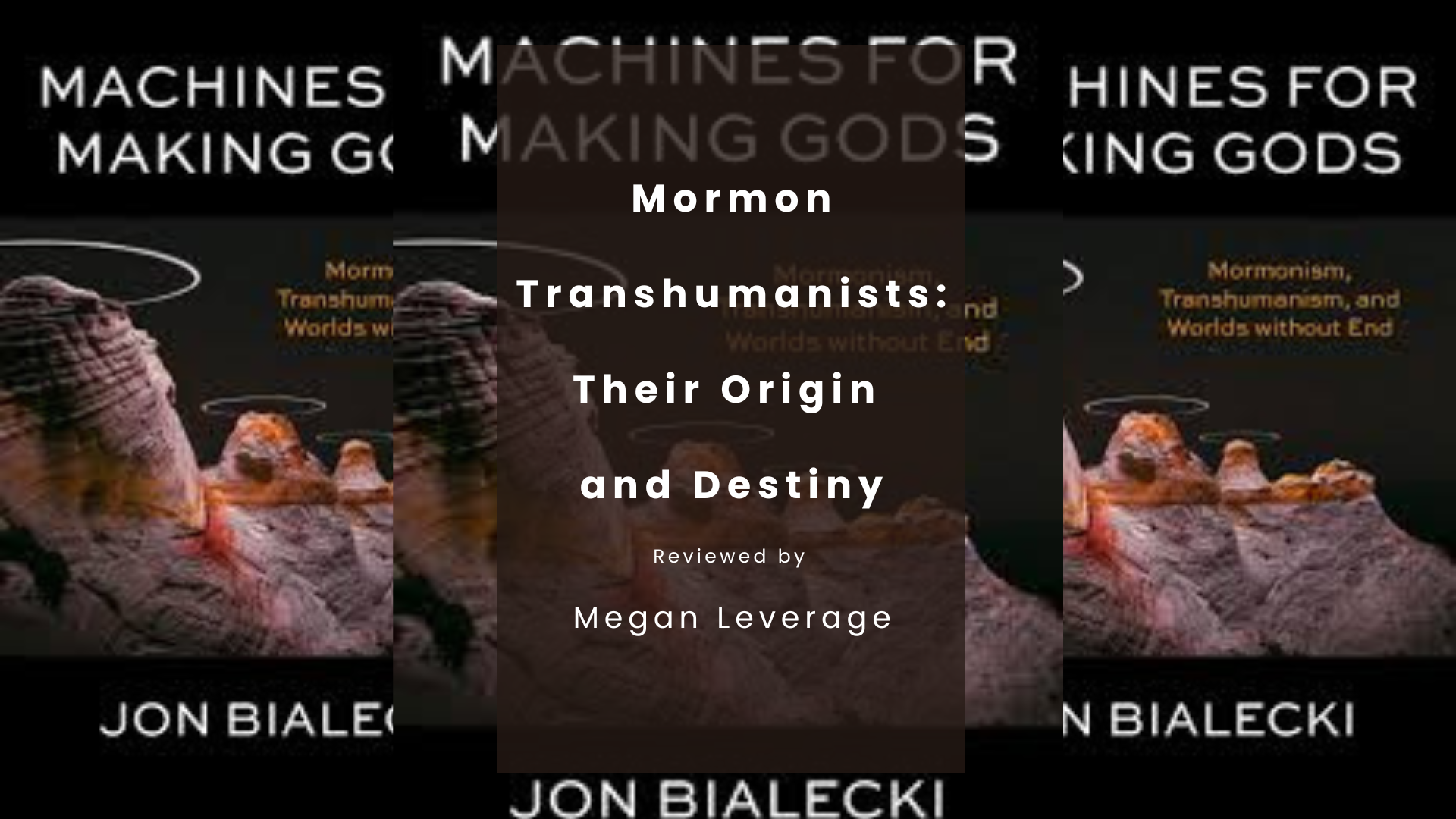
Circles of light crown the peaks of red rocks against black skies. Are they sacred halos gleaming or artificial lights beaming from a UFO? The beautiful cover image of the book Machines for Making Gods draws the reader into the “rhymes” of the Mormon Transhumanist Association (MTA). Despite the anti-scientific attitudes of conservative forms of Christianity, including and especially Mormonism, anthropologist of Christianity Jon Bialecki explores the complex relationship between religion and science, through the “foldings, inversions, and twists” of Mormonism and transhumanism (49). For those unfamiliar with the term, Bialecki defines transhumanism as “the positive anticipation of the possibility that increases in technology will allow Homo sapien sapiens to overcome their historic species’ limits to such as degree that they become something else altogether” (76).
This book is an ethnography of the MTA. Founded in 2006 and with a current membership of one thousand people, the MTA is the oldest and largest religious transhumanist movement. Demographically, MTA members tend to be highly educated, LDS, tech workers, and living in the American West. Through in-person and digital outlets, MTA members explore the potential connections between nineteenth-century Mormon theology and the future technoscience of transhumanism: how cryonics, nanotechnology, and computer simulation make possible the resurrection of the dead; how God could be a space alien or computer programmer; and how theosis (i.e., the belief that humans will become gods and create worlds of their own) could be a technological achievement. As Bialecki concedes, these ideas are the intellectual property of Mormon transhumanists. What Bialecki hopes to contribute uniquely, then, is a social analysis of the movement.
Across three parts and nine chapters, Bialecki explores the collectivities of Mormonism, transhumanism, and the MTA. Challenging the binaries of religion/science, openness/closure, and secular/mythic time, Bialecki examines their relationship to the dead, apocalypticism, worlds without end, and transformative ideas about kinship. At its heart, this book is about speculation. In the simplest terms, Bialecki argues, “Mormonism is a religion of belief” (146). And secular transhumanism is plausible science fiction. Taken together, the MTA creates new conceptual horizons. Bialecki adds that speculation is also social. Hence, the MTA is socially transformational.

Bialecki’s greatest contribution is his discussion of revisionist social issues, particularly gender and sexuality. While secular transhumanists are predominantly elite white men, Bialecki argues that the MTA is more progressive, offering feminist and queer ways of being Mormon. Take for example Blaire Ostler, former CEO of the MTA. Ostler readily writes about Heavenly Mother, the ordination of women, and queer polygamy or “a form of sacralized, non-heteronormative, feminist non-monogamy” (xx). Bialecki explores the connections between transhumanism and this future form of polygamy: “technological freedom from human limitation means nothing if one is constrained in whom a person can love, and in what form” (291).
Along these same lines, Bialecki’s study could be extended to discuss more aspects of human diversity, such as race. Anecdotally, researching the MTA in 2013, I recall online discussions about the Book of Mormon’s scriptures on righteousness and lightening skin tones— reinterpreted as electronic illuminations. Arguably not the most productive speculation, the MTA’s technoscientific post-racism would make a fascinating case study of Mormon race-making.
My main complaint about the book is its limited accessibility. It takes an already complicated subject of Mormon transhumanists and further complicates things by adding deep-track theories of structural anthropologist Claude Lévi-Strauss, French philosopher Henri Bergson, and the like. Instead of creating a clear and pointed lens for the reader, much of the introduction remains esoteric. To be sure, Bialecki offers an abridged version of the book, suggesting some readers skip the theoretical sections. This approach, however, excludes many readers from reaching the big idea of the book.
Machines for Making Gods contributes in several ways to the rich discussions on the topic of religion and science published in Dialogue. First, the MTA adds to the current understanding of the variety of Mormon attitudes toward science. Second, Bialecki shows that the MTA does not just counter the anti-scientific attitudes of the LDS Church but its conservatism more broadly. Indeed, in his fieldwork, Bialecki found that some MTA members were not drawn to the movement because of their interest in technoscience. Rather, they found a solution to the problematic history and policies of the LDS Church (e.g., anti-LGBTQ, racism, sexism) in the MTA. For these members, Mormon transhumanism is about morals, not knowledge. Third, Bialecki applies anthropological methods to frame the MTA’s speculations as myths of the future. Through the power of myth, Bialecki suggests that the MTA offers a model of and for the LDS Church in an increasingly technoscientific world. In this way, could the MTA transform the LDS Church by imagining its future?
Jon Bialecki. Machines for Making Gods: Mormonism, Transhumanism, and Worlds without End. New York: Fordham University Press, 2022. 368 pp. Paper: $35.00. ISBN: 9780823299362.