

 Back to full Issue

Articles/Essays – Volume 54, No. 4
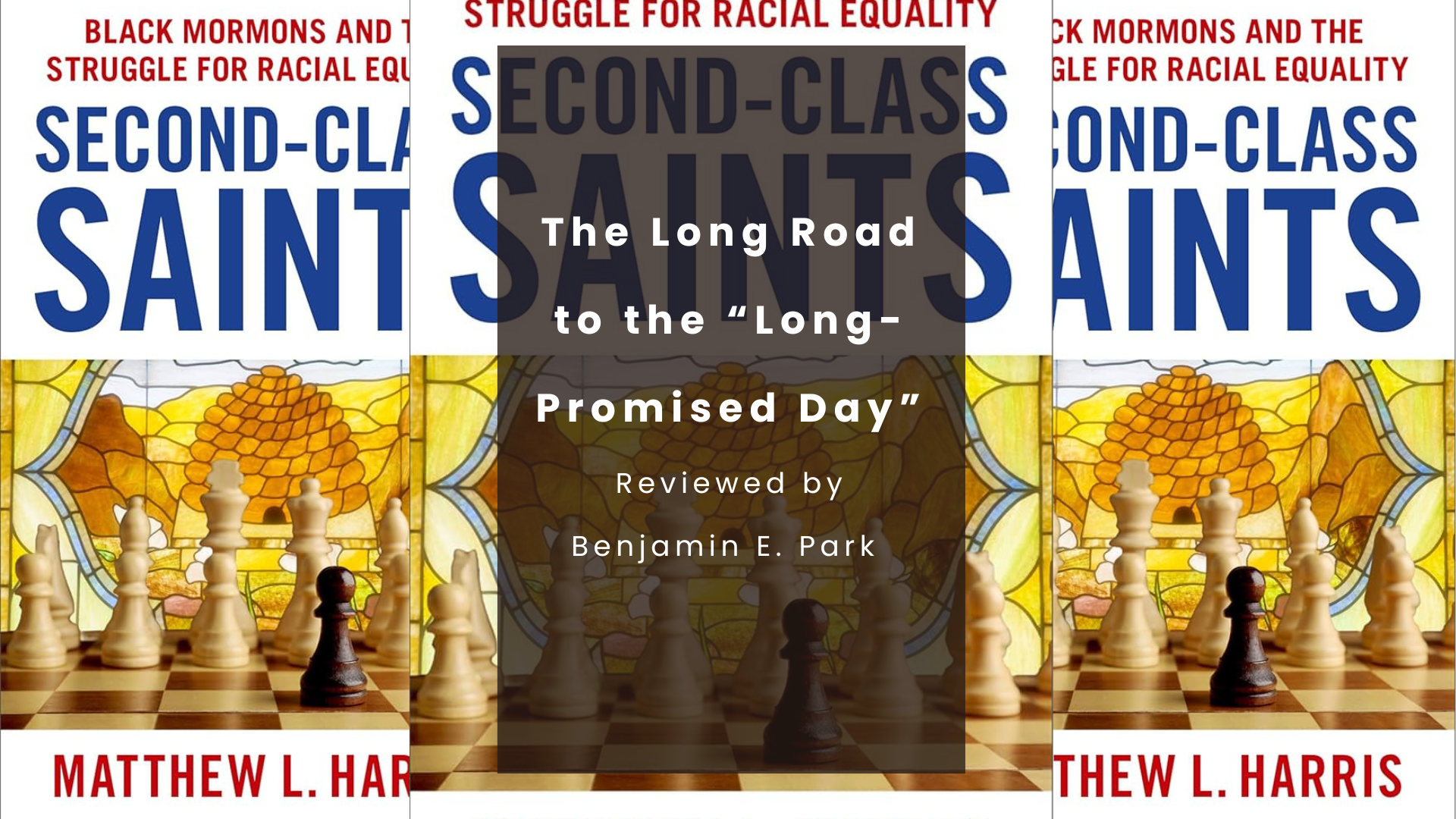
The Long Road to the “Long-Promised Day” | Matthew L. Harris, Second-Class Saints: Black Mormons and the Struggle for Racial Equality
Matthew Harris has provided the Mormon community with a gift: Second-Class Saints is a substantial work of scholarship based on enormous archival research and makes a compelling case concerning the Church of Jesus Christ of Latter-day Saints’ racial policies since World War II. While the parameters of the story are well known, the twentieth- and twenty-first-century Church’s evolving relationship with Black members has never been so meticulously documented and bracingly told as in this volume. Second-Class Saints will be a standard work for quite some time.
While the first chapter provides a general overview of the background, origins, and implementation of the LDS Church’s racial restriction—in which those of African descent were barred from priesthood ordination and temple participation—the book is primarily focused on the policy’s development in the mid-twentieth century, its demise in the 1970s, and the legacies that have remained to the present. There are some moments that will surprise even the most seasoned reader, like Harris’s documentation of an apostolic committee formed in the early 1950s to assess whether they could rescind the policy (57–61). Other sections add further context to common stories, like when Harris provides additional detail to the federal government’s investigation into Brigham Young University student practices or the Church’s tax-exempt status (197–202). And some portions provide a first attempt to contextualize the most recent developments in the twenty-first century, like when Harris analyzes the context for the Church’s 2012 statements that proclaimed, “All Are Alike Unto God” (293–306). Second-Class Saints, indeed, provides something for every reader, no matter their level of expertise.
The strongest part of a very strong book is its sources. Harris was able to gain access to a treasure trove of personal papers located in archives, universities, and family ownership, which enabled him to unearth facts and ideas that have been overlooked by previous historians. These collections are so numerous that Second-Class Saints features a six-page abbreviations index for its 110 pages of endnotes. At the heart of many of these sources were internal disagreements among LDS authorities, an excavation that demonstrates how race was as contested among Church leaders as it was among the general American public. Indeed, because this book is primarily focused on telling the story rather than analyzing its meaning or context, it provides numerous starting points for future scholars to investigate, introducing them to key moments or figures as told through previously overlooked sources and begging for more investigation.
Harris takes pains to document the ideology and theology at the heart of the racial policy and its aftermath. The book is at its best when unpacking the writings of, especially, Joseph Fielding Smith and Bruce R. McConkie to demonstrate both the depth of their racial views as well as, in McConkie’s case, how he evolved to eventually see a policy change as possible. While one might hope that Harris had spent more time placing their ideas within a wider context, this is arguably the most synthetic and comprehensive analysis of modern LDS leaders’ thinking on race that the historical field has yet produced.
Every historian is forced to frame their work in such a way that it prioritizes some questions over others. Second-Class Saints is no different. Because Harris’s archival source base primarily deals with the institutional Church and its elite critics, the story is primarily told through the lens of white voices. The Black experience is primarily implied rather than detailed, though more Black voices appear after the creation of the Genesis Group in the 1970s and the proliferation of Black activists in the twenty-first century. Excavating their lived realities and ideas would have required a different set of sources and methods beyond those framing this work. It will therefore be left to other historians to build on this institutional foundation and tell that story.
One other notable point of framing and prioritization concerns audience. Second-Class Saints is primarily devoted to addressing Mormon narratives and answering Mormon questions. This can be seen, for example, both in how Harris frequently refers to “the brethren”—a term with a particular meaning within LDS culture—as well as in how he tells a tale of competition between orthodox conservatives, primarily Smith and McConkie, and liberal critics, primarily Sterling McMurrin. The stakes of these debates are often cast in a way that is only significant to the LDS community. At times the narrative even veers toward a good-guys-vs.-bad-guys framing more reflective of internal debates rather than engaging the external context. The benefits of such an approach are that the work will reach a much larger audience of Latter-day Saints who typically find academic works unapproachable; the downsides include limited use for the broader academy.
Perhaps the chapter that best embodies this framing and its consequences is chapter 8, which explores the immediate fallout after Spencer W. Kimball’s 1978 declaration that ended the racial restriction. On the one hand, the chapter is Harris at his archival best: he meticulously traces the origins of several folkloric stories concerning the declaration as they spread across LDS culture between 1978 and 1985, largely embellished accounts created by McConkie himself that eventually garnered chastisement from his superiors. However, scholars outside Mormon studies might find such exhaustive detailing tedious, if not antiquarian. They might also be left desiring more analysis on how McConkie’s storytelling fit into a broader culture simultaneously struggling with a crisis of authority in the wake of Watergate and America’s racial protests, like how LDS leaders’ anxiety over reaffirming their clout in the wake of a fundamental change reflects contemporary social discord.
But one book cannot do everything. Second-Class Saints should be praised, and praised extensively, for what it did accomplish. Harris’s monumental achievement is in the vein of D. Michael Quinn: an archival-rich reckoning that will both prompt discussions within the Mormon community and serve as a foundation for future scholarship. It is an immediate classic.
Matthew L. Harris. Second-Class Saints: Black Mormons and the Struggle for Racial Equality. New York: Oxford University Press, 2024. 460 pp. Cloth: $39.99. ISBN: 9780197695715.