

 Back to full Issue

Articles/Essays – Volume 27, No. 4
Mormon Angels in America: Angels in America: A Gay Fantasia on National Themes
For Mormons, the co-option of our most sacred story for the purposes of theater might at first seem blasphemous. In fact, Eugene England in his regular This People round-up of recent LDS-related books and plays tagged part one of Angels, which he saw in London, as “offensive” and disrespectful.
Mormon Angels in America Angels in America: A Gay Fantasia on National Themes. Part 1: Millennium Approaches ; Pań 2: Perestroika. By Tony Kushner (New York: Theatre Communications Group, 1993, 1994).
Reviewed by David Pace, theater critic for the Event newspaper, Salt Lake City, and regional correspon-dent for Backstage , a national perform-ing arts weekly.
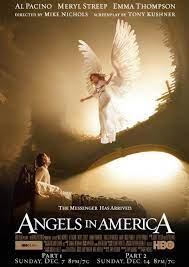
This year, the sesquicentennial of Joseph Smith’s martyrdom, the founder of the Mormon church found himself holding steady in an unlim-ited run of his 1993 Broadway debut. One hundred and fifty years after his death at the hands of an Illinois mob, the “obscure” boy-prophet from up-state New York has comfortably set-tled into Manhattan where, at the Walter Kerr Theater, an angel, sport-ing “magnificent pale grey wings” and accompanied by a blast of trum-pets, crashed through the ceiling of his Greenwich Village bedroom, scat-tering plaster and wiring below. “Very Steven Spielberg,” says the terrified but impressed man, who, this time around, is dying of AIDS. “Greetings Prophet,” says the female personage, hovering above the bed, now shat-tered in brilliant white light. “The Great Work begins/ The Messenger has arrived.”
Thus ends what one New York critic admiringly called the biggest cliffhanger in Broadway history: the first part of Tony Kushner ‘s two-part, seven-hour epic, Angelsin America. Somewhat ostentatiously subtitled A Gay Fantasia on National Themes , An-gels is the most talked-about show in memory and is the winner of the Pulitzer and Tony Awards for Best Play. It has been heralded as single-hand-edly re-inventing American political drama. Both epic and idiosyncratic, the fantastical and savagely comical Angels covers an incredibly broad so-cial, political, and mystical terrain from Judy Garland to Ethel Rosen-berg, from New Deal Socialism to the Supreme Court, and from the Jewish Kaddish to a postmodern vision of the Angel Moroni. While its story focuses on the disenfranchised gay man of the 1980s and the politics of AIDS, the show’s animating metaphor is unde-niably Mormonism – more specifi-cally, the story of Joseph Smith.
But the play also features three Mormon characters, two of whom, with another couple, form the parallel domestic dramas that make up Angels. Joe Pitt and his valium-addicted wife Harper are Utah transplants to New York where Joe, an attorney, works as the chief clerk for Justice Theodore Wilson of the Federal Court of Ap-peals, Second Circuit. In the same of-fice is Louis, a word processor whose lover, Prior Walter, is dying of AIDS and is eventually visited by the Angel. Both couples are in crisis, the latter be-cause of the ravages of disease and the former because Joe is himself a clos-eted homosexual, though he has never acted on his desires.
Brooding above both couples is a foreboding sense that the world is on “the threshold of revelation.” “[Everywhere,” says the distraught Harper to her confused husband, “things are collapsing, lies surfacing, systems of defense giving way …” Worried about the depleting ozone layer she ponders that “[m]aybe Christ will come again.” In her valium and grief-induced hallucinations she is spirited away by a sax-playing travel agent, Mr. Lies, to meet up with Prior in his own dream. Harper [to Prior, who is dressed in drag]: I’m not addicted. I don’t believe in addiction, and I never drink. And I never take drugs. Prior: Well, smell you, Nancy Drew. Harper: Except valium. Prior: Except valium, in wee fist-fuls. Harper: It’s terrible. Mormons are not supposed to be addicted to any-thing. I’m a Mormon. Prior: I’m a homosexual. Harper: Oh! In my church we don’t believe in homosexuals. Prior: In my church we don’t believe in Mormons.
Harper wanders through her dreams, eventually ending up for some time in Antarctica where the cli-mate seems to represent the deep freeze of her mind. Her husband Joe has immersed himself in the hope of a comeback for conservative America and a return to ” [i]ts sacred position among nations.” Ronald Reagan, for him, represents “truth restored.” It is the historical lawyer, Roy Cohn, henchman of Joe McCarthy and a closeted gay who has contracted AIDS, who ends up mentoring the young, strict Mormon. Scripted as a vociferous, profaning bully reminis-cent of Shakespeare’s Iago but more shrill, Cohn, who is threatened with disbarment for illegal acts, tries to muscle Joe into going to the Justice Department in Washington to “[c]ast a deep shadow on my behalf.”
Offended by the bald immorality of his adopted father, Joe refuses, and Cohn flies into a rage.
Roy: Boy, you are really some-thing, what the fuck do you think this is, Sunday School? Joe: No, but Roy this is . . . Roy: This is . . . this is gastric juices churning, this is enzymes and acids, this is intestinal is what this is, bowel movement and blood-red meat – this stinks, this is politics, Joe, the game of being alive. And you think you’re. . . What? Above that? Above alive is what? Dead! In the clouds! You’re on earth, goddamit! Plant a foot, stay a while.
The antithesis of Cohn and the idealistic but naive Joe is Louis, a Jew-ish liberal intellectual who, nevertheless, balks at that pro-active moment when theory hedges (or rather fails to hedge) real life. Terrified and nause-ated at the advancing AIDS of his lover, Louis admits Prior to the hospi-tal and then abandons him, leaving in a whirlwind of guilt that eventually drives him to self-punishing behav-iors.
That Louis, the Marxist social the-orist and Joe, the Republican Mor-mon lawyer become lovers near the end of part one, titled Millennium Approaches, represents just one conflu-ence of the many disparate narrative lines that Kushner pens. Other sur-prises in this fast-paced, highly imagi-native, at times dramatically jolting play soon follow, not the least of which is the appearance of Joe’s stern but plucky mother, Hannah Pitt, who, after a troubling phone call from her son, sells her home in Salt Lake City and moves to New York unan-nounced.
“Know why I decided to like you?” says a friend to Hannah as they look out over the Salt Lake Valley. “I decided to like you ’cause you’re the only unfriendly Mormon I ever met.” Hannah steals a puff from her friend’s cigarette. Her friend continues,
Sister Ella Chapter: This is the home of saints, the godliest place on earth, they say, and I think they’re right. That means there’s no evil here? No. Evil’s everywhere. Sin’s every-where. But this … is the spring of sweet water in the desert, the desert flower. Every step a Believer takes away from here is a step fraught with peril. I feel for you, Hannah Pitt, because you are my friend. Stay put. This is the right home of saints. Hannah: Latter-day saints. Sister Ella Chapter: Only kind left. Hannah: But still. Late in the day … for saints and everyone.
In New York Hannah will eventu-ally meet up with Prior, who in the second half, titled Perestroika , travels from the Circuit Court to Central Park and from the LDS Visitor’s Center near Lincoln Center to Heaven, alter-nately attempting to escape his calling as “prophet” and nervously embrac-ing it. “I wish you would be more true to your demographic profile,” says Prior to Hannah who has scolded him for assuming that he knows what she thinks about homosexuals, “[IJife is confusing enough.”
Confusion, spawned by the end of a millennium, is the topic of the “world’s oldest Bolshevik” who opens “Perestroika” with a lament that, since the collapse of the USSR, there is no unifying theory to guide the next cen-tury. But in the following scene the an-gel, still hovering above Prior’s bed, turns out to be neither angel of death nor eleventh-hour savior of the dying man, not a messenger of unification, but of stasis. It seems that God, tired of humanity’s relentless impulse for change, left heaven on the day of the San Francisco earthquake in 1906. The Angel has called the new prophet in hopes that he can undo the damage on earth, and convince the world to turn back, to stop moving so that God will return to Heaven and all will be well … or at least as before. “HOB-BLE YOURSELVES!” demands the Angel, condemning the migration of people across the land. “There is no Zion Save Where You Are!”
In one of the lengthier scenes Prior is badgered by the Angel whose bell-like voice is punctuated by an un-earthly cough and whose somersaults and spins in mid-air cause her attenu-ated wings to lift and fall. “Remove from their hiding place the Sacred Prophetic Implements,” she says amidst a flurry of pseudo-biblical, apocalyptic rhetoric. “The what ?” says Prior. She directs him to bronze spectacles with rocks instead of lenses and a large book with bright steel pages. The angel calls the glasses “peep-stones.”
During the course of the scene Prior and the Angel are both over-come by sexual feeling, apparently prompted, by “the great work” which has ostensibly begun. “The Body is the Garden of the Soul,” intones the breathless Angel, “… Plasma Orgas-mata.”
That Prior gets sexually aroused whenever the Angel is near (in the first half) or when he dons the glasses and reads the book (in the second half) suggests, as the Angel says, that what makes the “Engine of Creation Run” is “Not Physics But Ecstatics.”
Within the play’s hard-driven re-visionist view of Reagan-era values are themes of migration. At the begin-ning of Part One, for example, a rabbi sings the Kaddish over the body of Louis’s grandmother, a woman who crossed the ocean and, says the rabbi, “brought with us to America the vil-lages of Russia and Lithuania” to “grow up here … in the melting pot where nothing melted.” And in the diorama room at the LDS Visitor’s Cen-ter where Hannah, accompanied by the nearly deranged Harper, now works as a volunteer, a pioneer family of mannequins converses in a hokey, story-book style about their exodus West.
Spurred on by his impending death and his anxiety over what his nurse and friend, Belize, is convinced are hallucinations, Prior turns up at the Visitor’s Center and introduces himself to Harper as an “angelologist.” “Imagination is a dangerous thing,” says Prior to Harper. “In cer-tain circumstances, fatal,” says Harper. “It can blow up in your face. If it turns out to be true.” They are waiting for the diorama to begin and wondering where they ve seen each other before
. During the recorded presentation, and to the surprise of both, Louis sud-denly appears in the diorama while the pioneer father turns out to be Joe. “I don’t like cults,” says Louis as if caught in the middle of a conversation. Joe responds, “The Church of Jesus Christ of Latter-day Saints is not a cult.” “Any religion that’s not at least two thousand years old is a cult . . . ,” he says. “And I know people who would call that generous.”
“I never imagined losing my mind was going to be such hard work,” says Prior before leaving the visitor’s center. But the visions aren’t over yet. The Mormon Mother, perched on the seat of a covered wagon, then comes to life. She and Harper trudge through the dark, rainy night. “In your experience of the world, how do people change?” asks Harper as the two overlook the island of Manhattan.
Mormon Mother: Well it has something to do with God so iťs not very nice. God splits the skin with a jagged thumbnail from throat to belly and then plunges a huge filthy hand Reviews 195 in, he grabs hold of your bloody tubes and they slip to evade his grasp but he squeezes hard, he insists, he pulls and pulls till all your innards are yanked out and the pain! We can’t even talk about that. And then he stuffs them back, dirty, tangled and torn. It’s up to you to do the stitching.
Sequestered away from Harper and his mother, Joe is staying with Louis and consummating his sexual desires. Even sudden apparitions /visitations (the text is, typically, never clear) of Harper in the bedroom does not keep him from going back to Louis whom he finds not only sexu-ally compelling but intellectually chal-lenging. “Who if not the Right is putting the prude back in Jurispru-dence?” complains Louis as they lie in bed together. “Do you want to be pure, or do you want to be effective?” bandies Joe. “Choose. Even if our methods seem . . . extreme, even. We’ve worked hard to build a move-ment.”
Later at the dunes on nearby Jones beach, a famous hang-out for gays, Louis alludes to the “Explora-tion” of gay male sexuality “[aļcross an unmapped terrain.” Wftien the sub-ject turns to Joe’s religion Louis says, “So the fruity underwear you wear, that’s . . .” Joe: A temple garment. Louis: Oh my god. What’s it for? Joe: Protection. A second skin. I can stop wearing it if you . . . Louis: How can you stop wearing it if it’s a skin? Your past, your beliefs, your . . . Joe: I’m not your enemy. Louis. … I am in love with you. You and I, fundamentally, we’re the same. We both want the same things.
But, after a month’s absence, Louis is determined to visit Prior. “You don’t want to see me anymore,” worries Joe. “Anything. Whatever you want. I can give up anything. My skin.” At this point he pulls the upper part of the garment off. The weather is freezing. “What are you doing, some-one will see us,” says Louis. “I’m flayed,” says Joe. “No past now. I could give up anything. . . . Some-times self-interested is the most gener-ous thing you can be,” he continues as Louis hastily re-dresses him. “You ought to think about it.” “I will,” promises Louis.
Perestroika is left with what seems the impossible task of tying up the loose ends that Millennium Approaches almost recklessly scatters. Most of the loose ends are in fact resolved in an “Epilogue” as serene and hopeful as the first half is volatile and entropie. Before that, however, Roy Cohn is escorted into the hereafter by Ethel Rosenberg (whom in the 1950s he maliciously propelled toward execution) but surfaces later, in hell, hawking his legal expertise at a guilty and absent God. Ultimately rejected by Prior, Louis jettisons his Mormon lover who, Louis learns, was responsible for Judge Wilson’s most offensive anti-gay and anti-human judgments. Prior goes to heaven to return his prophetic mantle and demands a blessing for more life from a quorum of heavenly beings. And after a brief attempt at reconciliation, Harper gives Joe her stash of valium, takes the credit card, and escapes on an airplane to San Francisco.
It was at the Eureka Theatre in San Francisco that Angels in America premiered in 1991. Its circuitous route to Broadway and the Walter Kerr The-atre included a workshop production at both the Mark Taper Forum in Los Angeles and the Sundance Institute in Provo, Utah, and a hit engagement at the National Theatre in London where the show re-opened after its January 1992 British premiere and is still running. In October 1992 the premiere of Perestroika was paired with Millennium Approaches in a marathon Los Angeles production. Since then the show has played in such far-flung places as Tel Aviv. This fall the show opened in Chicago, and producer /di-rector Robert Altman has optioned Angels for a feature film.
With its odd but affecting mix of American culture and politics, reli-gion and law, gay aesthetics and dra-matic theory, Angels might at first appear to be theatrically “over-the-top.” Almost without exception, how-ever, critics have hailed the genius of Kushner’s deft handling of such a wide swath of material which has proven to be provocative as well as breathlessly entertaining.
For Mormons, the co-option of our most sacred story for the purposes of theater might at first seem blasphe-mous. In fact, Eugene England in his regular This People round-up of recent LDS-related books and plays tagged part one of Angels , which he saw in London, as “offensive” and disre-spectful.
What I saw was three of the most resonant, non-historical Mor-mon characters ever to appear on the professional stage, and my identification with them was absolutely revela-tory. Prompted by a New York theater critic to see the London show, I found myself seated in the tiny Cot-tesloe at the National Theatre and en-tranced by what was the most compelling cultural representation of my religion I had ever seen. There, on the stage were in-your-face Mor-mons, ambivalent and human, de-voted yet vulnerable, caught up in a world much larger than the Wasatch Front’s greenhouse of religious fo-ment and its fusion of individual and organizational faith.
That a golden book of life and an Angel might appear to a mere farm boy – perhaps the least likely earth-ling of all – in upstate New York is as fantastically appealing today as it was during the romanticism of the early nineteenth century. That the con-temporary counterpart of the boy prophet is a New York City homosex-ual dying of AIDS suggests the personal daring of Kushner. Prior speculates at one point, “[m]aybe I am a prophet. Not just me, all of us who are dying now. Maybe we’ve caught the virus of prophecy.”
Not everything about Kushner’s American epic is entirely satisfying, especially the fact that, at show’s end, Joe Pitt is entirely dismissed from the core of enlightened individuals who in the “Epilogue” gather around the Central Park fountain, featuring the Angel Bethesda. It’s as if Joe has been abandoned by not only Louis and Harper, but his mother as well, who, we are told in this last scene, “is noticeably different – she looks like a New Yorker, and she is reading the New York Times.”
In Louisville, Kentucky, where Kushner’s latest play premiered last April, the playwright indirectly sug-gested why Joe Pitt is out of favor by play’s end. Kushner is opposed to the relativist stance of a playwright, indulging both sides of a social or politi-cal issue for purposes of “fairness.” Evil, he insists, is there, and it is the job of the artist to expose it. “I chose the Mormon church for ‘Angels’ because it is one of the most homophobic religions/’ said Kushner, who claims that his play was deeply influ-enced by Fawn Brodie’s No Man Knows My History as well as works by Harold Bloom.
Mormon dramatists whose im-pulse is to write about their religion and culture have clearly been up-staged by a self-proclaimed agnostic gay Jew from Brooklyn. His imagina-tion has, among many other things, and despite some unfair demonizing of Joe near the play’s end, aptly cap-tured much of the essence of contem-porary Mormon character and the thrilling iconography of America’s most successful indigenous religion. Regardless of what one considers to be the quality and endurance of a play like Angels in America the lesson may be that playwrights and others interested in developing a Mormon theatrical literature had best get cracking. That such a play has issued from a non-Mormon playwright might say as much about the failure of Mormon dramatists to transcend the self-con-sciousness of their own social and cul-tural boundaries – to position them-selves in the world – as it does about Kushner ‘s ample talent.